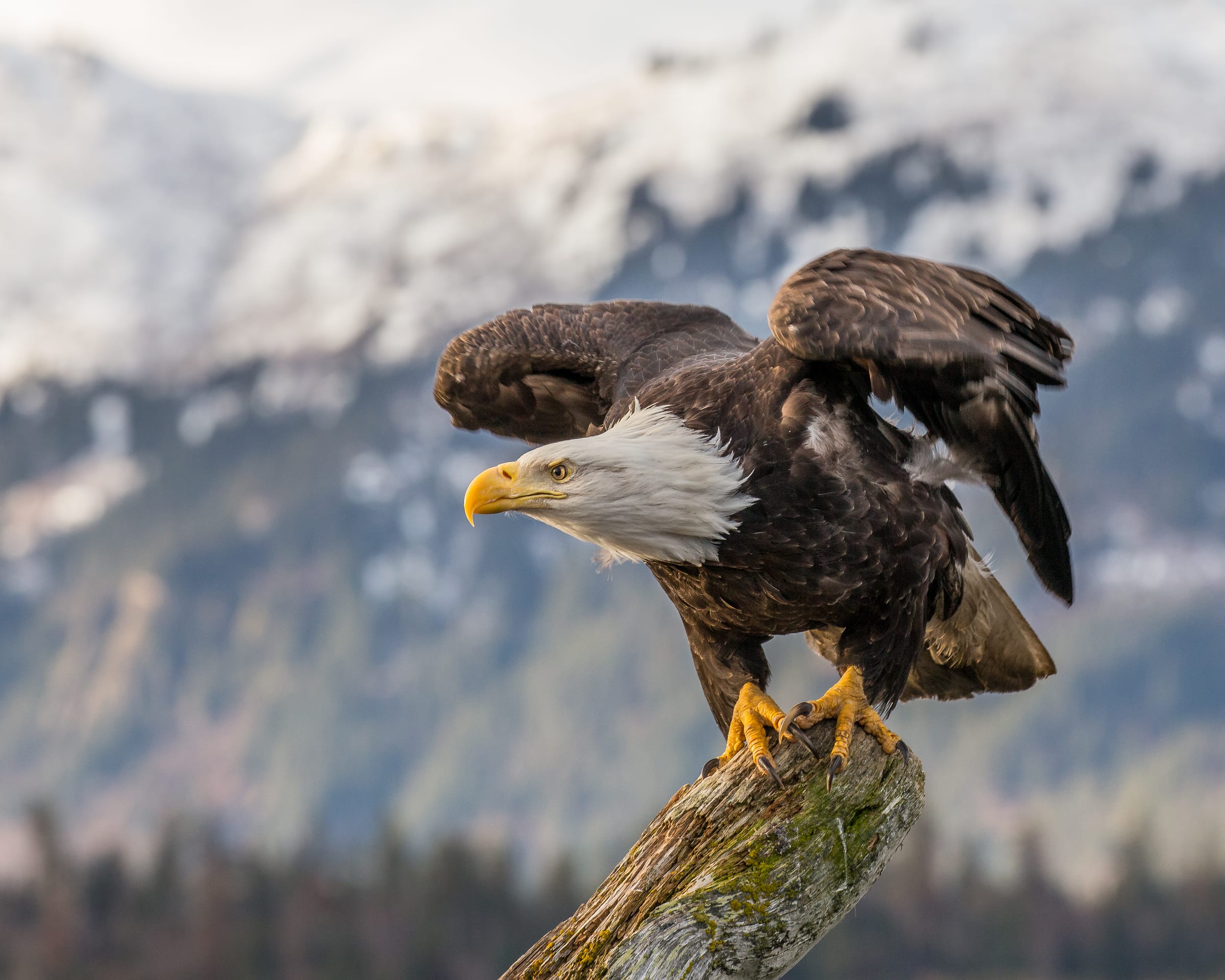
The bald eagle (Haliaeetus leucocephalus) is a bird of prey found in North America. A sea eagle, it has two known subspecies and forms a species pair with the white-tailed eagle (Haliaeetus albicilla), which occupies the same niche as the bald eagle in the Palearctic. Its range includes most of Canada and Alaska, all of the contiguous United States, and northern Mexico. It is found near large bodies of open water with an abundant food supply and old-growth trees for nesting.
The bald eagle is an opportunistic feeder that subsists mainly on fish, upon which it swoops down and snatches from the water with its talons. It builds the largest nest of any North American bird and the largest tree nests ever recorded for any animal species, up to 4 m (13 ft) deep, 2.5 m (8.2 ft) wide, and 1 metric ton (1.1 short tons) in weight. Sexual maturity is attained at the age of four to five years.
Plucks salmon from the river with three-metre wings outstretched.
Description
The plumage of an adult bald eagle is evenly dark brown with a white head and tail. The tail is moderately long and slightly wedge shaped. Males and females are identical in plumage coloration, but sexual dimorphism is evident in the species, in that females are 25% larger than males. The beak, feet and irises are bright yellow. The legs are feather free, and the toes are short and powerful with large talons. The highly developed talon of the hind toe is used to pierce the vital areas of prey while it is held immobile by the front toes. The beak is large and hooked, with a yellow cere. The adult bald eagle is unmistakable in its native range. The African fish eagle (Ichthyophaga vocifer) (from far outside the bald eagle's range) also has a brown body (albeit of somewhat more rufous hue), white head and tail, but differs from the bald eagle in having a white chest and black tip to the bill.
Range
The bald eagle's natural range covers most of North America, including most of Canada, all of the continental United States, and northern Mexico. It is the only sea eagle endemic to North America. Occupying varied habitats from the bayous of Louisiana to the Sonoran Desert and the eastern deciduous forests of Quebec and New England, northern birds are migratory, while southern birds are resident, remaining on their breeding territory all year. At minimum population, in the 1950s, it was largely restricted to Alaska, the Aleutian Islands, northern and eastern Canada, and Florida. From 1966 to 2015 bald eagle numbers increased substantially throughout its winter and breeding ranges, and as of 2018 the species nests in every continental state and province in the United States and Canada.
Habitat
The bald eagle occurs during its breeding season in virtually any kind of American wetland habitat such as seacoasts, rivers, large lakes or marshes or other large bodies of open water with an abundance of fish. Studies have shown a preference for bodies of water with a circumference greater than 11 km (7 mi), and lakes with an area greater than 10 km2 (4 sq mi) are optimal for breeding bald eagles.
Diet and feeding
The bald eagle is an opportunistic carnivore with the capacity to consume a great variety of prey. Fish often comprise most of the eagle's diet throughout their range. In 20 food habit studies across the species' range, fish comprised 56% of the diet of nesting eagles, birds 28%, mammals 14% and other prey 2%. More than 400 species are known to be included in the bald eagle's prey spectrum, far more than its ecological equivalent in the Old World, the white-tailed eagle, is known to take. Despite its considerably lower population, the bald eagle may come in second amongst all North American accipitrids, slightly behind only the red-tailed hawk, in number of prey species recorded.
Behavior
The bald eagle is a powerful flier, and soars on thermal convection currents. It reaches speeds of 56–70 km/h (35–43 mph) when gliding and flapping, and about 48 km/h (30 mph) while carrying fish. Its dive speed is between 120–160 km/h (75–99 mph), though it seldom dives vertically. Regarding their flying abilities, despite being morphologically less well adapted to faster flight than golden eagles (especially during dives), the bald eagle is considered surprisingly maneuverable in flight. Bald eagles have also been recorded catching up to and then swooping under geese in flight, turning over and thrusting their talons into the other bird's breast. It is partially migratory, depending on location. If its territory has access to open water, it remains there year-round, but if the body of water freezes during the winter, making it impossible to obtain food, it migrates to the south or to the coast. A number of populations are subject to post-breeding dispersal, mainly in juveniles; Florida eagles, for example, will disperse northwards in the summer. The bald eagle selects migration routes which take advantage of thermals, updrafts, and food resources. During migration, it may ascend in a thermal and then glide down, or may ascend in updrafts created by the wind against a cliff or other terrain. Migration generally takes place during the daytime, usually between the local hours of 8:00 a.m. and 6:00 p.m., when thermals are produced by the sun.