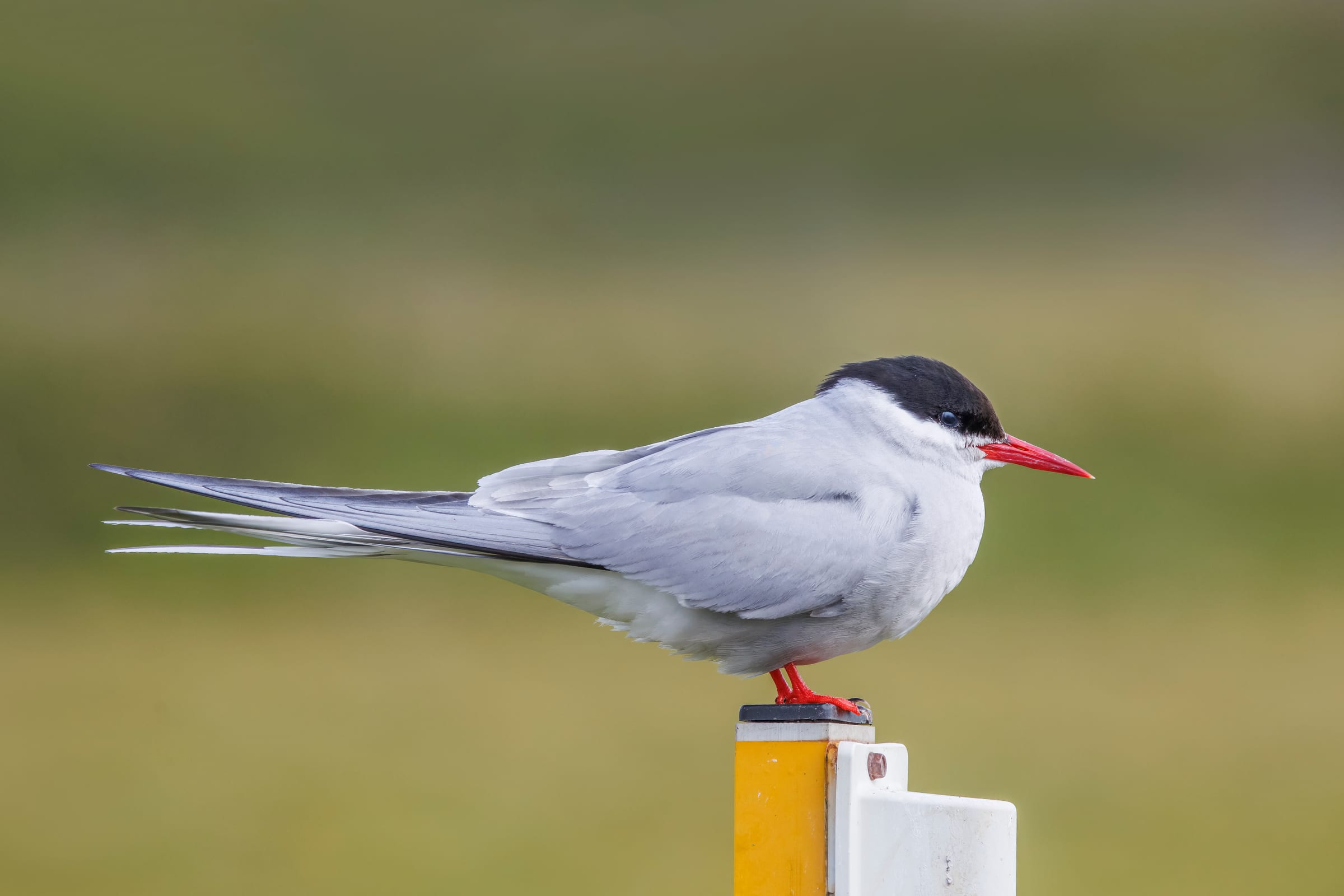
The Arctic tern (Sterna paradisaea) is a tern in the family Laridae. This bird has a circumpolar breeding distribution covering the Arctic and subarctic regions of Europe (as far south as Brittany), Asia, and North America (as far south as Massachusetts). The species is strongly migratory, seeing two summers each year as it migrates along a convoluted route from its northern breeding grounds to the Antarctic coast for the southern summer and back again about six months later. Recent studies have shown average annual round-trip lengths of about 70,900 km (38,300 nmi) for birds nesting in Iceland and Greenland, and about 48,700 km (26,300 nmi) for birds nesting in the Netherlands, while an individual from the Farne Islands in Northumberland with a light level geolocator tag covered a staggering 96,000 km (52,000 nmi) in ten months from the end of one breeding season to the start of the next. These are by far the longest migrations known in the animal kingdom.
Arctic terns are medium-sized birds. They have a length of 33–36 cm (13–14 in) and a wingspan of 76–85 cm (30–33 in), and weigh around 100 g. In the breeding season they are mainly grey and white, with a blood-red beak and feet, a black crown and nape, and white cheeks. The mantle is grey, and the scapulars grey, tipped white. The upper wing is grey with a white leading edge and a narrow blackish trailing edge on the primary feathers; the collar is completely white, as is the rump. The deeply forked tail is whitish, with grey outer webs. In winter, the forehead becomes partly white, and the bill and legs are black. Juveniles also have a partly white forehead, and narrow pale orangey-brown fringes on the grey mantle feathers (unlike common tern, where the mantle feathers are more completely gingery-brown).
Flies pole to pole every year — the longest migration on earth.
Description and taxonomy
The Arctic tern is a medium-sized bird around 33–36 cm (13–14 in) from the tip of its beak to the tip of its tail. The wingspan is 76–85 cm (30–33 in). The weight is 86–127 g (3.0–4.5 oz). The beak is dark red, as are the short legs and webbed feet. Like most terns, the Arctic tern has high aspect ratio wings and a tail with a deep fork.
The adult plumage is grey above, with a black nape and crown and white cheeks. The upperwings are pale grey, with the area near the wingtip being translucent. The tail is white, and the underparts pale grey. Both sexes are similar in appearance. The winter plumage is similar, but the crown is whiter and the bills are darker.
Juveniles differ from adults in their black bill and legs, "scaly" appearing wings, and mantle with dark feather tips, dark carpal wing bar, and short tail streamers. During their first summer, juveniles also have a whiter forecrown.
Distribution and migration
The Arctic tern has a continuous worldwide circumpolar breeding distribution; there are no accepted subspecies. It can be found in coastal regions in cooler temperate parts of North America and Eurasia during the northern summer. During the southern summer, it can be found at sea, reaching the northern edge of the Antarctic ice.
The Arctic tern is famous for its migration; it flies from its Arctic breeding grounds to the Antarctic and back again each year. The shortest distance between these areas is 19,000 km (12,000 mi). The long journey ensures that this bird sees two summers per year and more daylight than any other creature on the planet. One example of this bird's remarkable long-distance flying abilities involves an Arctic tern ringed as an unfledged chick on the Farne Islands in Northumberland, UK, in the northern summer of 1982 that reached Melbourne, Australia, in October, just three months after fledging, a journey of more than 22,000 km (14,000 mi). Another example is that of a chick ringed in Labrador, Canada, on 23 July 1928. It was found in South Africa four months later.
Ecology and behaviour
The diet of the Arctic tern varies depending on location and time, but is usually carnivorous. In most cases, it eats small fish or marine crustaceans. Fish species comprise the most important part of the diet, and account for more of the biomass consumed than any other food. Prey species are immature (1–2-year-old) shoaling species such as herring, cod, sandlances, and capelin. Among the marine crustaceans eaten are amphipods, crabs and krill. Sometimes, these birds also eat molluscs, marine worms, or berries, and on their northern breeding grounds, insects.
Arctic terns sometimes dip down to the surface of the water to catch prey close to the surface. They may also chase insects in the air when breeding. It is also thought that Arctic terns may, in spite of their small size, occasionally engage in kleptoparasitism by swooping at birds so as to startle them into releasing their catches. Several species are targeted—conspecifics, other terns (like the common tern), and some auk and grebe species.
Reproduction
Breeding begins around the third or fourth year. Arctic terns mate for life and, in most cases, return to the same colony each year. Courtship is elaborate, especially in birds nesting for the first time. Courtship begins with a so-called "high flight", where a female will chase the male to a high altitude and then slowly descend. This display is followed by "fish flights", where the male will offer fish to the female. Courtship on the ground involves strutting with a raised tail and lowered wings. After this, both birds will usually fly and circle each other.
Both sexes agree on a site for a nest, and both will defend the site. During this time, the male continues to feed the female. Mating occurs shortly after this. Breeding takes place in colonies on coasts, islands and occasionally inland on tundra near water. It often forms mixed flocks with the common tern. It lays from one to three eggs per clutch, most often two.
It is one of the most aggressive terns, fiercely defensive of its nest and young. It will attack humans and large predators, usually striking the top or back of the head. Although it is too small to cause serious injury to an animal of a human's size, it is still capable of drawing blood, and is capable of repelling many raptorial birds, polar bears and smaller mammalian predators such as foxes and cats.
Conservation status
The total population of the Arctic tern is estimated at more than two million individuals, with more than half of the population in Europe. The breeding range is very large, and although the population is considered to be decreasing, this species is evaluated as a species of least concern by the IUCN. Arctic terns are among the species to which the Agreement on the Conservation of African-Eurasian Migratory Waterbirds applies.
The population in New England was reduced in the late nineteenth-century because of hunting for the millinery trade. Exploitation continues in western Greenland, where the population of the species has been reduced greatly since 1950. In Iceland, the Arctic tern has been regionally uplisted to vulnerable as of 2018, due to the crash of sand eel (Ammodytes spp.) stocks.
In the southern part of its range, the Arctic tern has been declining in numbers. Much of this is due to a lack of food. However, most of these birds' range is extremely remote, with no apparent trend in the species as a whole. The Arctic terns' dispersal pattern is affected by changing climatic conditions, and its ability to feed in its Antarctic wintering is dependent on sea-ice cover, but unlike breeding species, it is able to move to a different area if necessary, and can be used as a control to investigate the effect of climate change on breeding species.