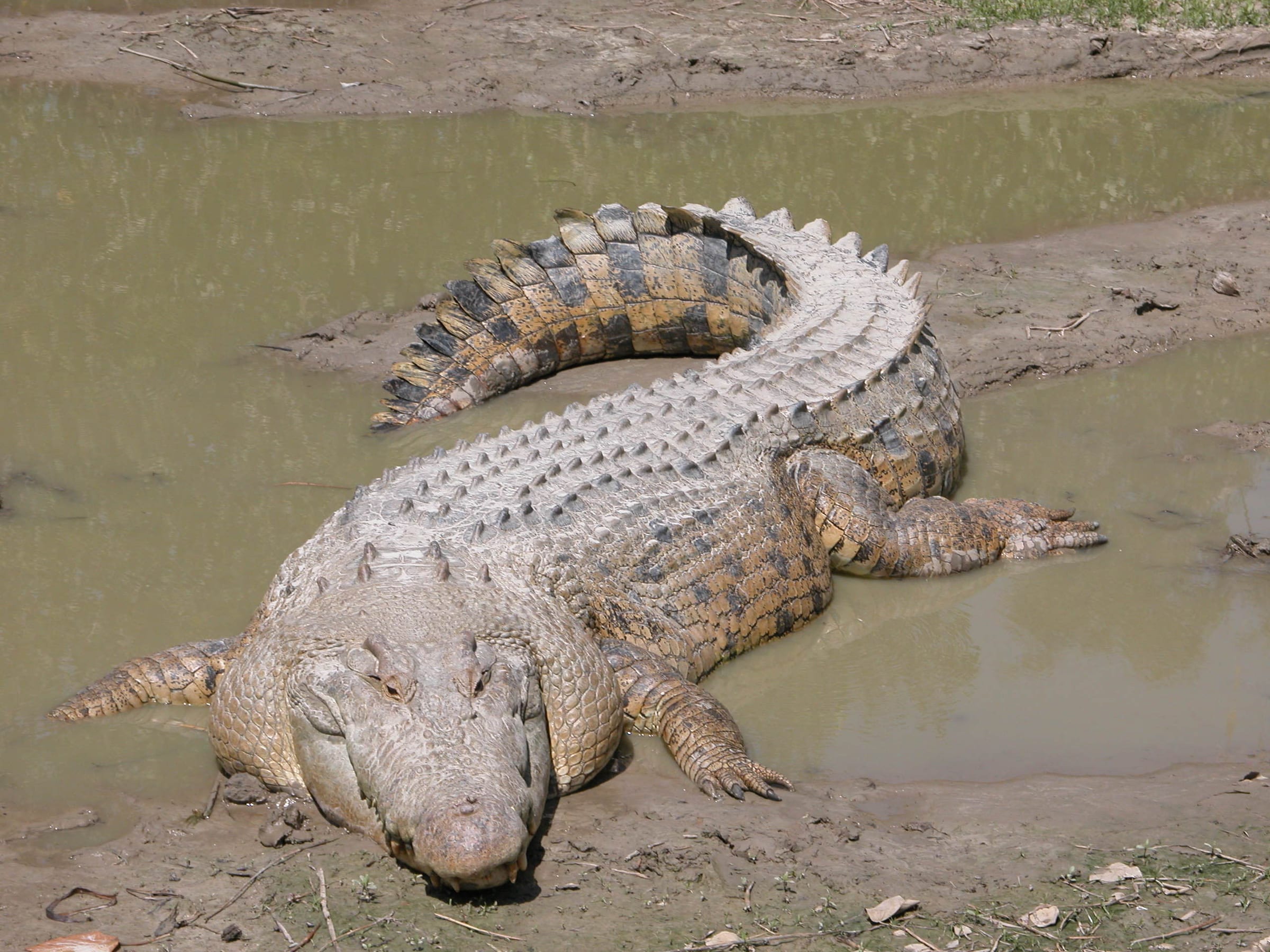
The saltwater crocodile (Crocodylus porosus) is a crocodilian native to saltwater habitats, brackish wetlands and freshwater rivers from India's east coast across Southeast Asia and the Sundaland to northern Australia and Micronesia. It has been listed as Least Concern on the IUCN Red List since 1996. It was hunted for its skin throughout its range up to the 1970s, and is threatened by illegal killing and habitat loss. It is regarded as dangerous to humans.
The saltwater crocodile is the largest living reptile. Males can grow to a weight of 1,000–1,500 kg (2,200–3,300 lb) and a length of 6 m (20 ft), rarely exceeding 6.3 m (21 ft). Females are much smaller and rarely surpass 3 m (9.8 ft). It is also called the estuarine crocodile, Indo-Pacific crocodile, marine crocodile, sea crocodile, and, informally, the saltie. A large and opportunistic hypercarnivorous apex predator, they ambush most of their prey and then drown or swallow it whole. They will prey on almost any animal that enters their territory, including other predators such as sharks, varieties of freshwater and saltwater fish including pelagic species, invertebrates such as crustaceans, various amphibians, other reptiles, birds, and mammals.
The largest living reptile, an apex predator from the dinosaur age.
Description
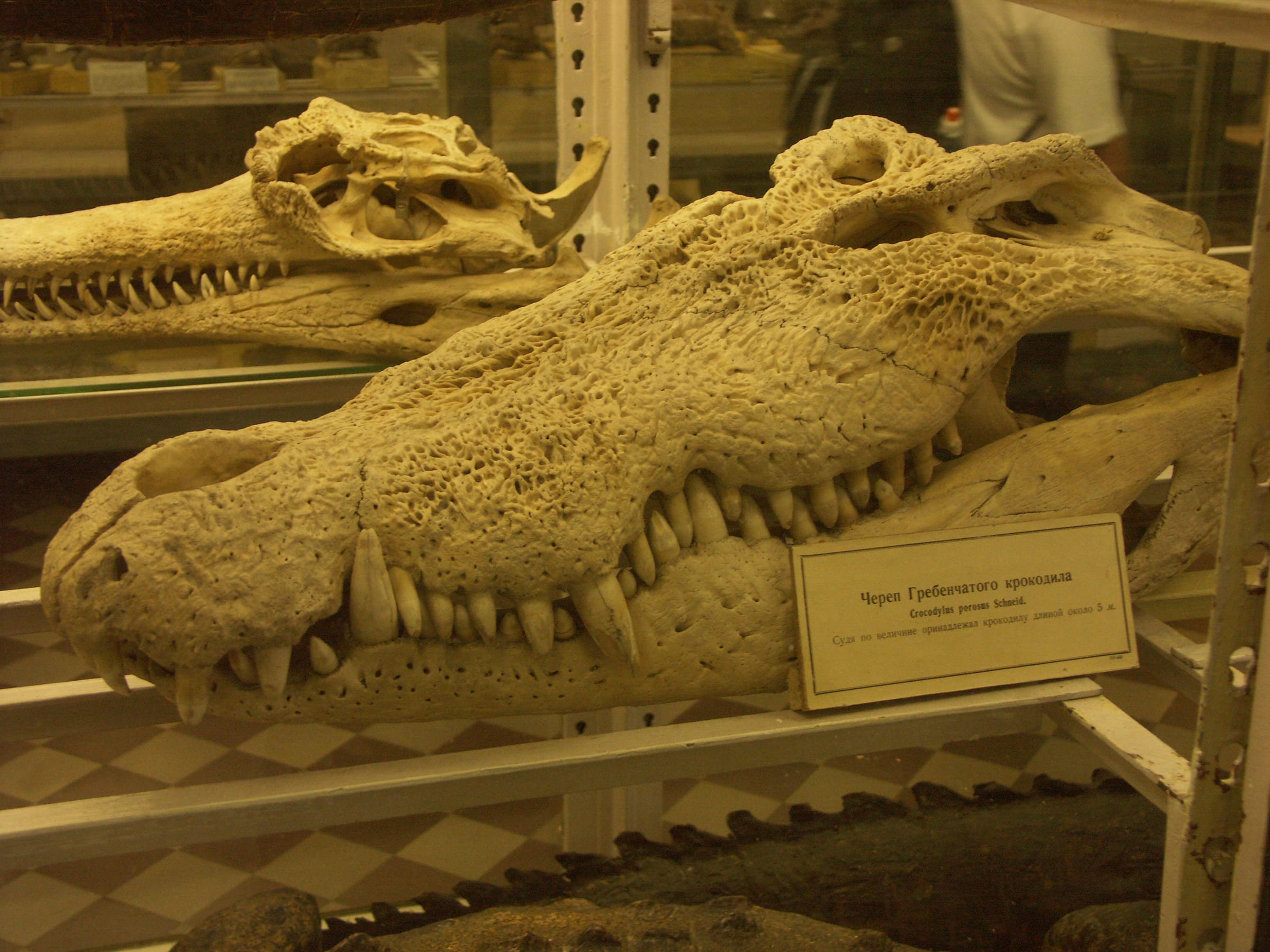
The saltwater crocodile has a wide snout compared to most crocodiles. However, it has a longer snout than the mugger crocodile (C. palustris); its length is twice its width at the base. A pair of ridges runs from the eyes along the centre of the snout. The scales are oval in shape and the scutes are either small compared to other species or commonly are entirely absent. In addition, an obvious gap is also present between the cervical and dorsal shields, and small, triangular scutes are present between the posterior edges of the large, transversely arranged scutes in the dorsal shield. The relative lack of scutes is considered an asset useful to distinguish saltwater crocodiles in captivity or in illicit leather trading, as well as in the few areas in the field where sub-adult or younger saltwater crocodiles may need to be distinguished from other crocodiles. It has fewer armour plates on its neck than other crocodilians.
The adult saltwater crocodile's broad body contrasts with that of most other lean crocodiles, leading to early unverified assumptions the reptile was an alligator.
Distribution and habitat
The saltwater crocodile inhabits coastal brackish mangrove swamps, river deltas and freshwater rivers from India's east coast, Sri Lanka and Bangladesh to Myanmar, Malaysia, Brunei, Indonesia, Philippines, Timor Leste, Palau, Solomon Islands, Singapore, Papua New Guinea, Vanuatu and Australia's north coast. The southernmost population in India lives in Odisha's Bhitarkanika Wildlife Sanctuary; in northern Odisha, it has not been recorded since the 1930s. It occurs along the Andaman and Nicobar Islands coasts and in the Sundarbans. In Sri Lanka, it occurs foremost in western and southern parts of the country.
In Myanmar, it inhabits the Ayeyarwady Delta.
In southern Thailand, it was recorded in Phang Nga Province.
Behaviour and ecology
The primary behaviour to distinguish the saltwater crocodile from other crocodiles is its tendency to occupy salt water. Though other crocodiles also have salt glands that enable them to survive in saltwater, a trait that alligators do not possess, most other species do not venture out to sea except during extreme conditions.
Saltwater crocodiles use ocean currents to travel long distances. In Australia, 20 crocodiles were tagged with satellite transmitters; 8 of them ventured out into open ocean, and one of them traveled 590 km (370 mi) along the coast in 25 days from the North Kennedy River on the eastern coast of Far North Queensland, around Cape York Peninsula, to the west coast in the Gulf of Carpentaria. Another individual swam 411 km (255 mi) in 20 days. Without having to move around much, sometimes simply by floating, the current-riding behaviour allows for the conservation of energy. They interrupted their movements and resided in sheltered bays for a few days until the current changed direction. Sometimes, they also swam up and down river systems.
Conservation status
The species is considered of minimal concern for extinction but is protected from the effects of international trade under the Convention on International Trade in Endangered Species (CITES) as follows:
Appendix I (prohibiting all commercial trade in the species or its parts/derivatives): All wild populations except for those of Australia, Indonesia and Papua New Guinea;
Appendix II (commercial trade allowed with export permit; import permits may or may not be required depending on the laws of the importing country): Australia, Indonesia and Papua New Guinea wild populations, plus all worldwide populations bred in captivity for commercial purposes.
Relationship with humans
Of all the crocodilians, the saltwater crocodile and Nile crocodile have the strongest tendency to becoming man-eating animals. The saltwater crocodile has a long history of attacking humans who venture into its territory. As a result of its power, intimidating size, and speed, survival of a predatory attack is unlikely if the crocodile is able to make direct contact. The only recommended policy for dealing with saltwater crocodiles is to completely avoid their habitat whenever possible, as they are exceedingly aggressive when encroached upon.