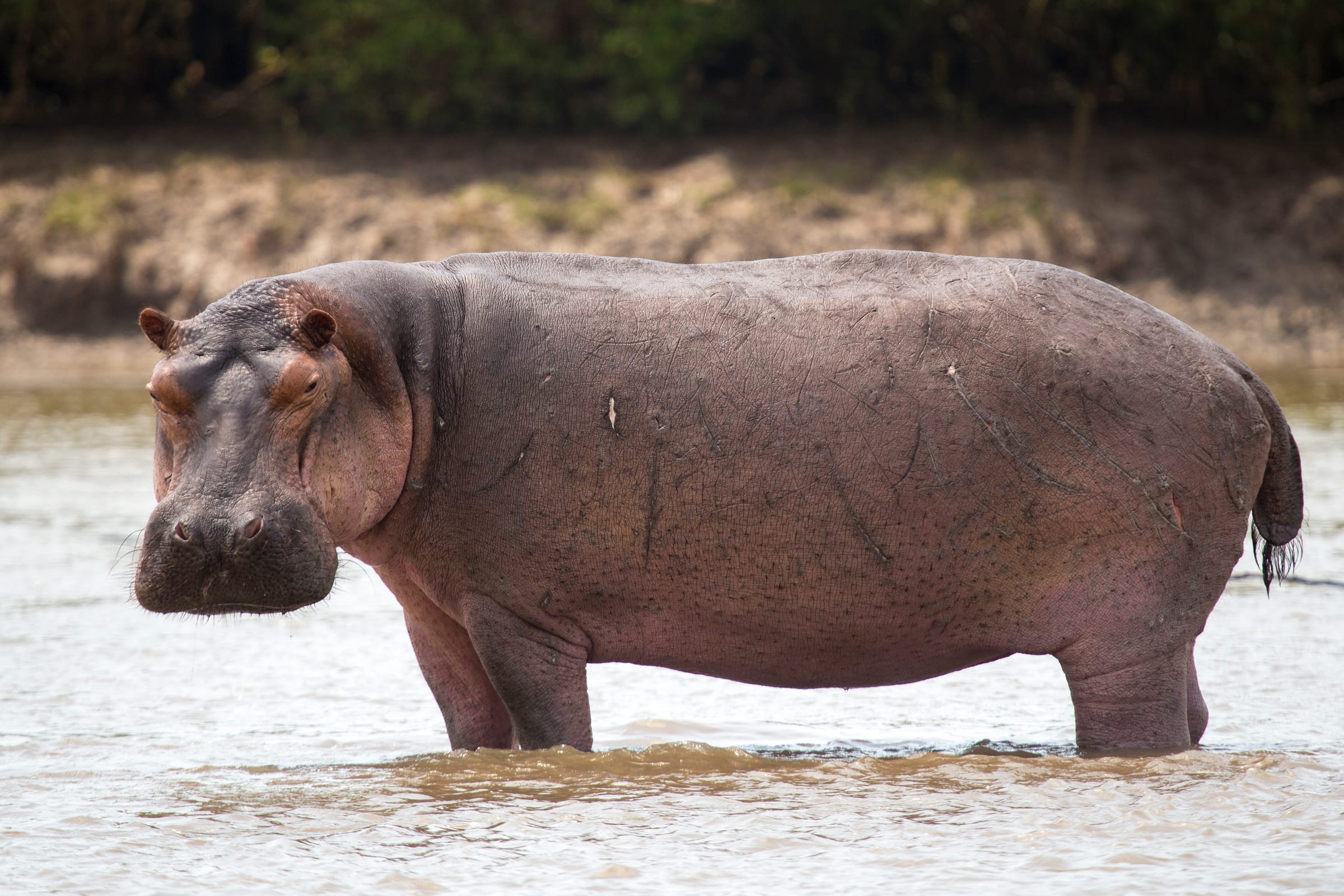
The hippopotamus (Hippopotamus amphibius; ; pl.: hippopotamuses), often shortened to hippo (pl.: hippos), further qualified as the common hippopotamus, Nile hippopotamus and river hippopotamus, is a large semiaquatic mammal native to sub-Saharan Africa. It is one of only two extant species in the family Hippopotamidae, the other being the pygmy hippopotamus (Choeropsis liberiensis or Hexaprotodon liberiensis). Its name comes from the Ancient Greek for "river horse" (ἱπποπόταμος).
After elephants and rhinoceroses, the hippopotamus is the next largest land mammal. It is also the largest extant land artiodactyl. Despite their physical resemblance to pigs and other terrestrial even-toed ungulates, the closest living relatives of the hippopotamids are cetaceans (whales, dolphins, porpoises, etc.), from which they diverged about 55 million years ago. Hippos are recognisable for their barrel-shaped torsos, wide-opening mouths with large canine tusks, nearly hairless bodies, short legs, and large size: adults average 1.5 t (1.7 short tons) for bulls (males) and 1.3 t (1.4 short tons) for cows (females).
Sweats pink sunscreen and kills more humans than lions.
Distribution and status
Hippopotamus amphibius arrived in Europe around 560–460,000 years ago, during the Middle Pleistocene. The distribution of Hippopotamus amphibius in Europe during the Pleistocene was largely confined to Southern Europe, including the Iberian Peninsula, Italy (southwards to Sicily), Greece, and probably Herzegovina, but extended into northwestern Europe, including northern France, Great Britain (as far north as Stockton-on-Tees), Belgium, the Netherlands, and western Germany during interglacial periods, such as the Last Interglacial (130–115,000 years ago). Analysis of ancient DNA indicates that Late Pleistocene European hippopotamuses are closely related to and nested within the genetic diversity of living African hippopotamuses. The youngest records of the species in Europe are from the Late Pleistocene of Greece, and the Rhine Graben of southwest Germany, dating to around 40–30,000 years ago.
Behaviour and ecology
Hippos are semiaquatic and require enough water to immerse in, while being close to grass. They mostly live in freshwater habitat, but can be found in estuaries. They prefer relatively still waters with gently sloping shores, though male hippos may also be found in very small numbers in more rapid waters with rocky slopes. Like most herbivores, hippos will consume a variety of plants if presented with them in captivity, but their diet in nature consists almost entirely of grass, with only minimal consumption of aquatic plants. Hippos spend most of the day in water to stay cool and hydrated. Just before night begins, they leave the water to forage on land. A hippo will travel 3–5 km (1.9–3.1 mi) per night, eating around 40 kg (88 lb) of grass. By dawn, they are back in the water.
Relationship with humans
Cut marks on bones of H. amphibius found at Bolomor Cave, a site in Spain preserving fossils dating from 230,000 to 120,000 years ago, provides evidence for Neanderthal butchery of hippopotamuses. The earliest evidence of modern human interaction with hippos comes from butchery cut marks on hippo bones found at the Bouri Formation and dated to around 160,000 years ago. 4,000–5,000 year old art showing hippos being hunted have been found in the Tassili n'Ajjer Mountains of the central Sahara near Djanet. The ancient Egyptians recognised the hippo as ferocious, and representations on the tombs of nobles show humans hunting them.
The hippo was also known to the Greeks and Romans. The Greek historian Herodotus described the hippo in The Histories (written circa 440 BC) and the Roman naturalist Pliny the Elder wrote about the hippo in his encyclopedia Naturalis Historia (written circa 77 AD). The Yoruba people called the hippo erinmi, which means "elephant of the water". Some individual hippos have achieved international fame. Huberta became a celebrity during the Great Depression for trekking a great distance across South Africa.
Taxonomy and origins
The common hippopotamus and the pygmy hippopotamus are the only living members of the family Hippopotamidae. Some taxonomists place hippos and anthracotheres in the superfamily Anthracotheroidea. Hippopotamidae are classified along with other even-toed ungulates in the order Artiodactyla.
Five subspecies of hippos have been described based on morphological differences in their skulls as well as differences in geographical range:
H. a. amphibius – (the nominate subspecies) ranges from Gambia east to Ethiopia and then south to Mozambique and historically ranged as far north as Egypt; its skull is distinguished by a moderately reduced preorbital region, a bulging dorsal surface, elongated mandibular symphysis and larger chewing teeth.
Characteristics
The hippopotamus is a megaherbivore and is the third-largest land mammal after elephants and some rhinoceros species. The mean adult weight is around 1.48 t (1.63 short tons) for bulls and 1.365 t (1.505 short tons) for cows. Exceptionally large males have been recorded reaching 2.66 t (2.93 short tons). Male hippos appear to continue growing throughout their lives, while females reach maximum weight at around age 25. It is 2.90 to 5.05 m (9 ft 6 in to 16 ft 7 in) long, including a tail of about 35 to 56 cm (1 ft 2 in to 1 ft 10 in) in length and 1.30 to 1.65 m (4 ft 3 in to 5 ft 5 in) tall at the shoulder, with males and females ranging 1.40 to 1.65 m (4 ft 7 in to 5 ft 5 in) and 1.30 to 1.45 m (4 ft 3 in to 4 ft 9 in) tall at the shoulder respectively. The species has a typical head–body length of 3.3–3.45 m (10.8–11.3 ft) and an average standing height of 1.4 m (4 ft 7 in) at the shoulder.