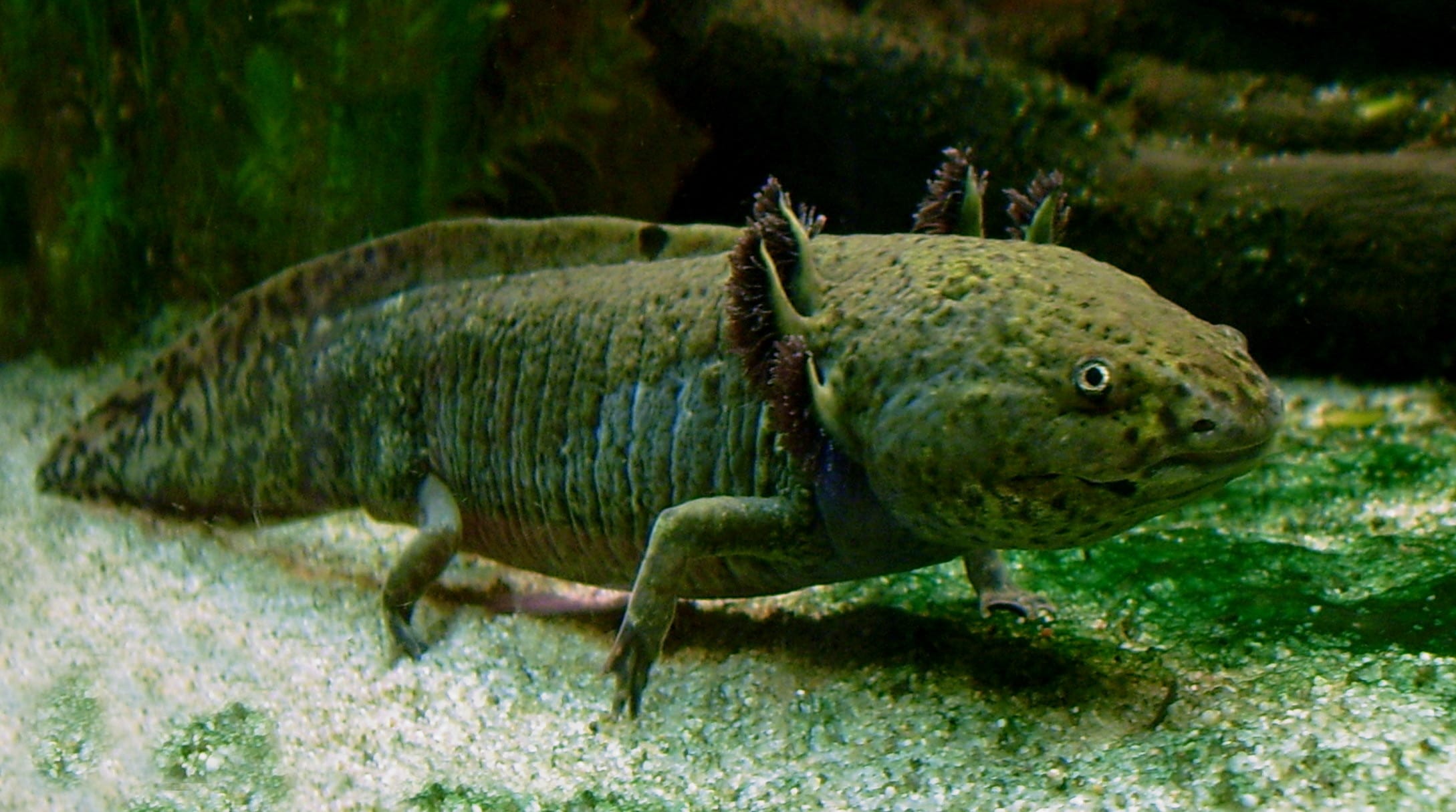
The axolotl ( ; from Classical Nahuatl: āxōlōtl [aːˈʃoːloːtɬ] ; Ambystoma mexicanum) is a species of mole salamander. It is neotenic, reaching sexual maturity without undergoing metamorphosis, and the adults remain fully aquatic with obvious external gills. Axolotls may be difficult to distinguish from the larval stage of other neotenic adult mole salamanders, in particular the tiger salamander, or other species such as mudpuppies.
Axolotls originally inhabited a system of interconnected wetlands and lakes in the highlands of Mexico. They were known to inhabit the smaller lakes of Xochimilco and Chalco and are presumed to have inhabited the larger lakes of Texcoco and Zumpango. The desiccation of these lakes, initiated by the Aztecs and accelerated during the 20th century, has led to the destruction of much of the axolotl's natural habitat, an area now largely occupied by Mexico City. Wild axolotls have been driven to near extinction by the introduction of invasive species such as tilapia and carp; with a decreasing population of around 50 to 1,000 adult individuals, the species has been assessed as critically endangered by the International Union for Conservation of Nature (IUCN) and is listed under Appendix II of the Convention on International Trade in Endangered Species (CITES).
Stays a smiling baby forever and regrows whatever it loses.
Description
A sexually mature adult axolotl, at age 18–27 months, ranges in length from 15 to 45 cm (6 to 18 in); a size close to 23 cm (9 in) is most common, and any greater than 30 cm (12 in) is rare. Axolotls possess features typical of salamander larvae, including external gills and a caudal fin extending from behind the head to the vent. Unlike most salamander species, axolotls retain their external gills when they mature into adulthood. This is a type of neoteny.
Axolotls have wide heads and lidless eyes. Their limbs are underdeveloped and possess long, thin digits. Three pairs of external gill stalks (rami) originate from behind the head and are used to move oxygenated water. These are lined with filaments (fimbriae) to increase the surface area for gas exchange. Four gill slits lined with gill rakers are hidden underneath the external gills, which prevent food from entering and allow particles to filter through. Males can be identified by their swollen cloacae lined with papillae, while females have noticeably wider bodies when gravid and full of eggs.
Physiology
The characteristic of the axolotl that attracts the most attention is its unusual healing ability; axolotls do not heal by scarring but are instead capable of tissue regeneration. Entire lost appendages, such as the limbs and tail, can regrow over a period of months. In certain cases, more vital structures can be regrown, such as tissues of the eye and heart. Axolotls can even restore parts of their central nervous system, including non-vital parts of their brains. They can readily accept transplants from other individuals—including eyes and parts of the brain—restoring these "alien organs" to full functionality. In special cases, axolotls have been able to repair a damaged limb while also generating an additional limb, resulting in an extra appendage that makes them attractive to pet owners as a novelty.
Wild population
Axolotls are within the same genus as the tiger salamander (Ambystoma tigrinum), being part of its species complex along with all other Mexican species of Ambystoma. Within the family Ambystomatidae, the closest relative of the axolotl is the Eastern tiger salamander. The axolotl's habitat is like that of most neotenic Ambystoma species: a high-altitude body of water surrounded by a risky terrestrial environment, or other conditions unsuitable for the terrestrial form, with these conditions thought to favor the development of neoteny. However, a population of terrestrial Mexican tiger salamanders occupies and breeds in the axolotl's habitat (the two species being sympatric).
The axolotl is native to the freshwater lakes of Xochimilco and Chalco in the Valley of Mexico (though the species may have also once inhabited the larger Lakes of Texcoco and Zumpango). Lake Chalco is an unstable ecosystem, often being drained as a flood control measure, and Lake Xochimilco is a remnant of its former self, now existing mainly as canals. The water temperature in Xochimilco rarely rises above 20 °C (68 °F), and may fall to 6–7 °C (43–45 °F) or lower in the winter. A population of Ambystoma inhabiting the artificial lake at Chapultepec was confirmed to contain axolotls; as of 23 October 2019, the extent of occurrence was 467 square kilometres (180 sq mi). Overall, the wild axolotl prefers a system of water channels and deep-water lakes with abundant aquatic vegetation.
Relation to humans
German naturalist and explorer Alexander von Humboldt noted in the 19th century that the Mexicans, having been vanquished by the Spanish Empire, lived "in great want, compelled to feed on roots of aquatic plants, insects and a problematical reptile called axolotl".
In 1863, a shipment of 34 adult axolotls was sent from Mexico City to the Jardin des Plantes in Paris, from which thousands of specimens were captive-bred and distributed around Europe for scientific research. Unaware of their neoteny, French zoologist Auguste Duméril was surprised when, instead of the axolotl, he found in the vivarium a new species, similar to the salamander. This discovery was the starting point of research about neoteny. It is not certain that Ambystoma velasci specimens were not included in the original shipment.
In Prague, the Czech physician Vilem Laufberger used thyroid hormone injections to induce an axolotl to grow into a terrestrial adult salamander. Unaware that it had already been carried out, Englishman Julian Huxley repeated the experiment using ground animal thyroid glands. Since then, experiments have often involved the injection of iodine or various thyroid hormones to induce metamorphosis.