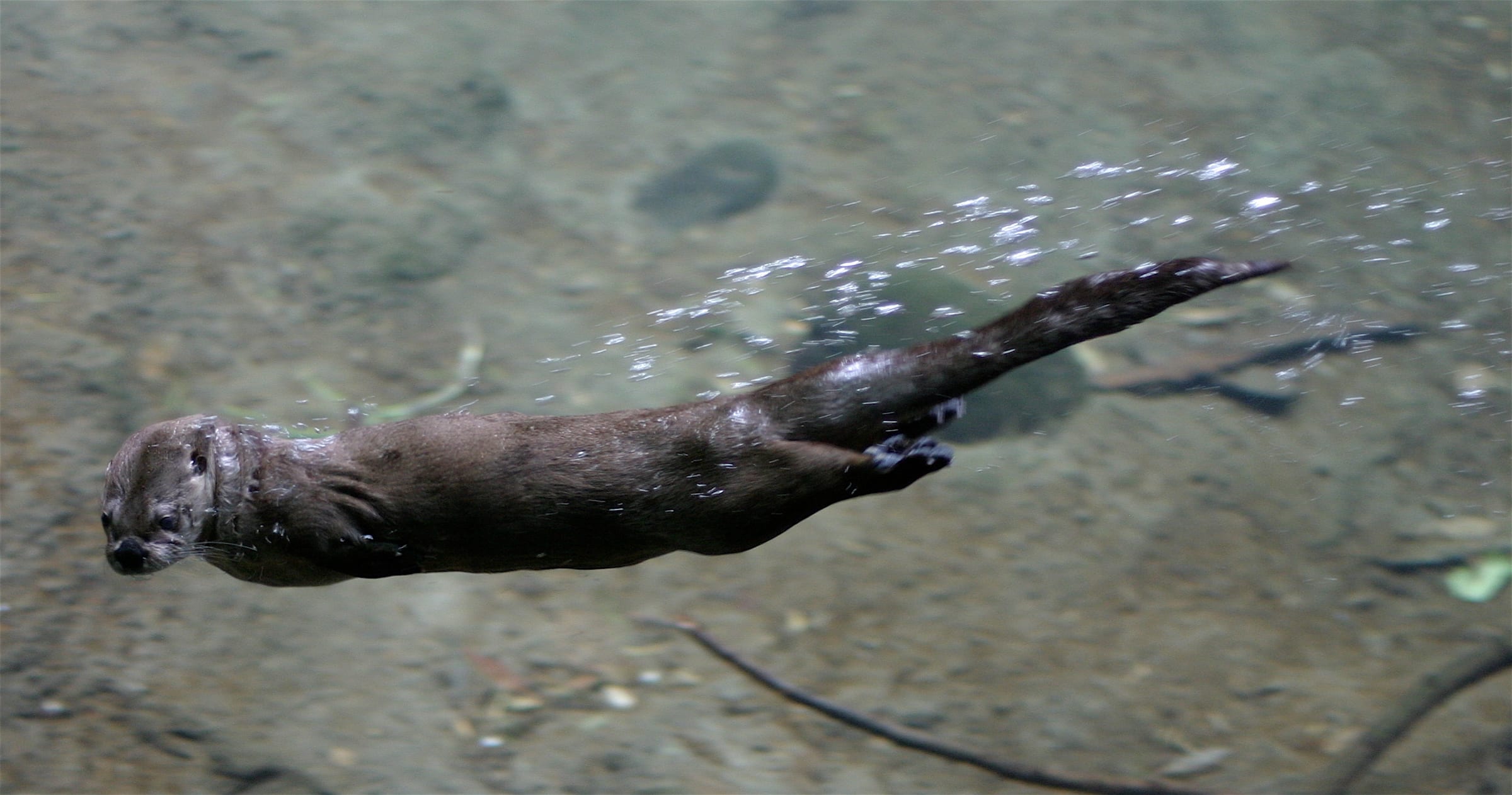
The North American river otter (Lontra canadensis), also known as the northern river otter and river otter, is a semiaquatic mammal that is endemic to the North American continent throughout most of Canada and along the coasts of the United States and its inland waterways. An adult North American river otter can weigh between 5 and 14 kilograms (11–31 lb). The river otter is protected and insulated by a thick, water-repellent coat of fur.
The North American river otter, a member of the subfamily Lutrinae in the weasel family (Mustelidae), is equally versatile in the water and on land. It establishes a burrow close to the water's edge in river, lake, swamp, coastal shoreline, tidal flat, or estuary ecosystems. The den typically has many tunnel openings, one of which generally allows the otter to enter and exit the body of water. Females give birth in these burrows, producing litters of one to six young.
Treats every river bank as a private waterslide.
Description
The North American river otter has long and thin whiskers that are used to detect prey in dark waters. An average adult male weighs about 11.3 kilograms (25 lb) against the female's average of 8.3 kg (18 lb). Its body length ranges from 66 to 107 cm (26–42 in). About one-third of the animal's total length consists of a long, tapered tail. Tail lengths range from 30 to 50 cm (12–20 in). Large males can exceed a weight of 15 kg (33 lb). It differs from the Eurasian otter by its longer neck, narrower visage, the smaller space between the ears, and shorter tail.
Males and female river otters show different nonsexual physical characteristics, with males typically being larger.
North American river otters can live 21–25 years in captivity, or 8–13 years in the wild.
Distribution and habitat
The North American river otter is found throughout North America, inhabiting inland waterways and coastal areas in Canada, the Pacific Northwest, the Atlantic states, and states on the Gulf of Mexico. They also inhabit the forested regions near the Pacific coast in North America. The species is also present throughout Alaska, including the Aleutian Islands, and the north slope of the Brooks Range.
Behavior
North American river otters only settle in areas that consist of vegetation, rock piles, and sufficient coverage.
North American river otters are renowned for their sense of play. Otter play mostly consists of wrestling with conspecifics. Chasing is also a common game. They rely upon play to learn survival skills such as fighting and hunting.
A highly active predator, the North American river otter has adapted to hunting in water and eats aquatic and semiaquatic animals. The vulnerability and seasonal availability of prey animals mainly governs its food habits and prey choices. This availability is influenced by detectability and mobility of the prey, habitat availability for the various prey species, environmental factors, such as water depth and temperature, and seasonal changes in prey supply and distribution in correspondence with otter foraging habitat.
Ecology
The diet of the North American River otters is extensive and mostly consists of fish, frogs, crayfish, turtles, insects, and some small mammals. They are known to hunt in pairs or alone and can hunt on both land and in the water. Lontra canadensis is a predator adapted to hunting in water, feeding on aquatic and semiaquatic animals. The vulnerability and seasonal availability of prey animals primarily determine their food habits and prey preferences.
Threats
Threats to North American river otter populations in North America vary regionally. North American river otter inhabitation is affected by type, distribution, and density of aquatic habitats and characteristics of human activities. Preceding the settlement of North America by Europeans, North American river otters were prevalent among aquatic habitats throughout most of the continent. Trapping, loss or degradation of aquatic habitats through filling of wetlands, and development of coal, oil, gas, tanning, timber, and other industries, resulted in local extinctions or population declines in North American river otter populations in many areas. In 1980, an examination conducted on U.S. river otter populations determined they were locally extinct in 11 states, and lost significant population in 9 other states. The most severe population declines occurred in interior regions where fewer aquatic habitats supported fewer otter populations. Although the distribution became reduced in some regions of southern Canada, the only province-wide extinction occurred on Prince Edward Island.