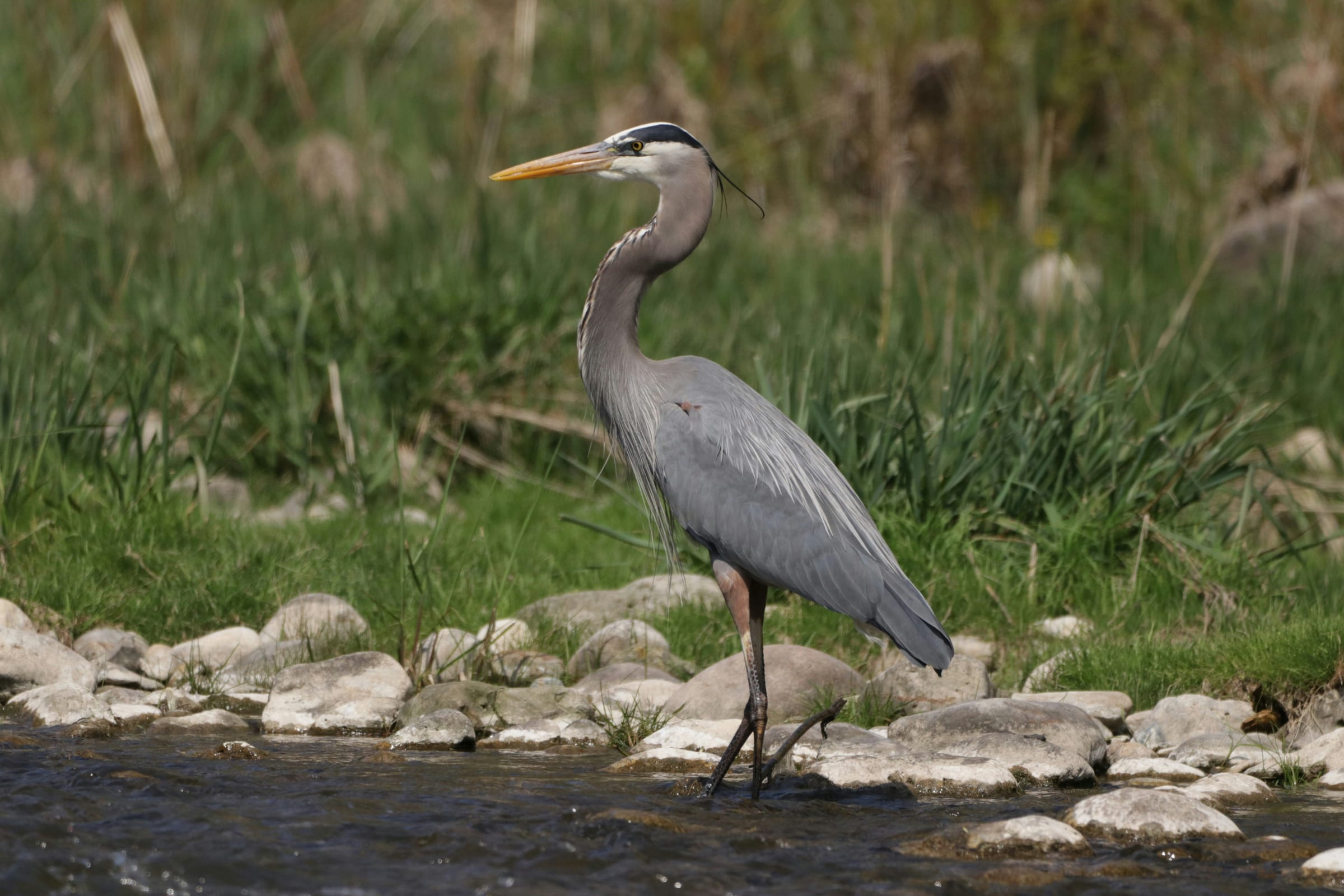
The great blue heron (Ardea herodias) is a large wading bird in the heron family (Ardeidae), common near shores of open water and wetlands over most of North and Central America, as well as Northwestern South America, the Caribbean, and the Galápagos Islands. It is occasionally found in the Azores and is a rare vagrant to Europe. An all-white population found in South Florida and the Florida Keys is known as the great white heron. Debate exists about whether these white birds are a color morph of the great blue heron, a subspecies of it, or an entirely separate species.
Stands utterly still until the river forgets it is there.
Description
The great blue heron is the largest heron native to North America. Among all extant herons, it is surpassed in size only by the Goliath heron (Ardea goliath) and the White-bellied heron (Ardea insignis). It exhibits a minor degree of sexual dimorphism; males are slightly larger than females, but otherwise the sexes are not easily outwardly distinguishable. It has a head-to-tail length of 91–137 cm (36–54 in), a wingspan of 167–201 cm (66–79 in), a height of 115–138 cm (45–54 in), and a weight of 1.82–3.6 kg (4.0–7.9 lb). In British Columbia, adult males averaged 2.48 kg (5.5 lb) and adult females 2.11 kg (4.7 lb). In Nova Scotia and New England, adult herons of both sexes averaged 2.23 kg (4.9 lb), while in Oregon, both sexes averaged 2.09 kg (4.6 lb) Thus, great blue herons are roughly twice as heavy as great egrets (Ardea alba), although only slightly taller than them, but they weigh only about half as much as a large goliath heron.
Distribution and habitat
The great blue heron is found throughout most of North America, as far north as Alaska and the southern Canadian provinces in the summer. In winter, the range extends south through Florida, Mexico, and the Caribbean to far northwestern South America (regular in Colombia and Venezuela, accidental elsewhere in South America). Birds east of the Rocky Mountains in the northern part of their range are migratory and winter in the coastal areas of the Southern United States, Central America, or northern South America. From the Southern United States southwards, and on the lower Pacific coast, they are year-round residents. However, their hardiness is such that individuals often remain through cold northern winters, as well, so long as fish-bearing waters remain unfrozen (which may be the case only in flowing water such as streams, creeks, and rivers).
The great blue heron can adapt to almost any wetland habitat in its range. It may be found in numbers in fresh and saltwater marshes, mangrove swamps, flooded meadows, lake edges, or shorelines. It is quite adaptable and may be seen in heavily developed areas as long as they hold bodies of fish-bearing water.
Great blue herons rarely venture far from bodies of water, but are occasionally seen flying over upland areas. They usually nest in trees or bushes near water's edge, often on islands (which minimizes the potential for predation) or partially isolated spots.
Behavior
The great blue heron (Ardea herodias) is widely recognized as an apex predator within many North American wetland systems. Its hunting behavior ranges across marshes, river edges and shallow coastal zones, where it consumes fish, amphibians, reptiles, invertebrates and small mammals, placing it at the top of local food webs. Adult great blue herons face relatively few natural predators, allowing them to function as dominant top-level consumers and key indicators of ecosystem health, particularly through their sensitivity to bioaccumulated contaminants.
The primary food for the great blue heron is fish. While they can prey on various sizes of fish from small fingerlings to large adult fish, measuring 60 cm (24 in) in length and weighing around 900 g (2.0 lb), small to medium-sized fish around 10–20 cm (3.9–7.9 in) are usually preferred. Primary prey fish is variable based on availability and abundance. In Nova Scotia, 98% of the diet was flounder. In British Columbia, the primary prey species are sticklebacks, gunnels, sculpins, and perch. California herons were found to live mostly on sculpin, bass, perch, flounder, and top smelt.
In art and logos
John James Audubon illustrates the great blue heron in Birds of America, Second Edition (published, London 1827–1838) as Plate 161. The image was engraved and colored by Robert Havell's London workshops. The original watercolor by Audubon is in the collection of the New-York Historical Society.
The great blue heron (with its color changed to orange) is the basis of logos for the Delmarva Shorebirds minor league baseball team from the team's 1996 inception.
Great white herons feature prominently in the logo for the Major League Soccer club Inter Miami CF.