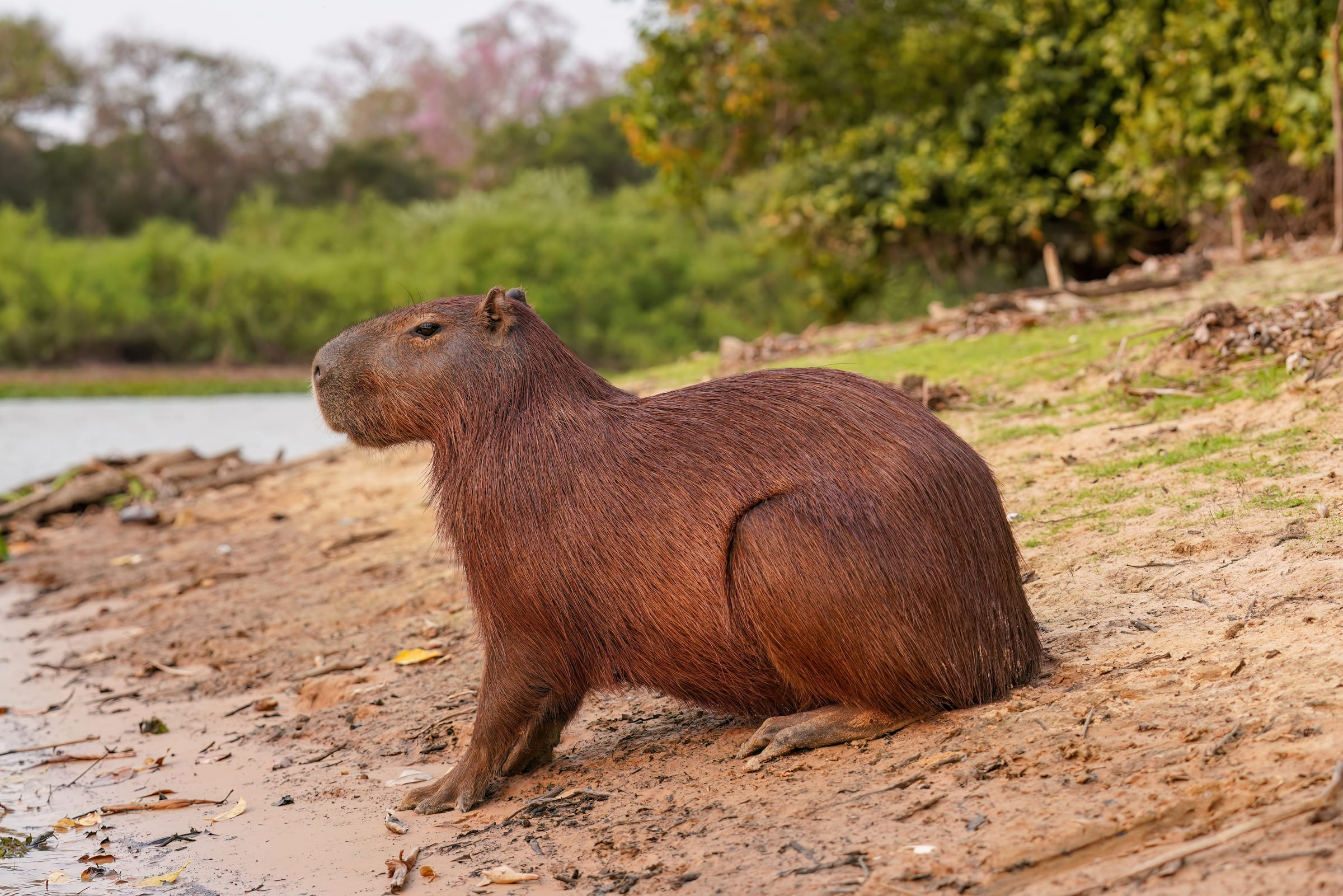
The capybara or greater capybara (Hydrochoerus hydrochaeris) is the largest living rodent, native to all countries in South America except Chile. It is a semiaquatic herbivore that inhabits savannas and dense forests, living near and in bodies of water and feeding mainly on grasses and aquatic plants.
Together with the lesser capybara, it constitutes the genus Hydrochoerus. Its other close relatives include guinea pigs and rock cavies, and it is more distantly related to the agouti, the chinchilla, and the nutria.
The largest rodent alive, friend to every animal it meets.
Description
The capybara has a heavy, barrel-shaped body and short head, with reddish-brown fur on the upper part of its body that turns yellowish-brown underneath. Its sweat glands can be found in the surface of the hairy portions of its skin, an unusual trait among rodents. The animal lacks down hair, and its guard hair differs little from over hair.Adult capybaras grow to 106 to 134 cm (3.48 to 4.40 ft) in length, stand 50 to 62 cm (20 to 24 in) tall at the withers, and typically weigh 35 to 66 kg (77 to 146 lb), with an average in the Venezuelan llanos of 48.9 kg (108 lb). Females are slightly heavier than males. The top recorded weights are 91 kg (201 lb) for a wild female from Brazil and 73.5 kg (162 lb) for a wild male from Uruguay. Also, an 81 kg individual was reported in São Paulo in 2001 or 2002. The dental formula is 1.0.1.31.0.1.3. Capybaras have slightly webbed feet and vestigial tails. Their hind legs are slightly longer than their forelegs; they have three toes on their rear feet and four toes on their front feet. Their muzzles are blunt, with nostrils, and the eyes and ears are near the top of their heads.
Its karyotype has 2n = 66 and FN = 102, meaning it has 66 chromosomes with a total of 102 arms.
Ecology
Capybaras are semiaquatic mammals found throughout all countries of South America except Chile. They live in densely forested areas near bodies of water, such as lakes, rivers, swamps, ponds, and marshes, as well as flooded savannah and along rivers in the tropical rainforest. They are superb swimmers and can hold their breath underwater for up to five minutes at a time. Capybara have flourished in cattle ranches. They roam in home ranges averaging 10 hectares (25 acres) in high-density populations.
Many escapees from captivity can also be found in similar watery habitats around the world. Sightings are fairly common in Florida, although a breeding population has not yet been confirmed. In 2011, one specimen was spotted on the Central Coast of California. These escaped populations occur in areas where prehistoric capybaras inhabited; late Pleistocene capybaras inhabited Florida and Hydrochoerus hesperotiganites in California and Hydrochoerus gaylordi in Grenada, and feral capybaras in North America may actually fill the ecological niche of the Pleistocene species.
Conservation and human interaction
Capybaras are not considered a threatened species; their population is stable throughout most of their South American range, though in some areas hunting has reduced their numbers. Capybaras are hunted for their meat and pelts in some areas, and otherwise killed by humans who see their grazing as competition for livestock. In some areas, they are farmed, which has the effect of ensuring the wetland habitats are protected. Their survival is aided by their ability to breed rapidly.
Capybaras have adapted well to urbanization in South America. They can be found in many areas in zoos and parks, and may live for 12 years in captivity, more than double their wild lifespan. Capybaras are docile and usually allow humans to pet and hand-feed them, but physical contact is normally discouraged, as their ticks can be vectors to Rocky Mountain spotted fever. The European Association of Zoos and Aquaria asked Drusillas Park in Alfriston, Sussex, England, to keep the studbook for capybaras, to monitor captive populations in Europe. The studbook includes information about all births, deaths and movements of capybaras, as well as how they are related.
Classification and phylogeny
The capybara and the lesser capybara both belong to the subfamily Hydrochoerinae along with the rock cavies. The living capybaras and their extinct relatives were previously classified in their own family Hydrochoeridae. Since 2002, molecular phylogenetic studies have recognized a close relationship between Hydrochoerus and Kerodon, the rock cavies, supporting placement of both genera in a subfamily of Caviidae.
Paleontological classifications previously used Hydrochoeridae for all capybaras, while using Hydrochoerinae for the living genus and its closest fossil relatives, such as Neochoerus, but more recently have adopted the classification of Hydrochoerinae within Caviidae. The taxonomy of fossil hydrochoerines is also in a state of flux. In recent years, the diversity of fossil hydrochoerines has been substantially reduced. This is largely due to the recognition that capybara molar teeth show strong variation in shape over the life of an individual. In one instance, material referred to four genera and seven species on the basis of differences in molar shape was later thought to represent differently aged individuals of a single species, Cardiatherium paranense.
Among fossil species, the name "capybara" can refer to the many species of Hydrochoerinae that are more closely related to the modern Hydrochoerus than to the "cardiomyine" rodents like Cardiomys. The fossil genera Cardiatherium, Phugatherium, Hydrochoeropsis, and Neochoerus are all capybaras under that concept.
Social organization
Capybaras are gregarious. While they sometimes live solitarily, they are more commonly found in groups of around 10–20 individuals, with two to four adult males, four to seven adult females, and the remainder juveniles. Capybara groups can consist of as many as 50 or 100 individuals during the dry season when the animals gather around available water sources. Males establish social bonds, dominance, or general group consensus. They can make dog-like barks when threatened or when females are herding young.
Capybaras have two types of scent glands: a morrillo, located on the snout, and anal glands. Both sexes have these glands, but males have much larger morrillos and use their anal glands more frequently. The anal glands of males are also lined with detachable hairs. A crystalline form of scent secretion is coated on these hairs and is released when in contact with objects such as plants. These hairs have a longer-lasting scent mark and are tasted by other capybaras. Capybaras scent-mark by rubbing their morrillos on objects, or by walking over scrub and marking it with their anal glands. Capybaras can spread their scent farther by urinating; however, females usually mark without urinating and scent-mark less frequently than males overall. Females mark more often during the wet season when they are in estrus. In addition to objects, males also scent-mark females.