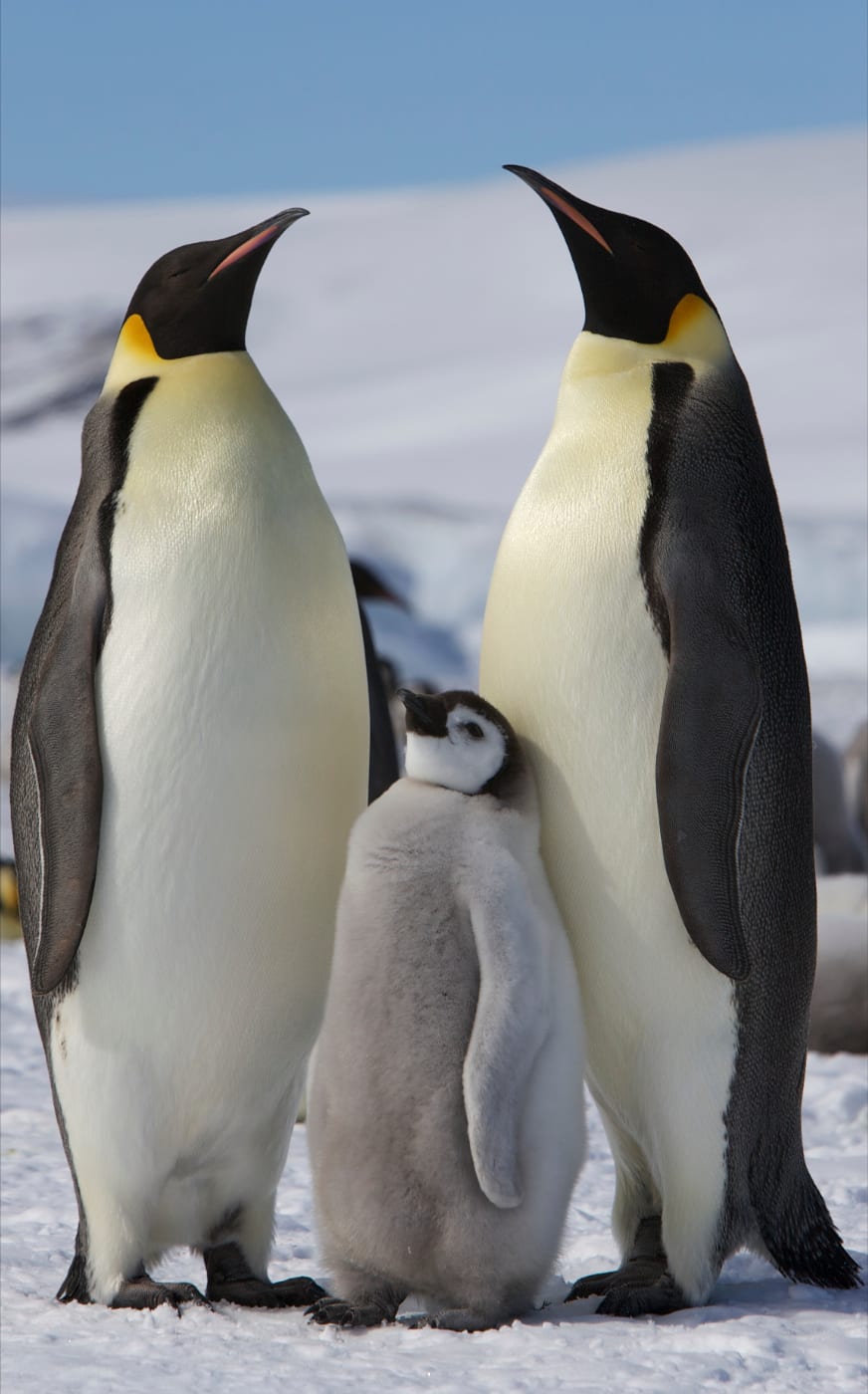
The emperor penguin (Aptenodytes forsteri) is the tallest and heaviest of all living penguin species and lives exclusively in Antarctica. The male and female are similar in plumage and size, reaching 100 cm (39 in) in length and weighing from 22 to 45 kg (49 to 99 lb). Feathers of the head and back are black and sharply delineated from the white belly, pale-yellow breast and bright-yellow ear patches.
Like all species of penguin, the emperor is flightless, with a streamlined body, and wings stiffened and flattened into flippers for a marine habitat. Its diet consists primarily of fish, but also includes crustaceans, such as krill, and cephalopods, such as squid. While hunting, the species can remain submerged around 20 minutes, diving to a depth of 535 m (1,755 ft). It has several adaptations to facilitate this, including an unusually structured haemoglobin to allow it to function at low oxygen levels, solid bones that reduce barotrauma, and the ability to reduce its metabolism and shut down non-essential organ functions.
Endures the coldest winter on earth to keep one egg warm.
Description
Adult emperor penguins are 110–120 cm (43–47 in) in length, averaging 115 cm (45 in). Due to the method of bird measurement that measures length between bill to tail, sometimes body length and standing height are confused, and some reported height even reaching 1.5 m (4 ft 11 in) tall. There are still more than a few papers mentioning that they reach a standing height of 1.2 m (3 ft 11 in) instead of body length. Although standing height of emperor penguin is rarely provided at scientific reports, Prévost (1961) recorded 86 wild individuals and measured maximum height of 1.08 m (3 ft 7 in). Friedman (1945) recorded measurements from 22 wild individuals and resulted height ranging 83–97 cm (33–38 in). Ksepka et al. (2012) measured standing height of 81–94 cm (32–37 in) according to 11 complete skins collected in American Museum of Natural History. The weight ranges from 22.7 to 45.4 kg (50 to 100 lb) and varies by sex, with males weighing more than females. It is the fifth heaviest living bird species, after only the larger varieties of ratite. The weight also varies by season, as both male and female penguins lose substantial mass while raising hatchlings and incubating their egg. Male emperor penguins must withstand the extreme Antarctic winter cold for more than two months while protecting their eggs; eating nothing during this time, male emperors will lose around 12 kg (26 lb) while waiting for their eggs to hatch.
Distribution and habitat
The emperor penguin has a circumpolar distribution in the Antarctic almost exclusively between the 66° and 77° south latitudes. It almost always breeds on stable pack ice near the coast and up to 18 km (11 mi) offshore. Breeding colonies are usually in areas where ice cliffs and icebergs provide some protection from the wind. Three land colonies have been reported: one (now disappeared) on a shingle spit at the Dion Islands on the Antarctic Peninsula, one on a headland at Taylor Glacier in Victoria Land, and most recently one at Amundsen Bay. Since 2009, a number of colonies have been reported on shelf ice rather than sea ice, in some cases moving to the shelf in years when sea ice forms late. As of 2022, there were 66 known breeding colonies.
The northernmost breeding population is on Snow Hill Island, near the northern tip of the Peninsula. Individual vagrants have been seen on Heard Island, South Georgia, and occasionally in New Zealand. The furthest north a vagrant has been recorded was in Denmark, Western Australia, in November 2024. This individual, which is believed to have originated from eastern Antarctica, was encountered by a group of surfers shortly after it arrived in Denmark, and was taken in by conservationists at the Department of Biodiversity, Conservation and Attractions to have its condition evaluated.
Behaviour
The emperor penguin is a social animal in its nesting and its foraging behaviour; birds hunting together may coordinate their diving and surfacing. Individuals may be active day or night. A mature adult travels throughout most of the year between the breeding colony and ocean foraging areas; the species disperses into the oceans from January to March.
The American physiologist Gerry Kooyman revolutionized the study of penguin foraging behaviour in 1971 when he published his results from attaching automatic dive-recording devices to emperor penguins. He found that the species reaches depths of 265 m (869 ft), with dive periods of up to 18 minutes. Later research revealed a small female had dived to a depth of 535 m (1,755 ft) near McMurdo Sound. It is possible that emperor penguins can dive for even deeper and longer periods, as the accuracy of the recording devices is diminished at greater depths. Further study of one bird's diving behaviour revealed regular dives to 150 m (490 ft) in water around 900 m (3,000 ft) deep, and shallow dives of less than 50 m (160 ft), interspersed with deep dives of more than 400 m (1,300 ft) in depths of 450 to 500 m (1,480 to 1,640 ft). This was suggestive of feeding near or at the sea bottom. In 1994, a penguin from Auster rookery reached a depth of 564 m (1,850 ft); the entire dive took him 21.8 min.
Relationship with humans
Since the 1930s, there have been several attempts at keeping emperor penguins in captivity. Malcolm Davis of the National Zoological Park made early attempts at keeping penguins, capturing several from Antarctica. He successfully transferred penguins to the National Zoological Park on 5 March 1940, where they lived for up to 6 years.
Until the 1960s, keeping attempts were largely unsuccessful, as knowledge of penguin keeping in general was limited and acquired by trial and error. The first to achieve a level of success was Aalborg Zoo where a chilled house was built especially for this Antarctic species. One individual lived for 20 years at the zoo and a chick was hatched there, but died shortly after.