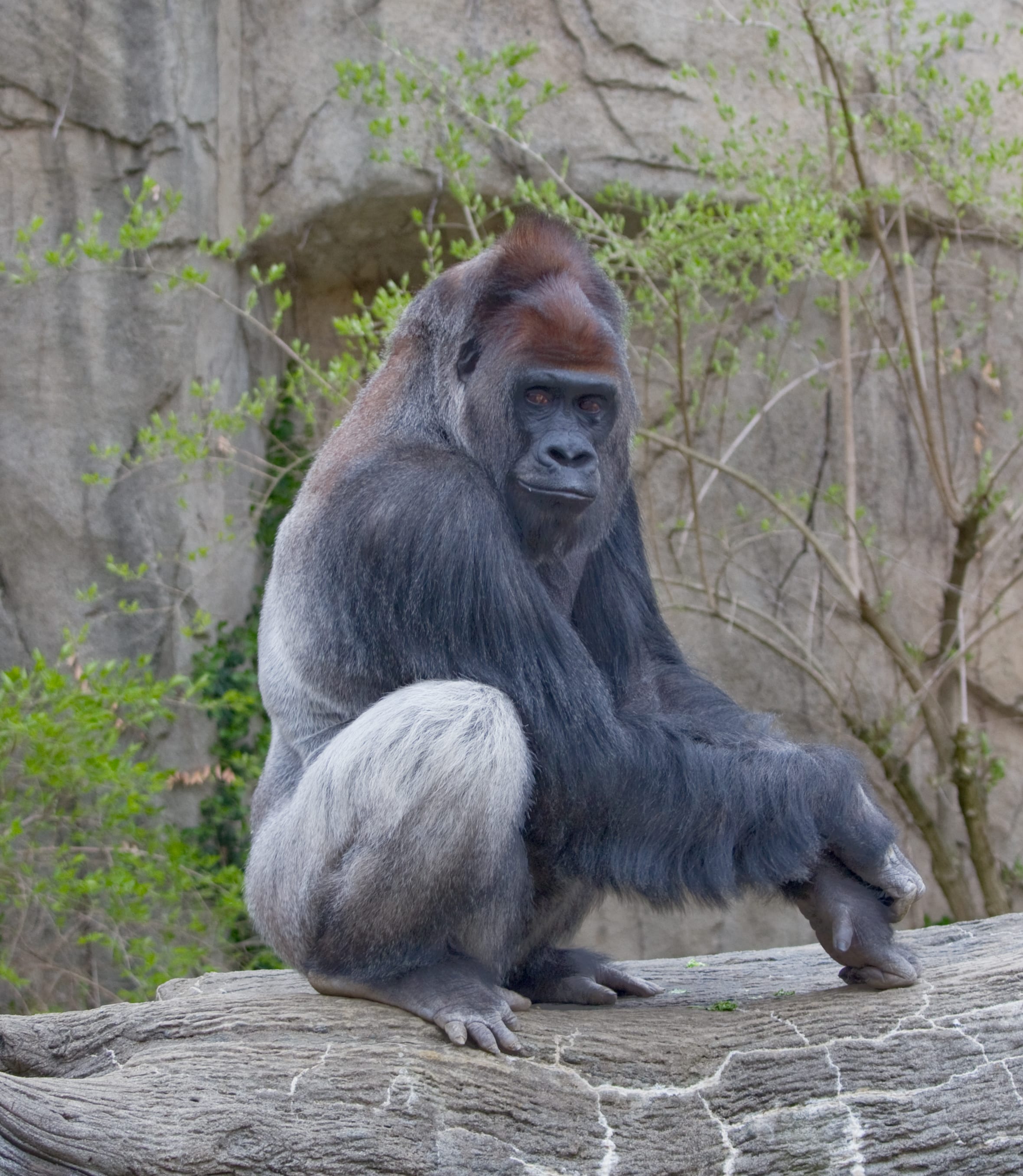
The western gorilla (Gorilla gorilla) is a great ape found in Africa, one of two species of the hominine genus Gorilla. Large and robust with males weighing around 168 kilograms (370 lb), the species is found in a region of midwest Africa, geographically isolated from the eastern gorilla (Gorilla beringei). The hair of the western species is significantly lighter in colour.
The western gorilla is the second largest living primate after the eastern gorilla. Two subspecies are recognised: the western lowland gorilla (Gorilla gorilla gorilla) is found in most of West Africa; while the Cross River gorilla (Gorilla gorilla diehli) is limited to a smaller range in the north at the border of Cameroon and Nigeria. Both subspecies are listed Critically Endangered.
The gentlest giant of the forest, four hundred pounds of vegetable.
Description
Western gorillas are generally lighter coloured than eastern gorillas. Western gorillas have black, dark grey or dark brown-grey hair with a brownish forehead. Males average 1.67 m (5.5 ft) although reaching a height up to 1.76 m (5.8 ft), with males weighing 145–191 kg (320–421 lb) and females weighing 58–72 kg (128–159 lb). Captive western gorillas average 157 kg (346 lb) in males and 80 kg (176 lb) in females. Another source describes the weight of wild male western lowland gorillas as 146 kg (322 lb). The Cross River gorilla differs from the western lowland gorilla in both skull and tooth dimensions.
Behaviour and ecology
Western gorillas live in groups that vary in size from two to twenty individuals. Such groups are composed of at least one male, several females and their offspring. A dominant male silverback heads the group, with younger males usually leaving the group when they reach maturity. Females transfer to another group before breeding, which begins at eight to nine years old; they care for their young infants for the first three to four years of their lives. The interval between births, therefore, is long, which partly explains the slow population growth rates that make the western gorilla so vulnerable to poaching. Due to the long gestation time, long period of parental care, and infant mortality, a female gorilla will only give birth to an offspring that survives to maturity every six to eight years. Western gorillas are long-lived and may survive for as long as 40 years in the wild. A group's home range may be as large as 30 km2 (12 sq mi), but is not actively defended. Wild western gorillas are known to use tools.
Conservation status
The World Conservation Union lists the western gorilla as critically endangered, the most severe denomination next to global extinction, on its 2007 Red List of Threatened Species. The Ebola virus might be depleting western gorilla populations to a point where their recovery might become impossible, and the virus reduced populations in protected areas by 33% from 1992 to 2007, which may be equal to a decline of 45% for a period of just 20 years spanning 1992 to 2011. Poaching, commercial logging, and civil wars in the countries that compose the western gorillas' habitat are also threats. Furthermore, reproductive rates are very low, with a maximum intrinsic rate of increase of about 3% and the high levels of decline from hunting and disease-induced mortality have caused declines in population of more than 60% over the last 20 to 25 years. Rather, under the optimistic estimate scenarios, population recovery would require almost 75 years. Yet within the next thirty years, habitat loss and degradation from agriculture, timber extraction, mining and climate change will become increasingly larger threats. Thus, a population reduction of more than 80% over three generations (i.e., 66 years from 1980 to 2046) seems likely. In the 1980s, a census taken of the gorilla populations in equatorial Africa was thought to be 100,000. Researchers adjusted the figure in 2008 after years of poaching and deforestation had reduced the population by halve to approximately 50,000.
Individuals
The names of individuals of the species include:
Bokito
Colo