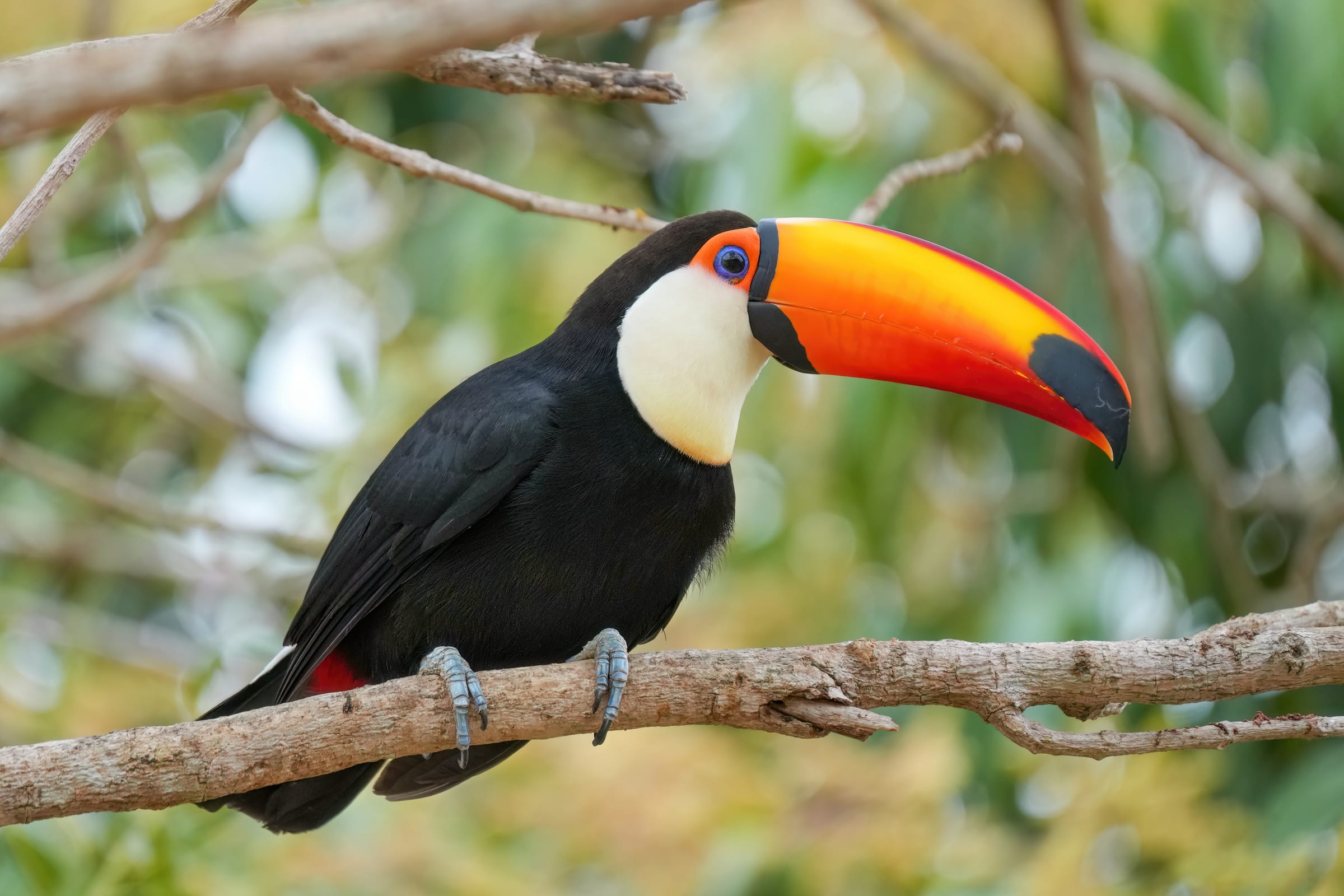
The toco toucan (Ramphastos toco) is a species of bird in the toucan family Ramphastidae. It is the largest species of toucan and has a distinctive appearance, with a black body, a white throat, chest and uppertail-coverts, and red undertail-coverts. Its most conspicuous feature is its huge beak, which is yellow-orange with a black base and a large spot on the tip. It is endemic to South America, where it has a wide distribution from the Guianas south to northern Argentina and Uruguay, and its range has recently been expanding southwards. Unlike other toucans, which inhabit continuous forests, toco toucans inhabit a variety of semi-open habitats at altitudes of up to 1,750 m (5,740 ft). They are especially common in the Brazilian cerrado, gallery forests, and the wetlands of the Pantanal.
Toco toucans mainly feed on fleshy fruits, but also supplement their diets with insects, eggs, and the nestlings of other birds. They will eat any available sugar-rich fruits, and show a high level of variation in their diet depending on the surrounding habitat. Breeding is seasonal, with the timing of the breeding season differing between regions. Nests are usually made in hollows in trees and contain two to four eggs; both parents incubate the eggs for 17–18 days before hatching. It is considered to be of Least Concern by BirdLife International.
Carries a giant beak that doubles as its air conditioner.
Description
Toco toucans are the largest species of toucan, with an average length of 56 cm (22 in). They cannot be mistaken for any other birds and are easily recognized by their large orange beaks. The body is mainly glossy black, with a white throat and upper throat. This white patch will sometimes have a citrine yellow tint and a red band where it meets the black breast, but these features are highly variable between individuals. The rump is white, while the underside of the tail, including the crissum, is red. The eye is brown (although it has also been reported as being varying shades of yellow, green, and blue), and is surrounded by a narrow blue ring, with the rest of the orbital skin being sulfur yellow to orange. A small patch of feathers near the lores is white and the orbital skin below the eye is sometimes greenish-yellow.
The extremely long and thin bill is usually reddest along the top of the culmen and has irregular orangish-brown bands on its sides, across the tomia. The beak varies in length from 173 to 215 mm (6.8 to 8.5 in) in male toucans and 158 to 202 mm (6.2 to 8.0 in) in females; on average, it is 200.5 mm (7.89 in) long in males and 178.6 mm (7.03 in) long in females. The base of the beak is black, forming a band thickest at the bottom of the mandible. The tip of the maxilla has a large black oval, which shines intensely when seen in light.
Distribution and habitat
The toco toucan is endemic to South America, where it has a wide distribution from the Guianas south to northern Argentina and Uruguay. In the northern portion of its range, it has several disjunct populations, including in the Guianas, in northern Brazil near the Rio Branco, and along the mouth of the Amazon upstream to around Manaus in eastern Amazonas. It is further found from coastal Maranhão southwest to southwestern Brazil, Bolivia, and Pampas de Heath in far southeastern Peru, and south through Piauí and Bahia to northern Argentina and Uruguay. It was previously thought to have gone extinct in Tucumán in northwestern Argentina by the late 1990s, but was rediscovered there in the early 2010s. The species's range in the Amazon rainforest may be increasing due to deforestation. Similarly, it has only been recorded from Uruguay recently; previously, the southward limit of its range was Lagoa dos Patos in Brazil. The recent expansion its range south of the 30th parallel may be caused by escapes of captive individuals or changes in ecological conditions. Toco toucans are generally resident, but will sometimes move en masse in search of food.
Behavior and ecology
Toco toucans are typically seen when flying or feeding in treetops, hopping from branch to branch. Their flight is somewhat undulating because they switch between heavy flapping and gliding when flying. Toco toucans, like other toucans, have large home ranges, with an average size of 86 ha (210 acres). They are more widely dispersed than other toucans, who do not cross large bodies of water, and are able to sustain flight across water bodies over 5 km (3.1 mi) wide.
Toco toucans are less active during the day, occasionally resting in treetops. They are less gregarious than other toucans and usually feed alone or in small groups at fruiting trees. When foraging together, toucans fly from treetop to treetop in single file. Members of a group will often preen each other, although this behaviour usually ends after egg-laying occurs, as mates begin to exclusively preen each other. After the end of the breeding season, toco toucans will sometimes form large flocks that fly around forests searching for fruit. These flocks may sometimes include other species like the white-throated toucan.
Relationship with humans
Because it prefers open habitats, the toco toucan is likely to benefit from the widespread deforestation in tropical South America; it is known to inhabit areas around airports and newly-made roads. It has a large range and except in the outer regions of its range, it is typically fairly common. It is therefore considered to be of Least Concern by BirdLife International. Toco toucans are hunted for their meat and for the pet trade; the large flocks it forms after the breeding season were previously known to be hunted heavily for meat, with their bills being kept as a souvenir. The impact of hunting on the population is unknown. A 2023 study of the wildlife trade in toucans found that toco toucans were the second most commonly traded species over a period from 1975 to 2018. They were exported from a greater range of Latin American countries than other toucans and were the most expensive, with an average retail price of US$12,450 in 2020 (equivalent to $15,490 in 2025) and some specimens fetching up to $13,400 (equivalent to $16,700 in 2025).