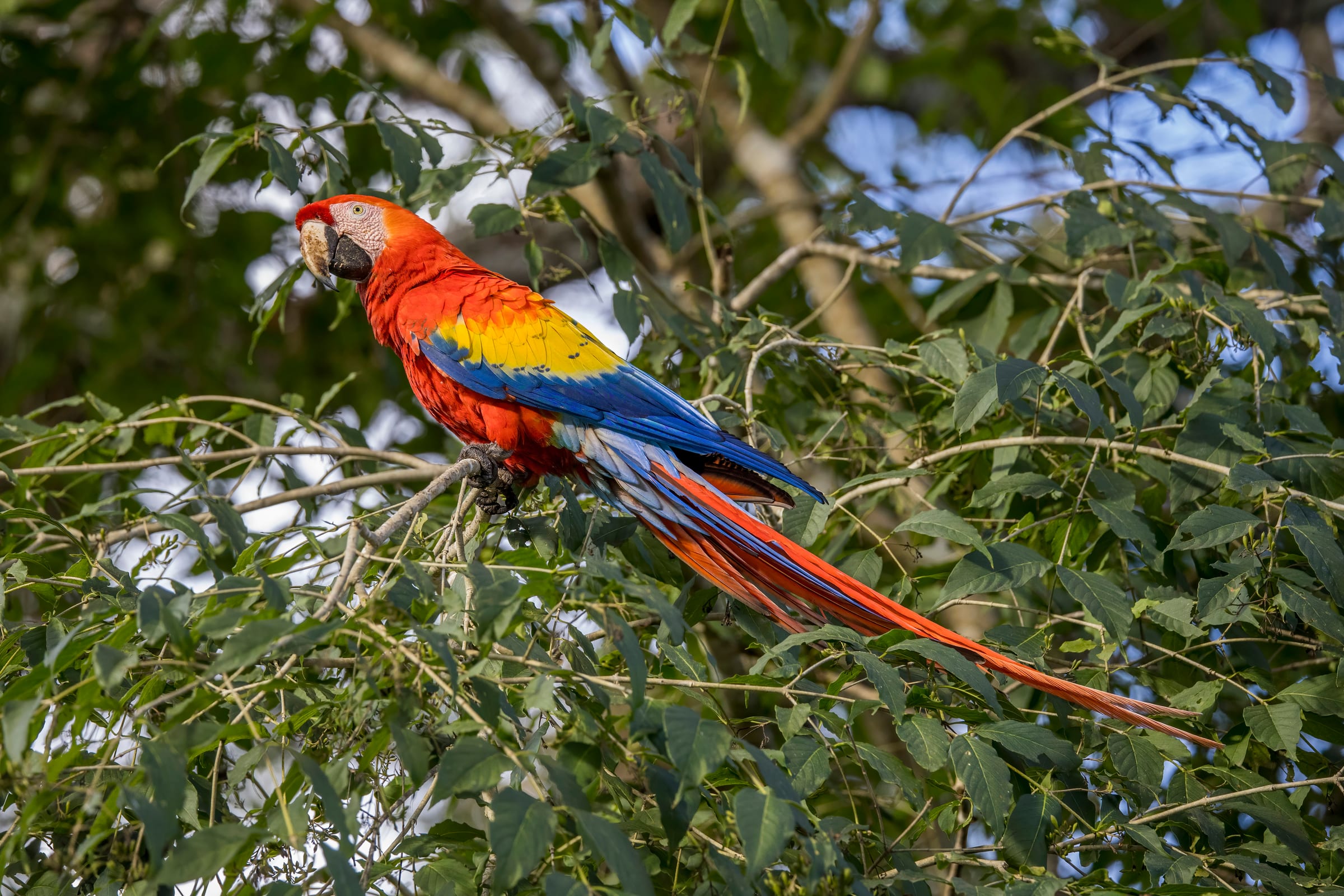
The scarlet macaw (Ara macao) also called the red-and-yellow macaw, red-and-blue macaw or red-breasted macaw, is a large yellow, green, red and blue Neotropical parrot native to humid evergreen forests of the Americas. Its range extends from southeastern Mexico to Peru, Ecuador, Colombia, Bolivia, Venezuela, Honduras, and Brazil in lowlands of 500 m (1,600 ft) (at least formerly) up to 1,000 m (3,300 ft), the Caribbean island of Trinidad, as well as the Pacific island of Coiba. Formerly, the northern extent of its range included southern Tamaulipas. In some areas, it has suffered local extinction because of habitat destruction, or capture for the parrot trade, but in other areas, it remains fairly common. It is the national bird of Honduras. Like its relative the blue-and-yellow macaw, the scarlet macaw is a popular bird in aviculture as a result of its striking plumage. It is the third most common macaw species in captivity after the blue-and-yellow and red-and-green macaw respectively. In recent years it has become much rarer in captivity and much more expensive due to stricter laws, its price being higher than even red-and-green macaws.
A flying rainbow with a beak that cracks Brazil nuts.
Description
It is about 84 centimeters (33 in) long, of which more than half is the pointed, graduated tail typical of all macaws, though the scarlet macaw has a larger percentage of tail than the other large macaws. The average weight is about 1 kilogram (2 lb 3 oz). The plumage is mostly scarlet, but the rump and tail-covert feathers are light blue, the greater upper wing coverts are yellow, the upper sides of the flight feathers of the wings are dark blue as are the ends of the tail feathers, and the undersides of the wing and tail flight feathers are dark red with metallic gold iridescence. Some individuals may have green in the wings. The Central American subspecies is larger and averages 89 cm or (35 in) in length.
There is bare white skin around the eye and from there to the bill. Tiny white feathers are contained on the face patch. The upper mandible is mostly pale horn in color and the lower is black. Juveniles have dark eyes; adults have light yellow eyes.
It is frequently confused with the slightly larger green-winged macaw, which has more distinct red lines in the face and no yellow in the wing.
Distribution and habitat
The scarlet macaw inhabits primarily humid, lowland subtropical rain forests, open woodlands, river edges, and savannas. In some regions, they are known to periodically visit natural mineral deposits (or 'licks'), typically in areas rich in clay and sediment, which the macaws will eat for digestive purposes and to glean vital nutrients, including sodium and calcium. The species' South American range is extensive, spanning much of the Amazon basin and [[Amazon rainforest|rainforest]] of the northern half of the continent, extending as far south as Peru (east of the Andes) and Bolivia. In Bolivia, it is quite common in the Aquicuana Reserve, in the northeastern Beni Department (near the city of Riberalta, the capital of the Bolivian Amazon region).
In (southern) North and Central America, the species' range extends from the Yucatán Peninsula (extreme southeastern Mexico and Belize) and southward through Guatemala, El Salvador, Honduras and Nicaragua, as well as the island of Coiba. It is seen infrequently on the mainland of Panamá, but is known in Costa Rica from isolated regions on the Pacific coast, mainly near the Nicoya Peninsula, Carara National Park and Peninsula de Osa.
Behavior
A typical sighting is of a single bird or a pair flying above the forest canopy, though in some areas flocks can be seen. Field observations in Costa Rica found that scarlet macaws spend nearly all their time high in the forest canopy, usually more than 10 m above the ground, and are rarely seen near or on the ground, likely to reduce predation risk and because most of their food sources occur in the canopy. They often gather at clay licks. Scarlet macaws communicate primarily through raucous honks; however, vocal communication is highly variable, and captive macaws are known to be adept mimics of human speech.
Wild scarlet macaws feed on fruits, nuts, seeds, flowers and nectar.
As with smaller parrot species, there are reports of their consumption of insects, larvae, and snails; however, this seems to be rare for macaws and is not a major component of their diet. Seeds of Cnidoscolus and Schizolobium are thought to be the main sources of protein for nestling scarlet macaws.
Predation
Young may be taken in the nest by arboreal predators such as snakes, monkeys and other small carnivores. Adults and fledglings may also be taken by large cats, such as jaguars, and by eagles and hawks.
Conservation status
The habitat of scarlet macaws is also considered to have the greatest latitudinal range for any bird in the genus Ara, as the estimated maximum territorial range covers 6,700,000 km2. Nevertheless, the scarlet macaw's habitat is fragmented, and the bird is mostly confined to tiny populations scattered throughout its original range in Middle America. However, as they still occur in large numbers over most of their original range in South America, the species is classified by IUCN as least concern. Its wild population is currently estimated to be between 50,000 and 499,999 individuals.
Commercial international trade in the species (including parts and derivatives) is prohibited by the bird's listing under CITES Appendix 1 due to poaching for the pet trade.
The northern subspecies, A. m. cyanopterus, is listed as endangered by the USFWS. The USFWS estimates that only 2,000–3,000 birds of the northern subspecies remain in the wild.