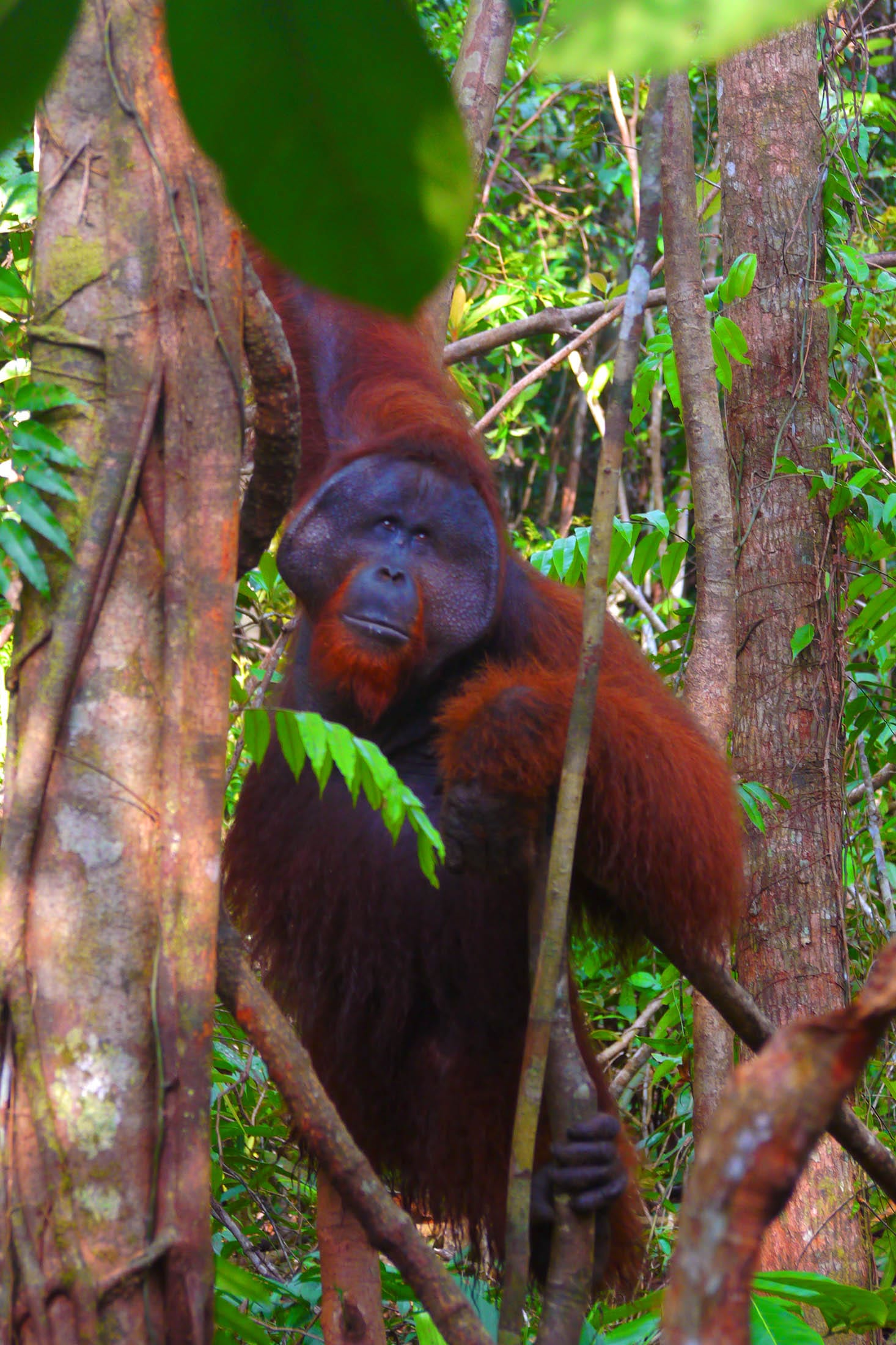
The Bornean orangutan (Pongo pygmaeus) is an orangutan species endemic to the island of Borneo. It belongs to the only genus of great apes native to Asia and is the largest of the three Pongo species. It has a coarse, reddish coat and up to 1.5 m (4 ft 11 in) long arms. It is sexually dimorphic — males are larger than females and develop large cheek pads (flanges).
The Bornean orangutan inhabits Borneo lowland rain forests and Borneo montane rain forests up to an elevation of 1,500 m (4,900 ft). Its diet includes fruits, seeds, flowers, bird eggs, sap and vines. It is highly intelligent, displaying tool use and distinct cultural patterns. It is listed as Critically Endangered, with deforestation, palm oil plantations, and hunting posing a serious threat to its survival.
Builds a new nest in the canopy every single night.
Description
The Bornean orangutan is the third-largest ape after the western gorilla, and the largest truly arboreal (or tree-dwelling) extant ape. Body weights broadly overlap with the considerably taller Homo sapiens, but the latter is considerably more variable in size. By comparison, the Sumatran orangutan is similar in size but, on average, is marginally lighter in weight. A survey of wild orangutans found that males weigh on average 75 kg (165 lb), ranging from 50 to 100 kg (110 to 220 lb), and 1.2–1.7 m (3 ft 11 in – 5 ft 7 in) long; females average 38.5 kg (85 lb), ranging from 30 to 50 kg (66 to 110 lb), and 1–1.2 m (3 ft 3 in – 3 ft 11 in) long. While in captivity, orangutans can grow considerably overweight, up to more than 165 kg (364 lb). The heaviest known male orangutan in captivity was an obese male named "Andy", who weighed 204 kg (450 lb) in 1959 when he was 13 years old.
The Bornean orangutan has a distinctive body shape with very long arms that may reach up to 1.5 metres in length. It has grey skin, a coarse, shaggy, reddish coat and prehensile, grasping hands and feet. Its coat does not cover its face unlike most mammals, although Bornean orangutans do have some hair on their faces including a beard and mustache. It also has large, fatty cheek pads known as flanges as well as a pendulous throat sac.
Distribution and habitat
The Bornean orangutan lives in tropical rain forests in the Bornean lowlands, as well as montane rain forests in mountainous areas up to 1,500 m (4,900 ft). This species lives throughout the canopy of primary and secondary forest, and moves large distances to find trees bearing fruit.
It is found in the two Malaysian states of Sabah and Sarawak, and four of the five Indonesian Provinces of Kalimantan. Due to habitat destruction, the species distribution is now highly patchy throughout the island, the species has become rare in the southeast of the island, as well as in the forest between the Rajang River in central Sarawak and the Padas River in western Sabah. Its presence in Brunei is uncertain and unconfirmed.
The first complete orangutan skeleton that was discovered was in the Hoa Binh province in Vietnam and thought to be from the late Pleistocene epoch. It differed from modern orangutans only in that its body was proportionately smaller compared to its head. This fossil and others confirm that orangutans once inhabited continental Southeast Asia even though currently, Bornean orangutans are only found in Malaysia and Indonesia.
Behavior and ecology
In history, orangutans ranged throughout Southeast Asia and into southern China, as well as on the island of Java and in southern Sumatra. They primarily inhabit peat swamp forest, tropical heath forest, and mixed dipterocarp forest.
Bornean orangutan are more solitary than their Sumatran relatives. Two or three orangutans with overlapping territories may interact, but only for short periods of time. Although orangutans are not territorial, adult males will display threatening behaviors upon meeting other males, and only socialize with females to mate. Males are considered the most solitary of the orangutans. The Bornean orangutan has a lifespan of 35–45 years in the wild; in captivity it can live to be about 60.
Despite being arboreal, the Bornean orangutan travels on the ground more than its Sumatran counterpart. This may be in part because no large terrestrial predators could threaten an orangutan in Borneo. In Sumatra, orangutans must face predation by the fierce Sumatran tiger.
Conservation status
The Bornean orangutan is more common than the Sumatran, with about 104,700 individuals in the wild, whereas just under 14,000 Sumatran orangutans are left in the wild. Orangutans are becoming increasingly endangered due to habitat destruction and the bushmeat trade, and young orangutans are captured to be sold as pets, usually entailing the killing of their mothers.
The Bornean orangutan is critically endangered according to the IUCN Red List of mammals, and is listed on Appendix I of CITES. The total number of Bornean orangutans is estimated to be less than 14% of what it was in the recent past (from around 10,000 years ago until the middle of the 20th century), and this sharp decline has occurred mostly over the past few decades due to human activities and development. Species distribution is now highly patchy throughout Borneo; it is apparently absent or uncommon in the southeast of the island, as well as in the forest between the Rajang River in central Sarawak and the Padas River in western Sabah (including the Sultanate of Brunei). A population of around 6,900 is found in Sabangau National Park, but this environment is at risk.
Genome and demographic history
Orangutans and humans diverged lineages approximately 14–18 million years ago. About 17,000 years ago, there was a migration of the Bornean orangutans as they eventually went to Sumatra, effectively trading places with the Sumatra orangutans that were there at the time. These two species of orangutans have been closely related throughout their evolutionary history because they were so close in physical proximity. Therefore, their genomes and demographic history are similar. The two species themselves are estimated to have split about 3.5 million years ago. Although these two species have officially diverged, it is speculated that the reason as to why they are genetically similar is because the males of each respective species tend to migrate between the two islands and breed with the females from their sister species. As a result, both the Bornean orangutans and the Sumatran orangutans have been studied closely as a pair, and thus much genome findings attribute evolutionary changes to this relationship. In addition, the Bornean orangutans, as compared to the Sumatran orangutans, have lower autosomal gene diversity. This is attributed to the fact that they have a much smaller population size. Also, the Bornean orangutans have lower nucleotide diversity.