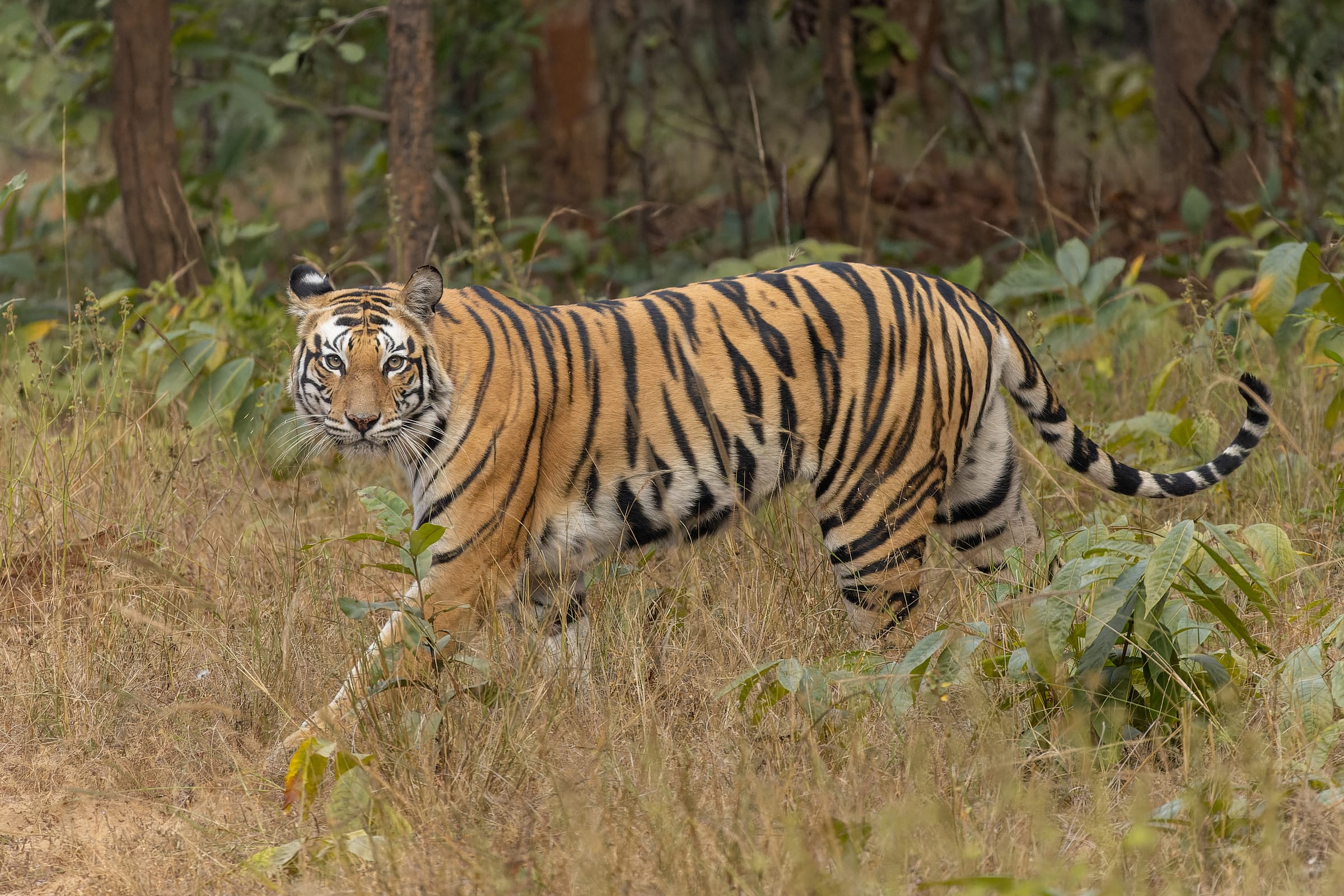
The Bengal tiger is a population of the Panthera tigris tigris subspecies. It ranks among the largest of wild cats. It is distributed from India, southern Nepal, Bangladesh, Bhutan to Southwestern China. Its historical range extended to the Indus Basin until the early 19th century, and it is thought to have been present in the Indian subcontinent since the Late Pleistocene about 12,000 to 16,500 years ago. It is threatened by poaching, habitat loss and habitat fragmentation.
As of 2022, the Bengal tiger population was estimated at 3,167–3,682 individuals in India, 316–355 individuals in Nepal, 131 individuals in Bhutan and around 125 individuals in Bangladesh. It is the national animal of India and Bangladesh.
A striped ghost moving silently through the mangrove dawn.
Distribution and habitat
The Bengal tiger's historical range covered the Indus River valley until the early 19th century, almost all of India, eastern Pakistan, southern Nepal, Bangladesh, Bhutan, and southwestern China. The modern tiger inhabits India, Bangladesh, Nepal, Bhutan, and southwestern China.
It is estimated to have been present in the Indian subcontinent since the Late Pleistocene, for about 12,000 to 16,500 years.
In 1982, a sub-fossil right middle phalanx was found in a prehistoric midden near Kuruwita in Sri Lanka, which is dated to about 16,500 years ago and tentatively considered to be of a tiger. Tigers appear to have arrived in Sri Lanka during a pluvial period, during which sea levels were depressed, evidently prior to the last glacial maximum about 20,000 years ago. The tiger probably arrived too late in southern India to colonise Sri Lanka, which earlier had been connected to India by a land bridge.
Ecology and behaviour
The basic social unit of the tiger is composed of a female and her offspring. Adult animals congregate only temporarily when special conditions permit, such as plentiful supplies of food. Otherwise, they lead solitary lives, hunting individually for the forest and grassland animals upon which they prey. Resident adults of either sex maintain home ranges, confining their movements to definite habitats within which they satisfy their needs and those of their cubs, which include prey, water and shelter. In this site, they also maintain contact with other tigers, especially those of the opposite sex. Those sharing the same ground are well aware of each other's movements and activities. In Chitwan National Park, radio-collared subadult tigers started dispersing from their natal areas earliest at the age of 19 months. Of the 14 subadults studied, the four females stayed closer to their mother's home range than the 10 males. The latter dispersed between 9.5 and 65.7 km (5.9 and 40.8 mi). None of them crossed open cultivated areas that were more than 10 km (6.2 mi) wide, but moved through prime alluvial and forested habitat.
Threats
None of the Tiger Conservation Landscapes within the Bengal tiger range is large enough to support an effective population size of 250 individuals. Habitat losses and the extremely large-scale incidences of poaching are serious threats to the species' survival.
The Forest Rights Act passed by the Indian government in 2006 grants some of India's most impoverished communities the right to own and live in the forests, which likely brings them into conflict with wildlife and under-resourced, under-trained, ill-equipped forest department staff. In the past, evidence showed that humans and tigers cannot co-exist.
Conservation efforts
An area of special interest lies in the "Terai Arc Landscape" in the Himalayan foothills of northern India and southern Nepal, where 11 protected areas composed of dry forest foothills and tall-grass savannas harbour tigers in a 49,000 square kilometres (19,000 mi2) landscape. The goals are to manage tigers as a single metapopulation, the dispersal of which between core refuges can help maintain genetic, demographic, and ecological integrity, and to ensure that species and habitat conservation becomes mainstreamed into the rural development agenda. In Nepal a community-based tourism model has been developed with a strong emphasis on sharing benefits with local people and on the regeneration of degraded forests. The approach has been successful in reducing poaching, restoring habitats, and creating a local constituency for conservation.
The WWF partnered with Leonardo DiCaprio to form a global campaign, "Save Tigers Now", with the ambitious goal of building political, financial and public support to double the wild tiger population by 2022. Save Tigers Now started its campaign in 12 different WWF Tiger priority landscapes, since May 2010.
This population of tigers has been assessed at the local level in several countries. It is listed as Endangered in Nepal, India, and Bhutan, While Bangladesh and China list it as Critically Endangered.
Characteristics
The Bengal tiger's coat is yellow to light orange, with stripes ranging from dark brown to black; the belly and the interior parts of the limbs are white, and the tail is orange with black rings. The white tiger is a recessive mutant, which is reported in the wild from time to time in Assam, Bengal, Bihar and especially in the former State of Rewa. However, it is not an occurrence of albinism. In fact, only one fully authenticated case of a true albino tiger is known, and there are no confirmed cases of black tigers, except for a possible specimen examined in Chittagong in 1846. Fourteen Bengal tiger skins in the collection of the Natural History Museum, London have 21–29 stripes.
Another recessive mutant is the golden tiger that has a pale golden fur with red-brown stripes. The mutants are very rare in nature.
The greatest skull length of a tiger is 351 mm (13.8 in) in males and 293 mm (11.5 in) in females. It has exceptionally stout teeth. Its canines are 7.5 to 10 cm (3.0 to 3.9 in) long and thus the longest among all cats.