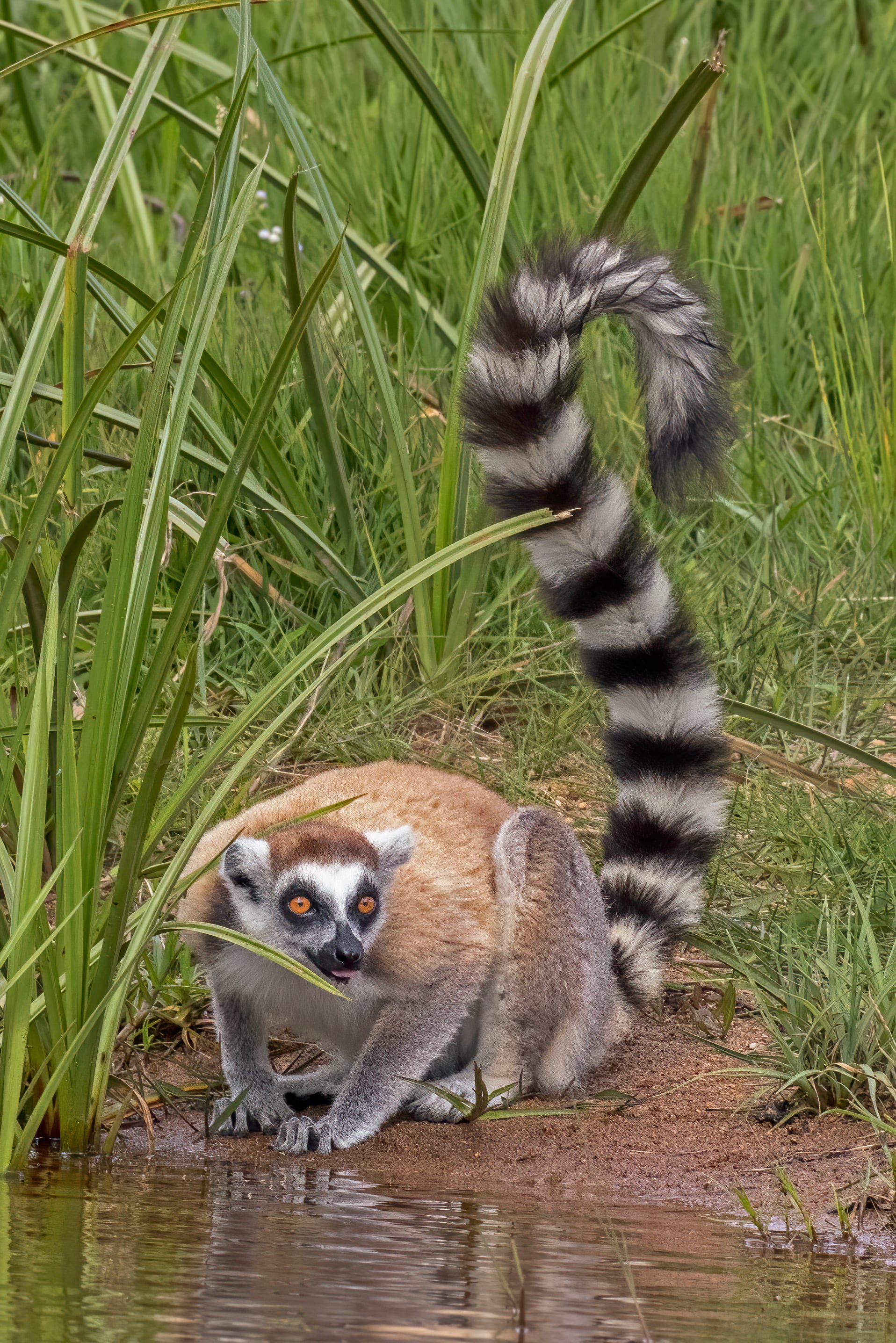
The ring-tailed lemur (Lemur catta) is a medium- to larger-sized strepsirrhine (wet-nosed) primate and the most internationally recognized lemur species, owing to its long, black-and-white, ringed tail. It belongs to Lemuridae, one of five lemur families, and is the only member of the Lemur genus. Like all lemurs, it is endemic to the island of Madagascar, where it is endangered. Known locally in Malagasy as maky ([makʲ] , spelled maki in French) or hira, it ranges from gallery forests to spiny scrub in the southern regions of the island. It is omnivorous, as well as the most adapted to living terrestrially of the extant lemurs.
The ring-tailed lemur is highly social, living in groups—known as "troops"—of up to 30 individuals. It is also a female-dominant species, a commonality among lemurs. To keep warm and reaffirm social bonds, groups will huddle together. Mutual grooming is another vital aspect of lemur socialization (as with all primates), reaffirming social and familial connections, while also helping rid each other of any potential insects. Ring-tailed lemurs are strictly diurnal, being active exclusively during daylight hours. Due to this lifestyle, they also sunbathe; the lemurs can be observed sitting upright on their tails, exposing their soft, white belly fur towards the sun. They will often also have their palms open and eyes gently closed. Like other lemurs, this species relies strongly on their sense of smell, and territorial marking, with scent glands, provides communication signals throughout a group's home range. The glands are located near the eyes, as well as near the anus. The males perform a unique scent-marking behavior called spur-marking and will participate in stink fights by dousing their tails with their pheromones and "wafting" them at opponents. Additionally, lemurs of both sexes will scent-mark trees, logs, rocks or other objects by simply rubbing their faces and bodies onto it, not unlike a domestic cat.
Sunbathes in lotus pose and rules a strictly female court.
Anatomy and physiology
The ring-tailed lemur is a relatively large lemur. Its average weight is 2.2 kilograms (4.9 lb). Its head–body length ranges between 39 and 46 cm (15 and 18 in), its tail length is 56 and 63 cm (22 and 25 in), and its total length is 95 and 110 cm (37 and 43 in). Other measurements include a hind foot length of 102 and 113 mm (4.0 and 4.4 in), ear length of 40 and 48 mm (1.6 and 1.9 in), and cranium length of 78 and 88 mm (3.1 and 3.5 in).
The species has a slender frame and narrow face, fox-like muzzle. The ring-tailed lemur's trademark—a long, bushy tail—is ringed in alternating black and white transverse bands, numbering 12 or 13 white rings and 13 or 14 black rings and always ending in a black tip. The total number of rings nearly matches the approximate number of caudal vertebrae (~25). Its tail is longer than its body and is not prehensile. Instead, it is only used for balance, communication, and group cohesion.
Ecology
The ring-tailed lemur is diurnal and semi-terrestrial. It is the most terrestrial of lemur species, spending as much as 33% of its time on the ground. However it is still considerably arboreal, spending 23% of its time in the mid-level canopy, 25% in the upper-level canopy, 6% in the emergent layer and 13% in small bushes. Troop travel is 70% terrestrial.
Troop size, home range, and population density vary by region and food availability. Troops typically range in size from 6 to 25, although troops with over 30 individuals have been recorded. The average troop contains 13 to 15 individuals. Home range size varies between 6 and 35 hectares (15 and 86 acres). Troops of the ring-tailed lemur will maintain a territory, but overlap is often high. When encounters occur, they are agonistic, or hostile in nature. A troop will usually occupy the same part of its range for three or four days before moving. When it does move, the average traveling distance is 1 km (0.62 mi). Population density ranges from 100 individuals per 1 km2 (0.39 sq mi) in dry forests to 250–600 individuals per km2 in gallery and secondary forests.
Behavior
Ring-tailed lemurs live in groups known as "troops," which are classified as multi-male groups, with a matriline as the core group. As with most lemurs, females socially dominate males in all circumstances, including feeding priority. Dominance is enforced by lunging, chasing, cuffing, grabbing and biting. Young females do not always inherit their mother's rank and young males leave the troop between three and five years of age. Both sexes have separate dominance hierarchies; females have a distinct hierarchy while male rank is correlated with age. Each troop has one to three central, high-ranking adult males who interact with females more than other group males and lead the troop procession with high-ranking females. Recently transferred males, old males or young adult males that have not yet left their natal group are often lower ranking. Staying at the periphery of the group they tend to be marginalized from group activity.
For males, social structure changes can be seasonal. During the six-month period between December and May a few males migrate between groups. Established males transfer on average every 3.5 years, although young males may transfer approximately every 1.4 years. Group fission occurs when groups get too large and resources become scarce.
Conservation status
In addition to being listed as endangered in 2014 by the IUCN, the ring-tailed lemur has been listed since 1977 by CITES under Appendix I, which makes trade of wild-caught specimens illegal. Although there are more endangered species of lemur, the ring-tailed lemur is considered a flagship species due to its recognizability. As of 2017, only about 2,000 ring-tailed lemurs are estimated to be left in the wild, making the threat of extinction far more serious for them than previously believed.