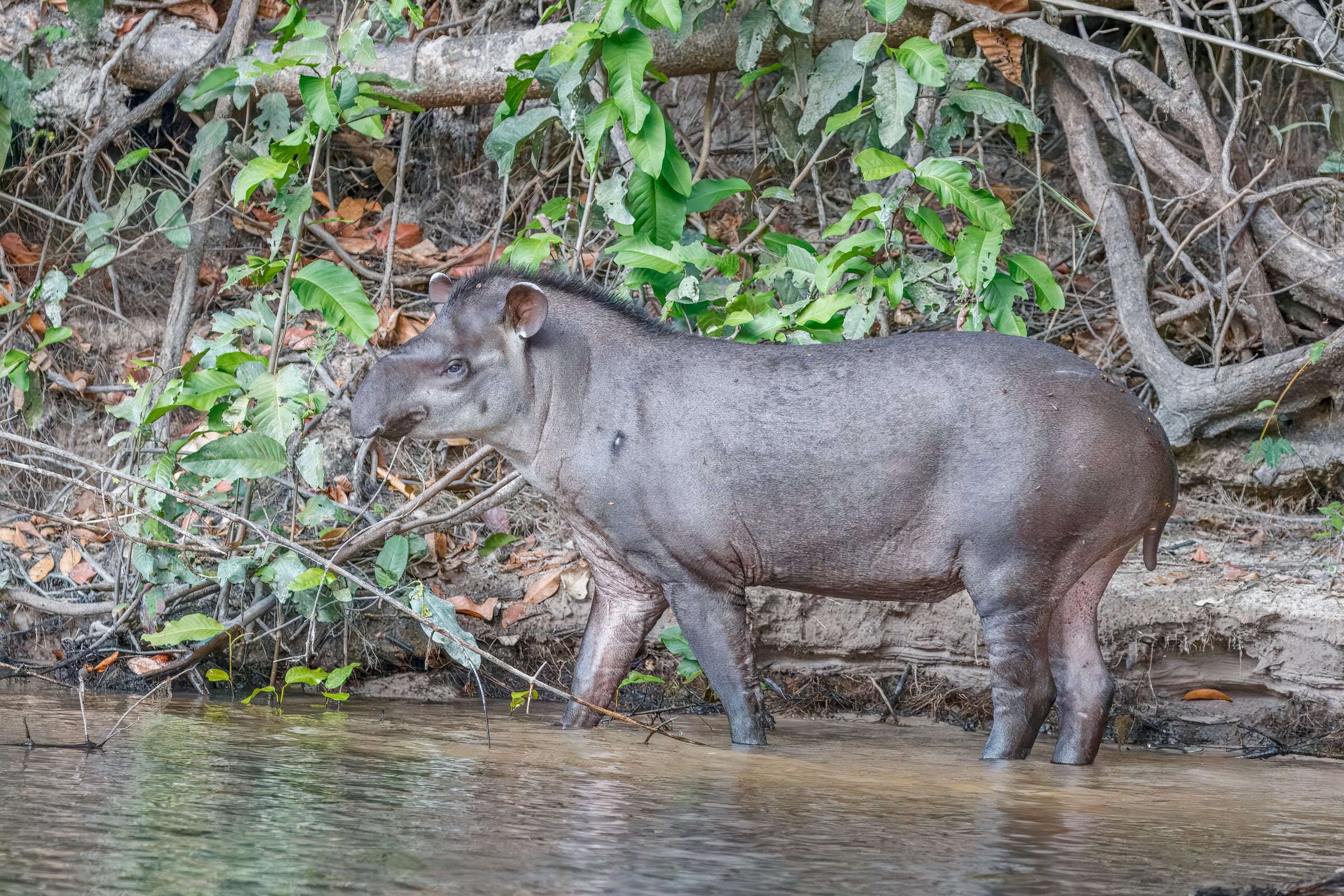
The South American tapir (Tapirus terrestris), also commonly called the Brazilian tapir (from the Tupi tapi'ira), the Amazonian tapir, the maned tapir, the lowland tapir, anta (Brazilian Portuguese), and la sachavaca (literally "bushcow", in mixed Quechua and Spanish), is one of the four recognized species in the tapir family (of the order Perissodactyla, with the mountain tapir, the Malayan tapir, and the Baird's tapir). It is the largest surviving native terrestrial mammal in the Amazon.
Most classifications also include Tapirus kabomani (also known as the dwarf black tapir or the kabomani tapir) as also belonging to the species Tapirus terrestris (Brazilian tapir), despite its questionable existence and the overall lack of information on its habits and distribution. The specific epithet derives from arabo kabomani, the word for tapir in the local Paumarí language. The formal description of this tapir did not suggest a common name for the species. The Karitiana people call it the little black tapir. It is, purportedly, the smallest tapir species, even smaller than the mountain tapir (T. pinchaque), which had been considered the smallest. T. kabomani is allegedly also found in the Amazon rainforest, where it appears to be sympatric with the well-known South American tapir (T. terrestris). When it was described in December of 2013, T. kabomani was the first odd-toed ungulate discovered in over 100 years. However, T. kabomani has not been officially recognized by the Tapir Specialist Group as a distinct species; recent genetic evidence further suggests it is likely a subspecies of T. terrestris. In 2024, the International Commission on Zoological Nomenclature (ICZN) has officially ruled that the binomen Tapirus pygmaeus has priority over Tapirus kabomani given that they are synonyms after a 2014 petition.
A prehistoric snorkel-nosed gardener seeding the rainforest floor.
Appearance
T. terrestris is dark brown, paler in the face, and has a low, erect crest running from the crown down the back of the neck. The round, dark ears have distinctive white edges. Newborn tapirs have a dark brown coat, with small white spots and stripes along the body. The South American tapir can attain a body length of 1.8 to 2.5 m (5 ft 11 in to 8 ft 2 in) with a 5 to 10 cm (2.0 to 3.9 in) short stubby tail and an average weight around 225 kg (496 lb). Adult weight has been reported ranging from 150 to 320 kg (330 to 710 lb). It stands somewhere between 77 and 108 cm (30 and 43 in) at the shoulder.
With an estimated mass of only 110 kg (240 lb), T. kabomani is the smallest living tapir. For comparison, the mountain tapir has a mass between 136 and 250 kg (300 and 551 lb). Tapirus kabomani is roughly 130 cm (51 in) long and 90 cm (35 in) in shoulder height.
It has a distinct phenotype from other members of the species. It can be differentiated by its coloration: it is a range of darker grey to brown than other T. terrestris strains. This species also features relatively short legs for a tapir caused by a femur length that is shorter than dentary length. The crest is smaller and less prominent. T. kabomani also seems to exhibit some level of sexual dimorphism as females tend to be larger than males and possess a characteristic patch of light hair on their throats. The patch extends from the chin up to the ear and down to the base of the neck.
Geographic range
The South American tapir can be found near water in the Amazon rainforest and River Basin in South America, east of the Andes. Its geographic range stretches from Venezuela, Colombia, and the Guianas in the north to Brazil, Argentina, and Paraguay in the south, to Bolivia, Peru, and Ecuador in the west. On rare occasions, waifs have crossed the narrow sea channel from Venezuela to the southern coast of the island of Trinidad (but no breeding population exists there).
Tapirus kabomani is restricted to South America. It is found in habitats consisting of a mosaic of forest and savannah. It has been collected in southern Amazonas (the type locality), Rondônia, and Mato Grosso states in Brazil. The species is also believed to be present in Amazonas department in Colombia, and it may be present in Amapá, Brazil, in north Bolivia and in southern French Guiana.
In 2024, the South American tapir was observed in the state of Rio de Janeiro for the first time since 1914. According to Marcelo Cupello, a scientist from Rio de Jaineiro's State Environmental Institution, the return of the species indicates that the state's forests are once again capable of sustaining populations of large mammals.
Diet
The South American tapir is an herbivore. Using its mobile nose, it feeds on leaves, buds, shoots, and small branches it tears from trees, fruit, grasses, and aquatic plants. They also feed on the vast majority of seeds found in the rainforest. This is known because the diet is studied through observation of browsing, analysis of feces, and studying stomach contents. Analysis of δ13C values of fossils of the South American tapir from Lapa do Bode cave in Ituaçu Municipality of the State of Bahia shows that their diet was predominantly composed of C3 plants.
Although it has been determined via fecal samples that T. kabomani feeds on palm tree leaves and seeds from the genera Attalea and Astrocaryum, much about the diet and ecology of T. kabomani is unknown. Previously discovered tapirs are known to be important seed dispersers and to play key roles in the rainforest or mountain ecosystems in which they occur. It is possible that T. kabomani shares this role with the other members of its genus although further research is required.
Behavior
T. terrestris is an excellent swimmer and diver, but also moves quickly on land, even over rugged, mountainous terrain. It has a life span of approximately 25 to 30 years. In the wild, its main predators are crocodilians (only the black caiman and Orinoco crocodile, the latter of which is critically endangered, are large enough to take these tapirs, as the American crocodile only exists in the northern part of South America) and large cats, such as the jaguar and cougar, which often attack tapirs at night when tapirs leave the water and sleep on the riverbank. The South American tapir is also attacked by the green anaconda (Eunectes murinus).
Although they may flee into the bush or into water when threatened, lowland tapirs are capable of defending themselves with their very powerful bite; in 2005, a 55 year old farmer stabbed a 400 lb female lowland tapir that was feeding in his cornfield, which responded by repeatedly biting the man. Both died from their wounds.
There is a need for more research to better explore social interactions.
Mating
T. terrestris mates in April, May, or June, reaching sexual maturity in the third year of life. Females go through a gestation period of 13 months (390–395 days) and will typically have one offspring every two years. A newborn South American tapir weighs about 15 pounds (6.8 kilos) and will be weaned in about six months.