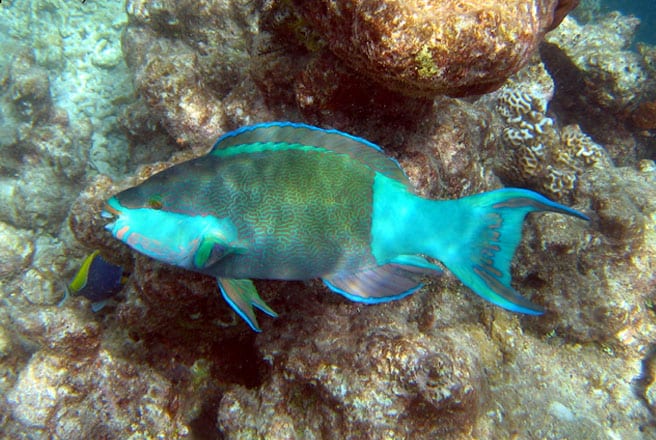
Parrotfish (named because their mouths resemble a parrot's beak) are a clade of fish placed in the subfamily Scarinae of the wrasse family (Labridae). Historically considered as the family Scaridae, genetic studies found them to be deeply nested within the wrasses, and they are now treated as a subfamily. With roughly 95 species, the group's largest species richness is in the Indo-Pacific. They are herbivores or corallivores inhabiting coral reefs, rocky coasts, and seagrass beds, and can play a significant role in bioerosion as some species eat away at the corals. This activity is also often attributed to enriching the sand content on the surrounding ocean floor.
Grinds coral into the white sand of every tropical beach.
Description
Parrotfish are named for their dentition, which is distinct from other fish, including other labrids; their numerous teeth are arranged in a tightly packed mosaic on the external surface of their jaw bones, forming a parrot-like beak with which they rasp algae from coral and other rocky substrates (which contributes to the process of bioerosion).
Maximum sizes vary within the group, with the majority of species reaching 30–50 cm (12–20 in) in length. However, a few species reach lengths in excess of 1 m (3 ft 3 in), with the green humphead parrotfish can reach up to 1.3 m (4 ft 3 in) TL (though is commonly 0.7 m (2 ft 4 in) SL). The smallest species is the bluelip parrotfish (Cryptotomus roseus), which has a maximum size of 13 cm (5.1 in).
Some parrotfish species, such as the queen parrotfish (Scarus vetula), secrete a mucus cocoon, particularly at night; prior to resting, some species extrude mucus from their mouths, forming a protective cocoon that envelops the fish, presumably hiding its scent from potential predators. This mucus envelope may also act as an early warning system, allowing the parrotfish to flee when it detects predators such as moray eels disturbing the membrane.
Biology
Most parrotfish species are herbivores, feeding mainly on epilithic algae. A wide range of other small organisms are sometimes eaten, including invertebrates (sessile and benthic species, as well as zooplankton), bacteria and detritus. A few mostly larger species such as the green humphead parrotfish (Bolbometopon muricatum) feed extensively on living coral (polyps). None of these are exclusive corallivores, but polyps can make up as much as half their diet or even more in the green humphead parrotfish. Overall it has been estimated that fewer than one percent of parrotfish bites involve live corals and all except the green humphead parrotfish prefer algae-covered surfaces over live corals. Nevertheless, when they do eat coral polyps, localized coral death can occur. Their feeding activity is important for the production and distribution of coral sands in the reef biome, and can prevent algal overgrowth of the reef structure. The teeth grow continuously, replacing material worn away by feeding. Whether they feed on coral, rock or seagrasses, the substrate is ground up between the pharyngeal teeth. After they digest the edible portions from the rock, they excrete it as sand, helping create small islands and the sandy beaches. The humphead parrotfish can produce 90 kg (200 lb) of sand each year. Or, on average (as there are so many variables i.e. size/species/location/depth etc.), almost 250 g (9 oz) per parrotfish per day.
Relation to humans
A commercial fishery exists for some of the larger species, particularly in the Indo-Pacific, but also for a few others like the Mediterranean parrotfish. Despite their striking colors, their feeding behavior renders them highly unsuitable for most marine aquaria.
Parrotfish are important in maintaining ecosystem balance; their protection has been proposed as a way of saving Caribbean coral reefs from being overgrown with seaweed and sponges. Parrotfish on the Great Barrier Reef have an outsized role in maintaining its health; they are the only group among the thousands of native fish species that regularly performs the task of scraping and cleaning inshore coral reefs.