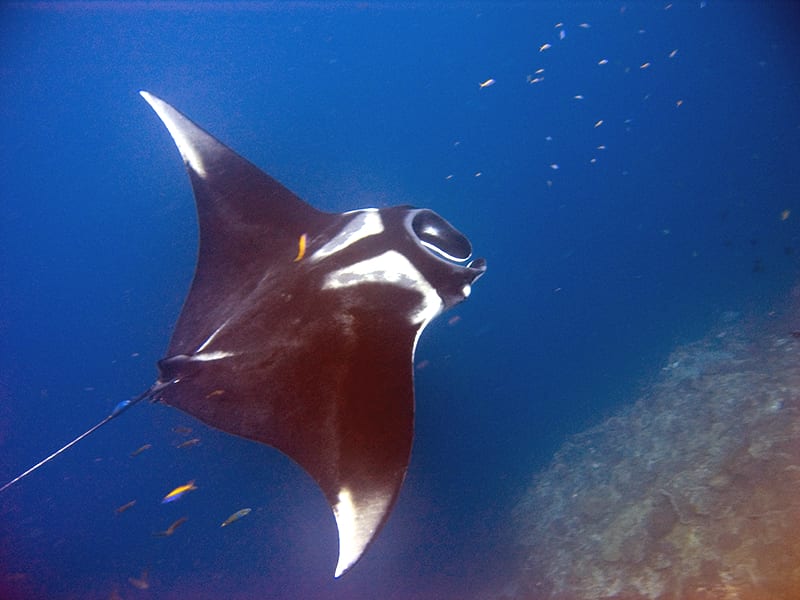
The giant oceanic manta ray, giant manta ray, or oceanic manta ray (Mobula birostris) is a species of ray in the family Mobulidae and the largest type of ray in the world. It is circumglobal and is typically found in tropical and subtropical waters but can also be found in temperate waters. Until 2017, the species was classified in the genus Manta, along with the smaller reef manta ray (Mobula alfredi). DNA testing revealed that both mantas are closer related to some Mobula species than these are to other Mobula, being claded together. As a result, the two Manta species were absorbed into Mobula to reflect the new classification.
Glides on seven metres of wing through warm blue water.
Description
The giant oceanic manta ray can grow up to 9 m (30 ft) in length and a disc size of 7 m (23 ft) across, with a weight around 3,000 kg (6,600 lb), but the typical size is 4.5 m (15 ft). It is dorsoventrally flattened and has large, triangular pectoral fins on either side of the disc.
At the front, it has a pair of cephalic fins, which are forward extensions of the pectoral fins. These can be rolled up in a spiral for swimming or can be flared out to channel water into the large, forward-pointing, rectangular mouth when the animal is feeding.
The teeth are in a band of 18 rows and are restricted to the central part of the lower jaw.
Distribution and habitat
The giant oceanic manta ray has a widespread distribution in tropical and temperate waters worldwide. In the Northern Hemisphere, it has been recorded as far north as southern California and New Jersey in the United States, Aomori Prefecture in Japan, the Sinai Peninsula in Egypt, and the Azores in the northern Atlantic. In the Southern Hemisphere, it occurs as far south as Peru, Uruguay, South Africa, and New Zealand.
It is an ocean-going species and spends most of its life far from land, travelling with the currents and migrating to areas where upwellings of nutrient-rich water increase the availability of zooplankton. The oceanic manta ray is often found in association with offshore oceanic islands.
Biology
When traveling in deep water, the giant oceanic manta ray swims steadily in a straight line, while further inshore, it usually basks or swims idly. Mantas may travel alone or in groups of up to 50. They sometimes associate with other fish species, as well as sea birds and marine mammals. About 27% of their diet is based on filter feeding, and they migrate to coastlines to hunt varying types of zooplankton such as copepods, mysids, shrimp, euphausiids, decapod larvae, and on occasion, varying sizes of fish. When foraging, it usually swims slowly around its prey, herding the planktonic creatures into a tight group before speeding through the bunched-up organisms with its mouth open wide. While feeding, the cephalic fins are spread to channel the prey into its mouth and the small particles are sifted from the water by the tissue between the gill arches. As many as 50 individual rays may gather at a single, plankton-rich feeding site. Research published in 2016 proved about 73% of their diet is mesopelagic (deep-water) sources including fish. Earlier assumptions about exclusively filter feeding were based on surface observations.
Relation to humans
The oceanic manta ray is considered to be endangered by the IUCN's Red List of Endangered Species because its population has decreased drastically over the last 20 years due to overfishing. Because M. birostris feeds in shallow waters, the risk of them getting caught in fishing equipment is higher, especially in surface drift gillnets and bottom set nets. Whatever the type of fishing (artisanal, targeted, or bycatch), the impact on a population with a low fecundity rate, a long gestation period with mainly a single pup at a time, and a late sexual maturity can only be seriously detrimental to a species that cannot compensate for the losses over several decades.
Since the 1970s, fishing for manta rays has been significantly boosted by the price of their gill rakers on the traditional Chinese medicine market. In Chinese culture, they are the main ingredient in a tonic that is marketed to increase immune system function and blood circulation, though no strong evidence supports that the tonic is actually beneficial to health. For this reason and others, gill rakers are sold at relatively high prices – up to $400 per kilogram – and are sold under the trade name pengyusai. In June 2018, the New Zealand Department of Conservation classified the giant oceanic manta ray as "data deficient" with the qualifier "threatened overseas" under the New Zealand Threat Classification System.