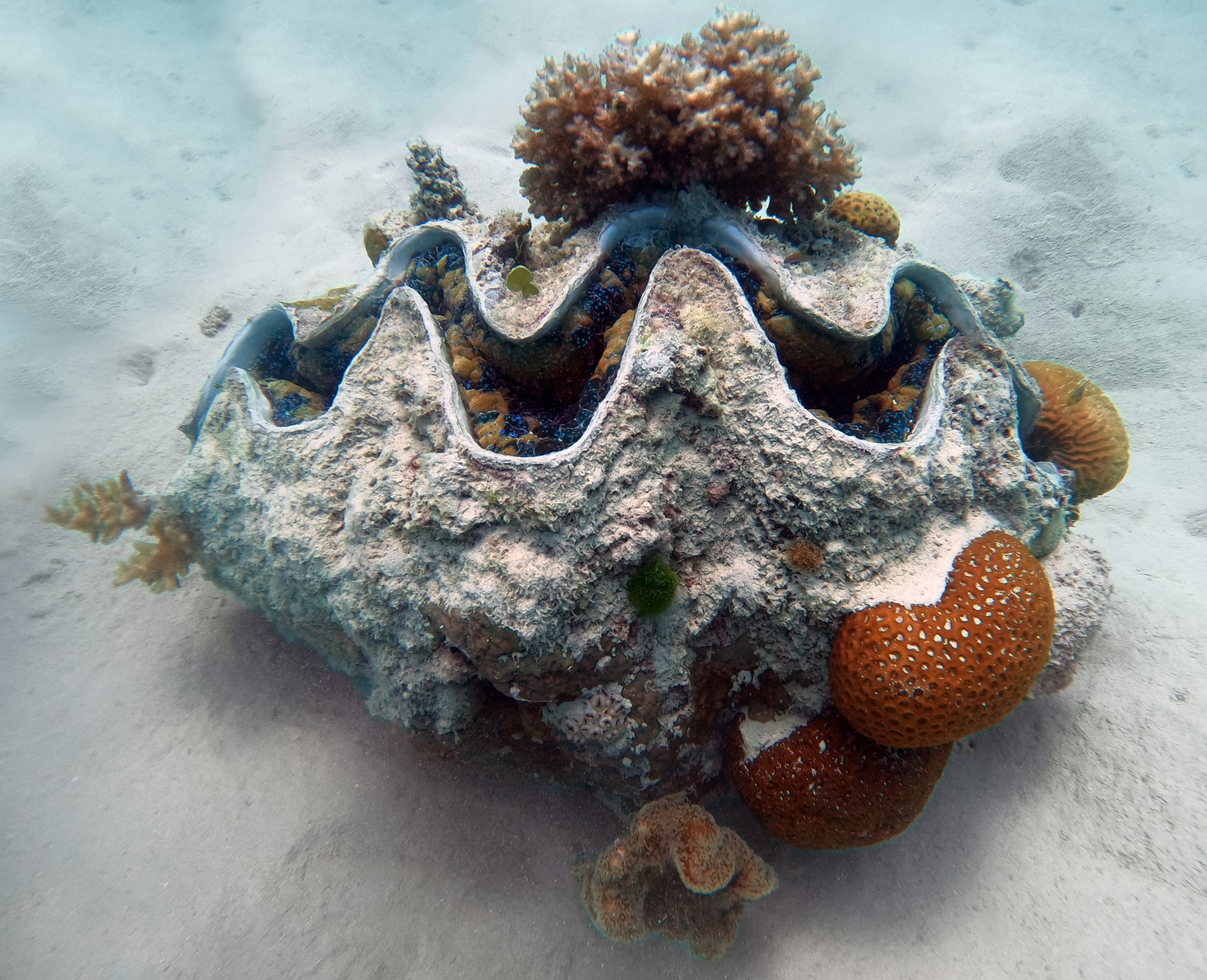
Tridacna gigas, the giant clam, is the best-known species of the giant clam genus Tridacna. Giant clams are the largest living bivalve molluscs. Several other species of "giant clam" in the genus Tridacna are often misidentified as Tridacna gigas.
These clams were known to indigenous peoples of East Asia for thousands of years and the Venetian scholar and explorer Antonio Pigafetta documented them in a journal as early as 1521. One of a number of large clam species native to the shallow coral reefs of the South Pacific and Indian oceans, they may weigh more than 200 kilograms (440 lb), measure as much as 120 cm (47 in) across, and have an average lifespan in the wild of more than 100 years. They also are found off the shores of the Philippines and in the South China Sea in the coral reefs of Malaysia.
Lives a century in one place, painting its own colours.
Anatomy
Young T. gigas are difficult to distinguish from other species of Tridacninae. Adult T. gigas are the only giant clams unable to close their shells completely, allowing part of the brownish-yellow mantle to remain visible. Tridacna gigas has four or five vertical folds in its shell, which serves as the main characteristic differentiating it from the similar T. derasa that has six or seven vertical folds. Similar to coral matrices composed of calcium carbonate, giant clams grow their shells through the process of biomineralization, which is very sensitive to seasonal temperature. The isotopic ratio of oxygen in carbonate and the ratio between strontium and calcium together may be used to determine historical sea surface temperature.
The mantle border itself is covered in several hundred to several thousand pinhole eyespots approximately 0.5 mm (0.020 in) in diameter. Each one consists of a small cavity containing a pupil-like aperture and a base of 100 or more photoreceptors sensitive to three different ranges of light, including UV, which may be unique among molluscs. These receptors allow T. gigas to partially close their shells in response to dimming of light, change in the direction of light, or the movement of an object. The optical system forms an image by sequential, local dimming of some eyes using pigment from the aperture.
Ecology
Giant clams are filter-feeders, yet 65–70 percent of their nutritional needs are supplied by zooxanthellae. This enables giant clams to grow as large as one meter in length even in nutrient-poor coral-reef waters. The clams cultivate algae in a special circulatory system that enables them to keep a substantially higher number of symbionts per unit of volume. The mantle's edges are packed with symbiotic zooxanthellae, which presumably use carbon dioxide, phosphates, and nitrates supplied by the clam.
In very small clams—10 milligrams (0.010 g) dry tissue weight—filter feeding provides approximately 65% of total carbon needed for respiration and growth; comparatively larger clams (10 grams (0.35 oz)) acquire only 34% of carbon from this source. A single species of zooxenthellae may be symbionts of both giant clams and nearby reef–building (hermatypic) corals.
Recent modelling work suggests that giant clams host photosynthetic algae arranged in vertical columns and employ iridescent iridocyte cells to channel sunlight — in a model developed by Sweeney et al. (2024) this arrangement yields a quantum photon-to-electron conversion efficiency of up to ~67 %, placing them among the most efficient natural solar-energy harvesting systems known.
Conservation status
There is concern among conservationists about whether those who use the species as a source of livelihood are overexploiting it. The numbers in the wild have been greatly reduced by extensive harvesting for food and the aquarium trade. The species is listed in Appendix II of the Convention on International Trade in Endangered Species (CITES) meaning international trade (including in parts and derivatives) is regulated.
T. gigas has been reported as locally extinct in peninsular Malaysia, while T. derasa and Hippopus porcellanus are restricted to Eastern Malaysia. These recent local extinctions have motivated the introduction of giant clams to Hawaii and Micronesia following maricultural advancements. Restocked individuals in the Philippines have successfully dispersed their own spawned larvae to at least several hundred meters away after only ten years.
Human relevance
The main reason that giant clams are becoming endangered is likely to be intensive exploitation by bivalve fishers. Mainly large adults are killed because they are the most profitable.
The giant clam is considered a delicacy in Japan (known as himejako), France, Southeast Asia, and many Pacific Islands. Some Asian foods include the meat from the muscles of clams. Large amounts of money are paid for the adductor muscle, which is believed to have aphrodisiac powers in some Chinese regions.
On the black market, giant clam shells are sold as decorative accoutrements.