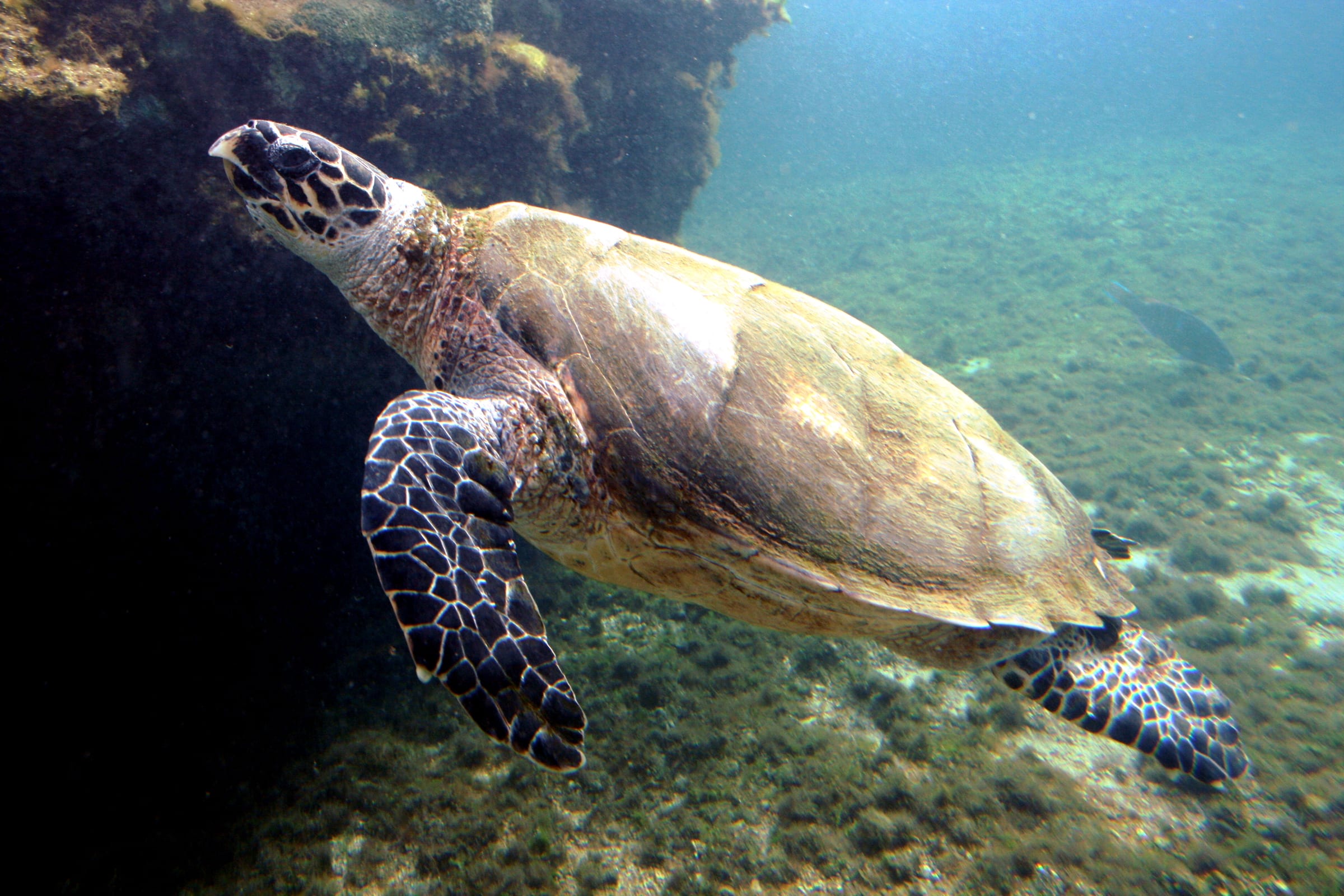
The hawksbill sea turtle (Eretmochelys imbricata) is a critically endangered sea turtle belonging to the family Cheloniidae. It is the only extant species in the genus Eretmochelys. The species has a global distribution that is largely limited to tropical and subtropical marine and estuary ecosystems.
The appearance of the hawksbill is similar to that of other sea turtles. In general, it has a flattened body shape, a protective carapace, and flipper-like limbs, adapted for swimming in the open ocean. E. imbricata is easily distinguished from other sea turtles by its sharp, curving beak with prominent tomium, and the saw-like appearance of its shell margins. Hawksbill shells slightly change colors, depending on water temperature. While this turtle lives part of its life in the open ocean, it spends more time in shallow lagoons and coral reefs. The World Conservation Union classifies E. imbricata as critically endangered, primarily as a result of human fishing practices. Hawksbill shells were the primary source of tortoiseshell material used for decorative purposes. The Convention on International Trade in Endangered Species regulates the international trade of hawksbill sea turtles and products derived from them.
Sleeps wedged into reef crevices, dreams of sea sponges.
Description
Adult hawksbill sea turtles typically grow to 1 m (3 ft) in length, weighing around 80 kg (180 lb) on average. The heaviest hawksbill ever captured weighed 127 kg (280 lb). The turtle's shell, or carapace, has an amber background patterned with an irregular combination of light and dark streaks, with predominantly black and mottled-brown colors radiating to the sides.
Several characteristics of the hawksbill sea turtle distinguish it from other sea turtle species. Its elongated, tapered head ends in a beak-like mouth (from which its common name is derived), and its beak is more sharply pronounced and hooked than others. The hawksbill's forelimbs have two visible claws on each flipper.
A readily distinguished characteristic of the hawksbill is the pattern of thick scutes that make up its carapace. While its carapace has five central scutes and four pairs of lateral scutes like several members of its family, E. imbricata's posterior scutes overlap in such a way as to give the rear margin of its carapace a serrated look, similar to the edge of a saw or a steak knife. The turtle's carapace can reach almost 1 m (3 ft) in length. The hawksbill appears to frequently employ its sturdy shell to insert its body into tight spaces in reefs.
Distribution
Hawksbill sea turtles have a wide range, found predominantly in tropical reefs of the Indian, Pacific, and Atlantic Oceans. Of all the sea turtle species, E. imbricata is the one most associated with warm, tropical waters. Two significant subpopulations are known, in the Atlantic and Indo-Pacific.
In the Atlantic, hawksbill populations range as far west as the Gulf of Mexico and as far southeast as the Cape of Good Hope in South Africa. They live off the Brazilian coast (specifically Bahia, Fernando de Noronha).
Habitat and feeding
Adult hawksbill sea turtles are primarily found in tropical coral reefs. They are usually seen resting in caves and ledges in and around these reefs throughout the day. As a highly migratory species, they inhabit a wide range of habitats, from the open ocean to lagoons and even mangrove swamps in estuaries. Little is known about the habitat preferences of early life-stage E. imbricata; like other young sea turtles, they are assumed to be completely pelagic, remaining at sea until they mature. However, they have been known to seek habitats where they are able to camouflage or hide to minimize predator detection.
While they are omnivorous, sea sponges are their principal food; they constitute 70–95% of the turtles' diets. However, like many spongivores, they feed only on select species, ignoring many others. Caribbean populations feed primarily on the orders Astrophorida, Spirophorida, and Hadromerida in the class Demospongiae.
Conservation
Consensus has determined sea turtles, including E. imbricata to be at least threatened, because of their slow growth and maturity and low reproductive rates. Humans have killed many adult turtles, both accidentally and deliberately. Their existence is threatened due to pollution and loss of nesting areas because of coastal development. Biologists estimate that the hawksbill population has declined 80 percent in the past 100–135 years. Human and animal encroachment threatens nesting sites, and small mammals dig up the eggs to eat. In the US Virgin Islands, mongooses raid hawksbill nests (along with other sea turtles, such as Dermochelys coriacea) right after they are laid.
Life history
Less is known about the life history of hawksbills by comparison to several other sea turtle species. Their life history may be divided into three phases, the: (i) early life history phase from approximately 4–30 cm straight carapace length, (ii) benthic phase when the immature turtles recruit to foraging areas, and (iii) reproductive phase, when individuals reach sexual maturity and begin periodically migrating to breeding grounds. The early life history phase is not as geographically resolved as other sea turtle species. This phase appears to vary across ocean regions and may occur in both pelagic and nearshore waters, possibly lasting from 0–4 years of age. One study from the central Pacific Ocean population used bomb radiocarbon (14C) dating and von Bertalanffy growth models to estimate hawksbills reach sexual maturity at ~ 72 cm and 29 years of age (range 23–36 years). Hawksbills show a degree of fidelity after recruiting to the benthic phase however, the movement to other similar habitats is possible.