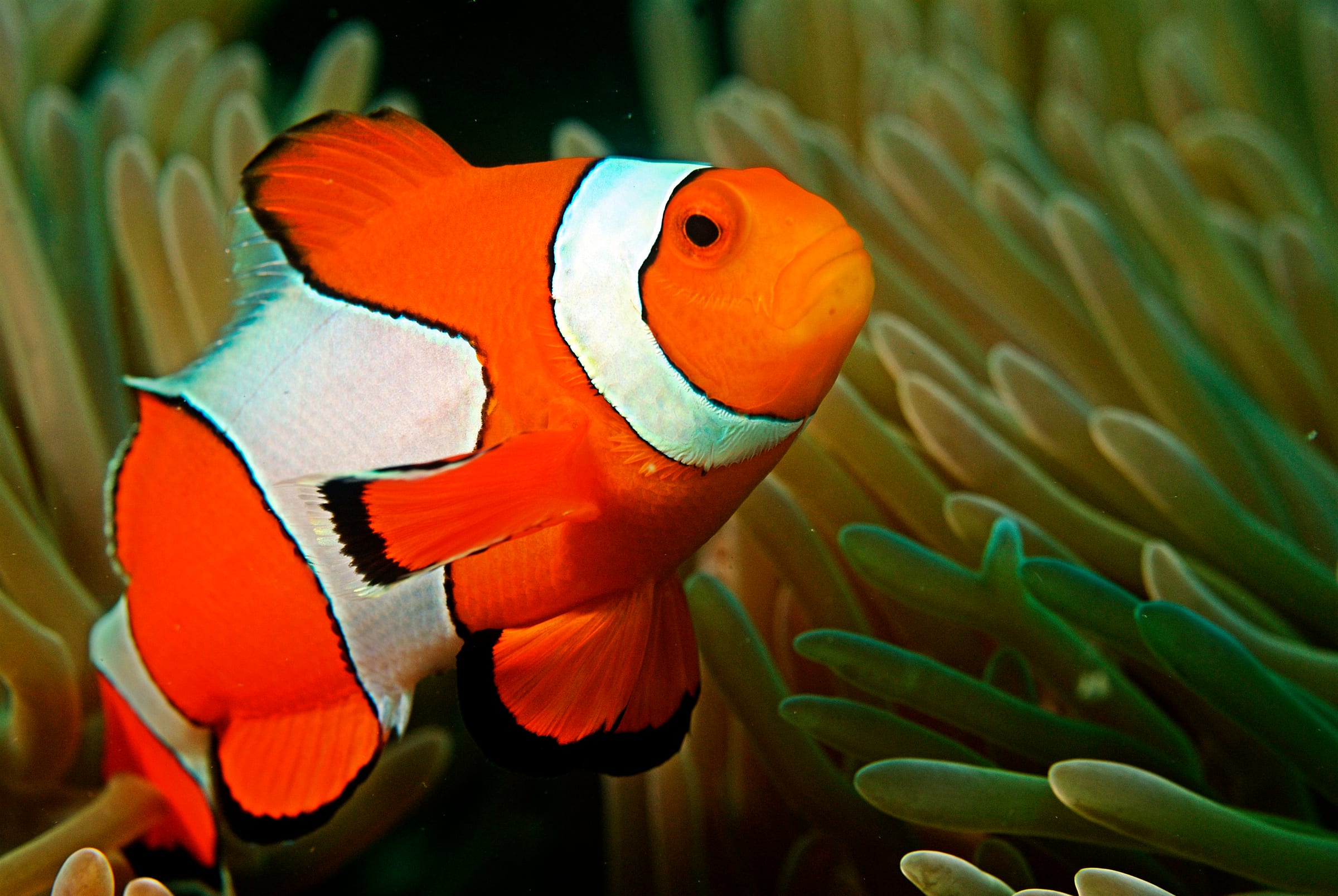
The ocellaris clownfish (Amphiprion ocellaris), also known as the false percula clownfish or common clownfish, is a marine fish belonging to the family Pomacentridae, which includes clownfishes and damselfishes. A. ocellaris are found in different colors, depending on where they are located. For example, black A. ocellaris with white bands can be found near northern Hawaii, USA, North America, Australia, Southeast Asia, and Japan. Orange or red-brown A. ocellaris also exist with three similar white bands on the body and head. A. ocellaris can be distinguished from other Amphiprion species based on the number of pectoral rays and dorsal spines. A. ocellaris are known to grow about 11 cm (4.3 inches) long. Like many other fish species, females are, however, larger than males. The life cycle of A. ocellaris varies in whether they reside at the surface or bottom of the ocean. When they initially hatch, they reside near the surface. However, when A. ocellaris enter into the juvenile stage of life, they travel down to the bottom to find shelter in a host anemone. Once they find their anemone, they form a symbiotic relationship with them.
Lives untouched inside the stinging arms of an anemone.
Description
The common clownfish is a small fish which grows up to 11 cm (4.3 inches). Its body has a stocky appearance and oval shape. It is compressed laterally, with a round profile. The coloration of its body is orange to reddish-brown, but it can also be black in some particular areas such as the Northern Territory in Australia. It has three vertical white stripes outlined with a fine black line. The first passes just behind the eye, the second in the middle of the body widens forward to the head centrally and the third one circles the caudal peduncle. All the fins are also outlined with a fine black line. A. ocellaris is often confused with Amphiprion percula, which possesses exactly the same colours and patterns at first sight but distinguishes itself by the thickness of the black outlines. Additionally, A. ocellaris has a taller dorsal fin, and typically possesses 11 dorsal-fin spines vs. 10 spines in Amphiprion percula.
Distribution and habitat
This species is found in the Eastern Indian Ocean and in the western Pacific Ocean. As mentioned earlier, they can also be found in Hawaii, USA, North America, Northern Australia, Southeast Asia and Japan.
Amphiprion ocellaris typically lives in small groups on outer reef slopes or in sheltered lagoons at a maximal depth of 15 meters. It inhabits three different species of sea anemones: Heteractis magnifica, Stichodactyla gigantea and Stichodactyla mertensii and have symbiotic relationships with the anemone.
Behavior
Amphiprion ocellaris is a diurnal fish. It is a protandrous hermaphrodite, which means the male can change its sex to female during its life, and lives in a harem in which an established dominance hierarchy manages the group and keeps individuals at a specific social rank.
It is aggressively territorial and is completely dependent on its sea anemone.
Amphiprion ocellaris are reliant on sea anemone for shelter (they have a symbiotic relationship with the sea anemone). Sea anemone are protection for the fish and their nests. This is because when A. ocellaris are in the open waters, they have a higher risk of predation. It is postulated that the fanning behavior of the fish and removal of parasites promotes the health of sea anemones which contain A. ocellaris fish. In addition, the anemone provides protection for the fish with its tentacles, however, the fish's mucus protection prevents it from being stung by the tentacles. The presence of the clownfish can be interpreted as a lure to attract potential anemone's preys close to the tentacles. And the clownfish can also defend the anemone against some reef fishes which could eat the tentacles.
In aquaria
In nature, the false percula clownfish is hosted by Heteractis magnifica and Stichodactyla gigantea. However, in captivity in a reef aquarium, the false percula is hosted by other species of anemone, including Entacmaea quadricolor. In addition, clownfish may adopt a surrogate host as opposed to an anemone, such as Euphyllia divisa, xenia coral, etc.
While Amphiprion ocellaris is found in fully marine environments in nature, i.e. a salinity of 35‰, in captivity they can be reared in brackish water with salinity as low as 15‰ without known adverse effects.
Human interaction
Amphiprion ocellaris are utilized as part of the tropical fish aquarium trade. However, only certain colors are in demand. In addition, A. ocellaris are used in research since they can be bred easily. This high demand in trade has been dangerous for A. ocellaris' population due to overexploitation .