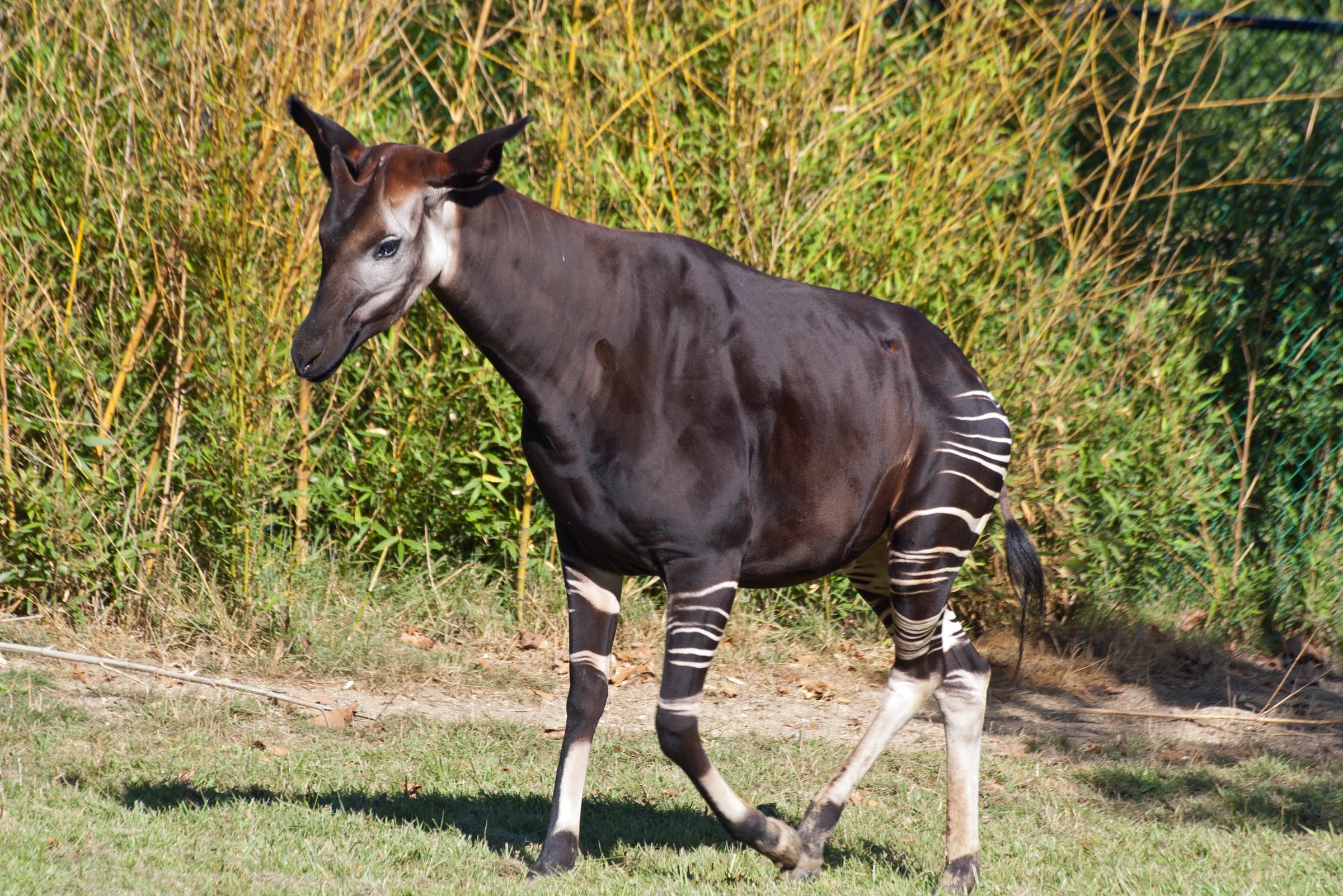
The okapi (; Okapia johnstoni), also known as the forest giraffe, zebra giraffe, and Congolese giraffe, is an artiodactyl mammal that is endemic to the northeast Democratic Republic of the Congo in central Africa. However, non-invasive genetic identification has suggested that a population has occurred south-west of the Congo River as well. It is the only species in the genus Okapia. Although the okapi has striped markings reminiscent of zebras, it is most closely related to the giraffe. The okapi and the giraffe are the only living members of the family Giraffidae.
The okapi stands about 1.5 m (4 ft 11 in) tall at the shoulder and has a typical body length around 2.5 m (8 ft 2 in). Its weight ranges from 200 to 350 kg (440 to 770 lb). It has a long neck, and large, flexible ears. Its coat is a chocolate to reddish brown, much in contrast with the white horizontal stripes and rings on the legs, and white ankles. Male okapis have short, distinct horn-like protuberances on their heads called ossicones, less than 15 cm (5.9 in) in length. Females possess hair whorls, and ossicones are absent.
Half zebra, half giraffe, all secret of the Congo.
Description
The okapi is a medium-sized giraffid, standing 1.5 m (4 ft 11 in) tall at the shoulder. Its average body length is about 2.5 m (8 ft 2 in) and its weight ranges from 200 to 350 kg (440 to 770 lb). It has a long neck, and large and flexible ears. In sharp contrast to the white horizontal stripes on the legs and white ankles, the okapi's coat is a chocolate to reddish brown. The distinctive stripes resemble those of a zebra. These features serve as an effective camouflage amidst dense vegetation. The face, throat, and chest are greyish white. Interdigital glands are present on all four feet, and are slightly larger on the front feet. Male okapis have short, hair-covered horn-like structures called ossicones, less than 15 cm (5.9 in) in length, which are similar in form and function to the ossicones of a giraffe. The okapi exhibits sexual dimorphism, with females 4.2 cm (1.7 in) taller on average, slightly redder, and lacking prominent ossicones, instead possessing hair whorls.
Distribution and habitat
The okapi is endemic to the Democratic Republic of the Congo, where it occurs north and east of the Congo River. It ranges from the Maiko National Park northward to the Ituri rainforest, then through the river basins of the Rubi, Lake Tele, and Ebola to the west and the Ubangi River further north. Smaller populations exist west and south of the Congo River. It is also common in the Wamba and Epulu areas. It is extinct in Uganda.
The okapi inhabits canopy forests at elevations of 500–1,500 m (1,600–4,900 ft). It occasionally uses seasonally inundated areas, but does not occur in gallery forests, swamp forests, and habitats disturbed by human settlements. In the wet season, it visits rocky inselbergs that offer forage uncommon elsewhere. Results of research conducted in the late 1980s in a mixed Cynometra forest indicated that the okapi population density averaged 0.53 animals per square kilometre. In 2008, it was recorded in Virunga National Park. There is also evidence that okapis were also observed in the Semuliki Valley in Uganda by Europeans, but later became extinct in the late 1970s. The Semuliki Valley provides a similar habitat to the Congo Basin.
Ecology and behaviour
Okapis are primarily diurnal, but may be active for a few hours in darkness. They are essentially solitary, coming together only to breed. They have overlapping home ranges and typically occur at densities around 0.6 animals per square kilometre. Male home ranges average 13 km2 (5.0 sq mi), while female home ranges average 3–5 km2 (1.2–1.9 sq mi). Males migrate continuously, while females are sedentary. Males often mark territories and bushes with their urine, while females use common defecation sites. Grooming is a common practice, focused at the earlobes and the neck. Okapis often rub their necks against trees, leaving a brown exudate.
The male is protective of his territory, but allows females to pass through the domain to forage. Males visit female home ranges at breeding time. Although generally tranquil, the okapi can kick and butt with its head to show aggression. As the vocal cords are poorly developed, vocal communication is mainly restricted to three sounds — "chuff" (contact calls used by both sexes), "moan" (by females during courtship) and "bleat" (by infants under stress). Individuals may engage in Flehmen response, a visual expression in which the animal curls back its upper lips, displays the teeth, and inhales through the mouth for a few seconds. The leopard is the main natural predator of the okapi.
Status
The IUCN classifies the okapi as endangered. It is fully protected under Congolese law. The Okapi Wildlife Reserve and Maiko National Park support significant populations of the okapi, though a steady decline in numbers has occurred due to several threats. Other areas of occurrence are the Rubi Tele Hunting Reserve, the Abumombanzi Reserve, the
Sankuru Nature Reserve, the Lomami National Park. Major threats include habitat loss due to logging and human settlement. Extensive hunting for bushmeat and skin and illegal mining have also led to population declines. A threat that has emerged quite recently is the presence of illegal armed groups around protected areas, inhibiting conservation and monitoring actions. A small population occurs north of the Virunga National Park, but lacks protection due to the presence of armed groups in the vicinity. In June 2012, a gang of poachers attacked the headquarters of the Okapi Wildlife Reserve, killing six guards and other staff as well as all 14 okapis at their breeding center.
Etymology and taxonomy
Although the okapi was unknown to the Western world until the 20th century, it may have been depicted since the early fifth century BCE on the façade of the Apadana at Persepolis, a gift from the Ethiopian procession to the Achaemenid kingdom.
For years, Europeans in Africa had heard of an animal that they came to call the African unicorn. It was brought to prominent European attention by speculation on its existence found in press reports covering Henry Morton Stanley's journeys in 1887. In his travelogue of exploring the Congo, Stanley mentioned a kind of donkey that the natives called the atti, which scholars later identified as the okapi.
When the British special commissioner in Uganda, Sir Harry Johnston, discovered some Pygmy inhabitants of the Congo being abducted by a showman for exhibition, he rescued them and promised to return them to their homes. The Pygmies fed Johnston's curiosity about the animal mentioned in Stanley's book. Johnston was puzzled by the okapi tracks the natives showed him; while he had expected to be on the trail of some sort of forest-dwelling horse, the tracks were of a cloven-hoofed beast.