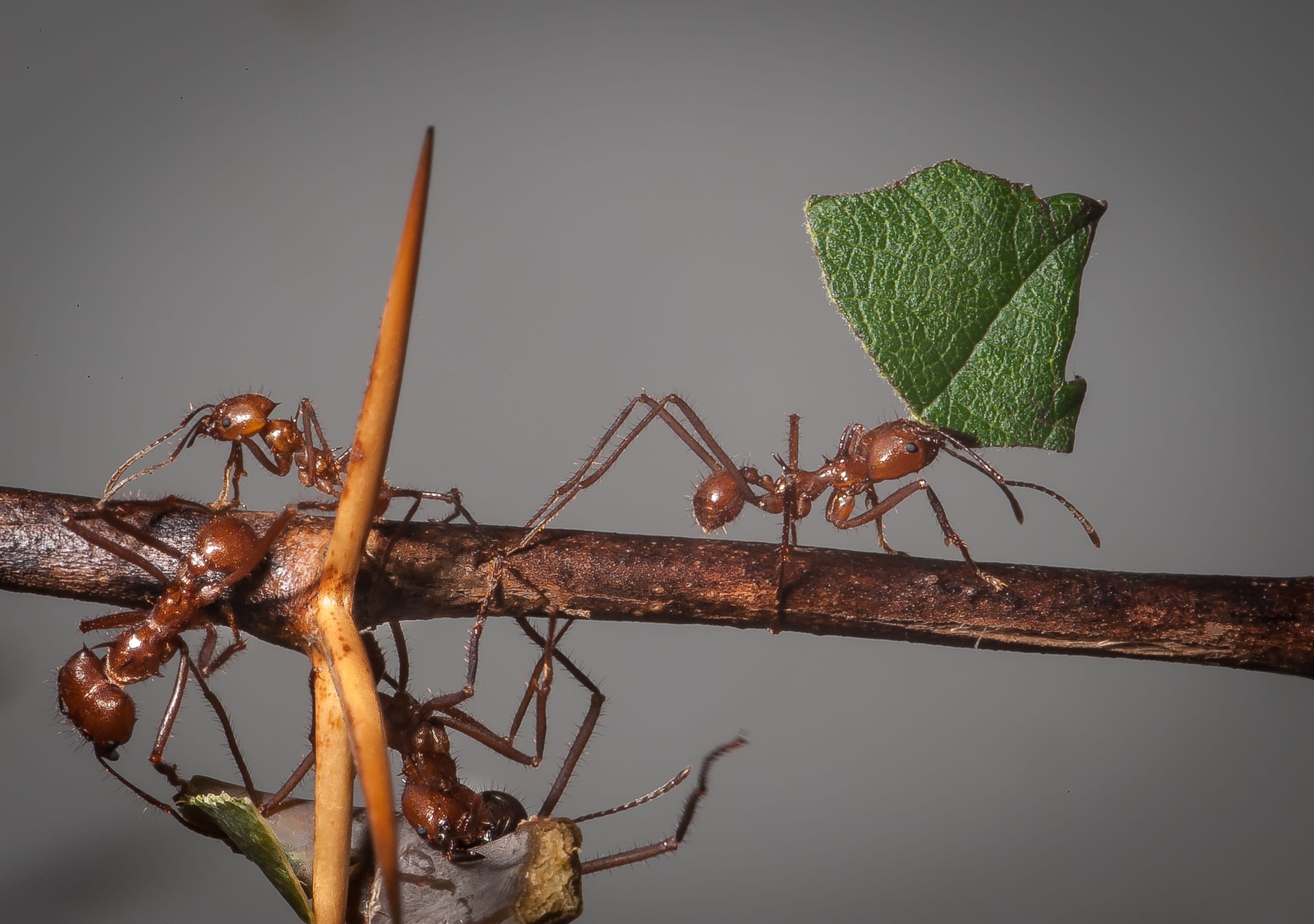
Leafcutter ants are fungus-growing ants that share the behaviour of cutting leaves which they carry back to their nests to farm fungus. Next to humans, leafcutter ants form some of the largest and most complex animal societies on Earth. In a few years, the central mound of their underground nests can grow to more than 30 m (98 ft) across, with smaller radiating mounds extending out to a radius of 80 m (260 ft), taking up 30 to 600 m2 (320 to 6,460 sq ft) and occupied by 3.55 million individuals.
Marches green parades to underground fungus farms older than agriculture.
Behaviour
Leafcutter ants have very specific roles in taking care of the fungal garden and dumping the refuse. Waste management is a key role for each colony's longevity. The necrotrophic parasitic fungus Escovopsis threatens the ants' food source and thus is a constant danger to the ants. The waste transporters and waste-heap workers are the more dispensable leafcutter ants, ensuring the more precious ants can work. The Atta colombica species, unusually for the Attine tribe, have an external waste heap. Waste transporters take the waste, which consists of used substrate and discarded fungus, to the waste heap. Once dropped off at the refuse dump, the heap workers organise the waste and constantly shuffle it around to aid decomposition. A. colombica have been observed placing dead ants around the perimeter of the waste heap.
In addition to feeding the fungal garden with foraged food, mainly consisting of leaves, it is protected from Escovopsis by the antibiotic secretions of Actinomycetota (genus Pseudonocardia). This mutualistic micro-organism lives in the metapleural glands of the ant. Actinomycetota are responsible for producing the majority of the world's antibiotics today.
Leafcutter ants use chemical communication and stridulation (substrate-borne vibrations) to communicate with each other.
Leafcutting groups
Leafcutter ants are any of at least 55 species of leaf-chewing ants belonging to the three genera Atta, Acromyrmex, and Amoimyrmex, within the tribe Attini.
These species of tropical, fungus-growing ants are all endemic to South and Central America, Mexico, and parts of the southern United States. Leafcutter ants can carry up to 50 times their body weight and cut and process fresh vegetation (leaves, flowers, and grasses) to serve as the nutritional substrate for their fungal cultivates. The leaf cutter ant species has a bite force of 800 mN, which is 2600 times their body weight, which allows them to cut leaves as well as defend the nest.
Acromyrmex and Atta ants have much in common anatomically; however, the two can be identified by their external differences. Atta ants have three pairs of spines and a smooth exoskeleton on the upper surface of the thorax, while Acromyrmex ants have four pairs and a rough exoskeleton. The exoskeleton itself is covered in a thin layer of mineral coating, composed of rhombohedral crystals that are generated by the ants. Amoimyrmex and Acromyrmex differ in that Amoimyrmex lacks tubercles on the first gastral segment, and recent phylogenetic evidence shows that Amoimyrmex diverged before the other two genera of leafcutter ants.
Colony lifecycle
Winged females and males leave their respective nests en masse and engage in a nuptial flight known as the revoada (Portuguese) or vuelo nupcial (Spanish). Each female mates with multiple males to collect the 300 million sperm she needs to set up a colony.
Once on the ground, the female loses her wings and searches for a suitable underground lair in which to found her colony. The success rate of these young queens is very low, and only 2.5% will go on to establish a long-lived colony. To start her own fungus garden, the queen stores bits of the parental fungus garden mycelium in her infrabuccal pocket, which is located within her oral cavity. Colonies are generally founded by individual queens — haplometrosis. Because colonies with multiple queens over the lifespan of the colony have been found by a large number of investigators – by Weber (1937), Jonkman (1977), Huber (1907), Moser & Lewis (1981), Mariconi & Zamith (1963), Moser (1963), and Walter et al. (1938) — it is believable that some colonies have multiple foundresses — termed pleometrosis. Colony founding by pleometrosis has only been confirmed in Atta texana, by Vinson (1985).
Ant–fungus mutualism
Their societies are based on an ant–fungus mutualism, and different species of ants use different species of fungus, but all of the fungi the ants use are members of the family Lepiotaceae. The ants actively cultivate their fungus, feeding it with freshly cut plant material and keeping it free from pests and molds. This mutualistic relationship is further augmented by another symbiotic partner, a bacterium that grows on the ants and secretes chemicals; essentially, the ants use portable antimicrobials. Leaf cutter ants are sensitive enough to adapt to the fungi's reaction to different plant material, apparently detecting chemical signals from the fungus. If a particular type of leaf is toxic to the fungus, the colony will no longer collect it. The only two other groups of insects to use fungus-based agriculture are ambrosia beetles and termites. The fungus cultivated by the adults is used to feed the ant larvae, and the adult ants feed on leaf sap. The fungus needs the ants to stay alive, and the larvae need the fungus to stay alive, so mutualism is obligatory.
Parasites
When the ants are out collecting leaves, they are at risk of attack by some species of phorid flies, parasitoids that lay eggs in the crevices of the worker ants' heads. Often, a minim will stand on a worker ant's leaf and ward off any attack.
Also, the wrong type of fungus can grow during cultivation. Escovopsis, a highly virulent fungus, has the potential to devastate an ant garden, as it is horizontally transmitted. Escovopsis was cultured, during colony foundation, in 6.6% of colonies. However, in one- to two-year-old colonies, almost 60% had Escovopsis growing in the fungal garden.
Nevertheless, leafcutter ants have many adaptive mechanisms to recognize and control infections by Escovopsis and other micro-organisms. The most common known behaviors rely on workers reducing the number of fungal spores by grooming, or removing an infected piece of the fungus garden and throwing it away at the waste dump (described as weeding).