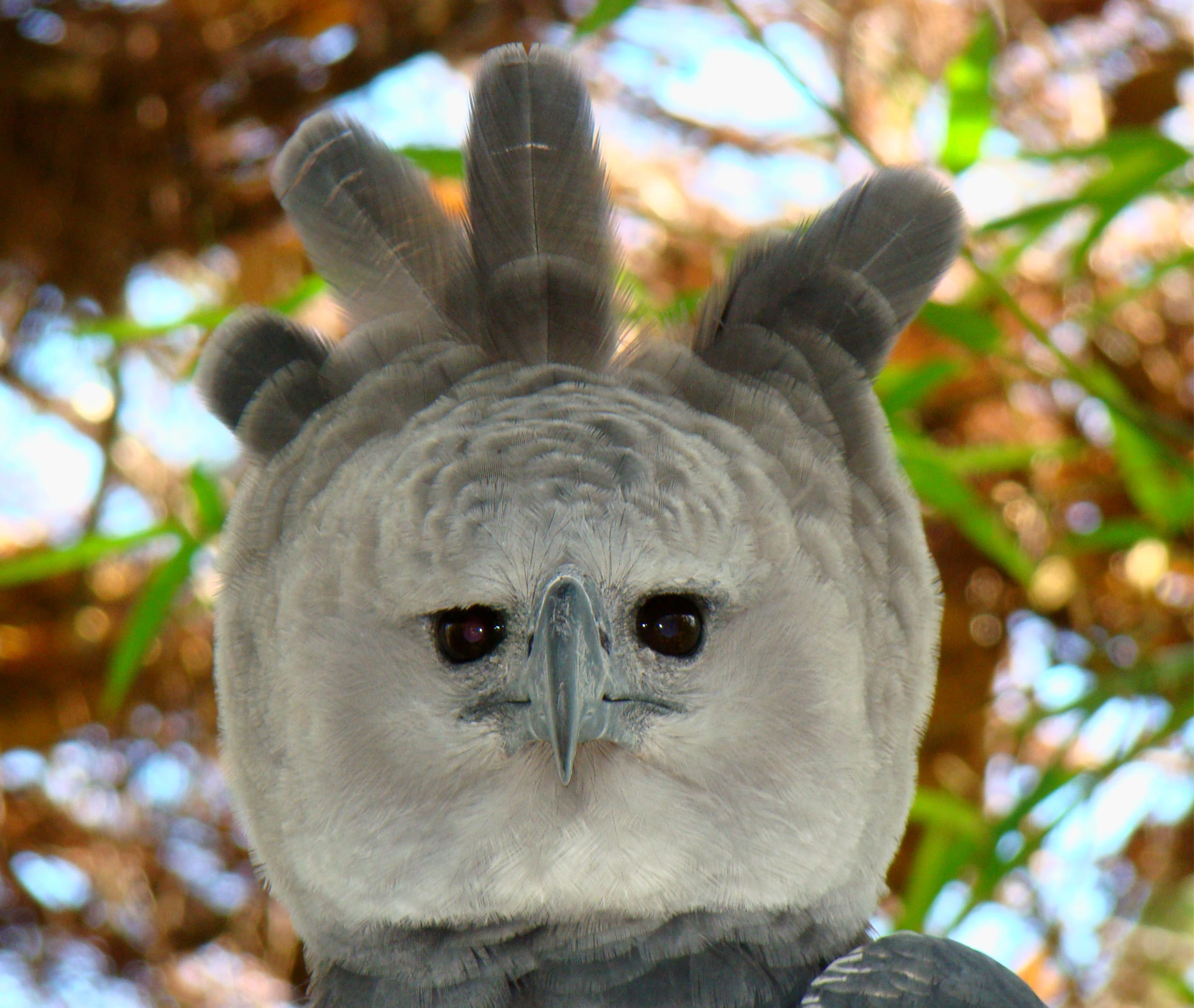
The harpy eagle (Harpia harpyja) is a large neotropical species of eagle. It is also called the American harpy eagle to distinguish it from the Papuan eagle, which is sometimes known as the New Guinea harpy eagle or Papuan harpy eagle. It is the largest bird of prey throughout its range, and among the largest extant species of eagles in the world. It usually inhabits tropical lowland rainforests in the upper (emergent) canopy layer. Destruction of its natural habitat has caused it to vanish from many parts of its former range, and it is nearly extirpated from much of Central America. It is the only member of the genus Harpia, which, together with Harpyopsis, Macheiramphus and Morphnus, forms the subfamily Harpiinae.
Plucks monkeys from the canopy with talons the size of grizzly claws.
Description
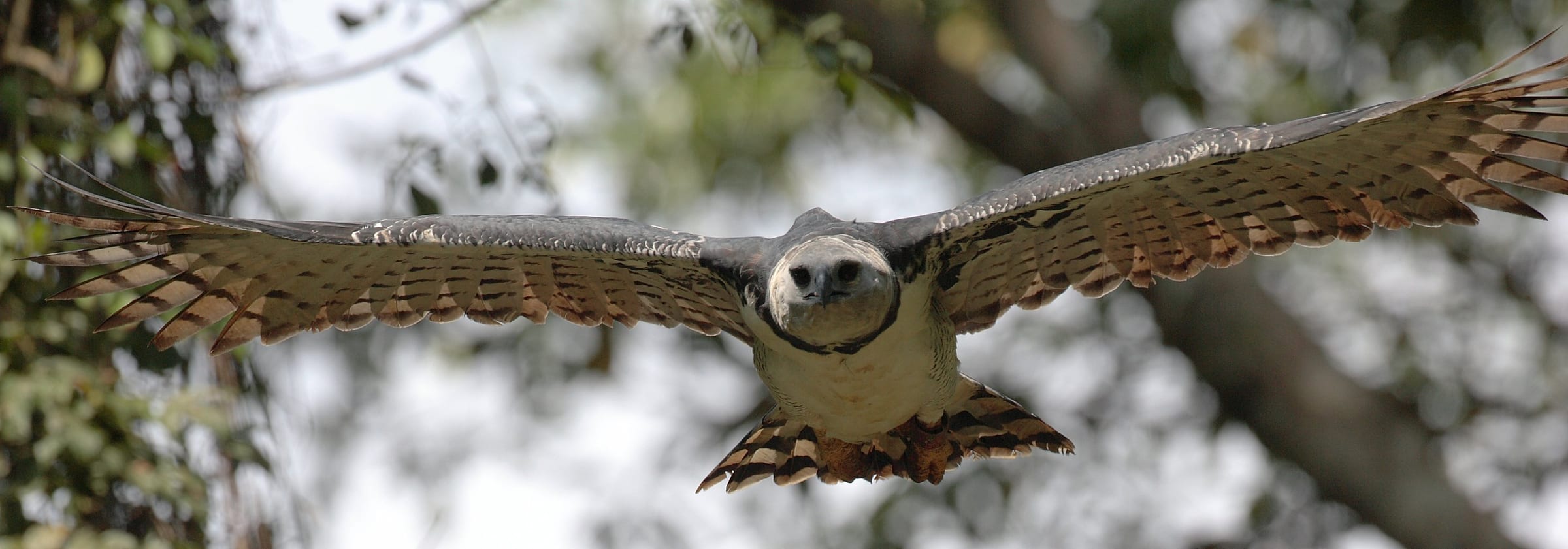
The upperside of the harpy eagle is covered with slate-black feathers, and the underside is mostly white, except for the feathered tarsi, which are striped black. A broad black band across the upper breast separates the gray head from the white belly. The head is pale grey, and is crowned with a double crest. The upperside of the tail is black with three gray bands, while the underside of it is black with three white bands. The irises are gray or brown or red, the cere and bill are black or blackish and the tarsi and toes are yellow. The plumage of males and females is identical. The tarsus is up to 13 cm (5.1 in) long.
Distribution and habitat
Relatively rare and elusive throughout its range, the harpy eagle is found from southern Mexico (incl. Chiapas, Oaxaca and the Yucatán states) and south through Central America, into South America to as far south as Argentina. They can still be seen by tourists and locals in Costa Rica and Panama. As their preferred habitat is rainforest, they nest and hunt predominantly in the emergent layer. The eagle is most common in Brazil, where it is found across the entire country. With the exception of some areas of the aforementioned Panama and Costa Rica, the species is nearly extinct in Central America, likely due to the logging industry's decimation of much of the Meso-American rainforests. Their habitat is expected to decline further due to climate change.
Behavior
Full grown harpy eagles are at the top of a food chain. They possess the largest talons of any living eagle and have been recorded as carrying prey weighing up to roughly half of their own body weight. This allows them to snatch from tree branches live sloths and other large prey items. Most commonly, harpy eagles use perch hunting, in which they scan for prey activity while briefly perched between short flights from tree to tree. Upon spotting prey, the eagle quickly dives and grabs it. Sometimes, harpy eagles are "sit-and-wait" predators (common in forest-dwelling raptors), perching for long periods on a high point near an opening, a river, or a salt lick, where many mammals go to attain nutrients. On occasion, they may also hunt by flying within or above the canopy. They have also been observed tail-chasing: pursuing another bird in flight, rapidly dodging among trees and branches, a predation style common to hawks (genus Accipiter) that hunt birds.
Status and conservation
Although the harpy eagle still occurs over a considerable range, its distribution and populations have dwindled considerably. It is threatened primarily by habitat loss due to the expansion of logging, cattle ranching, agriculture, and prospecting. Secondarily, it is threatened by being hunted as an actual threat to livestock and/or a supposed one to human life, due to its great size. Although the harpy eagle is not actually known to prey on humans and only rarely on domestic stock, a scientifically documented case of this species attacking an adult woman has been reported, and its large size and nearly fearless behaviour around humans reportedly making it an "irresistible target" for hunters. Such threats apply throughout its range, in large parts of which the bird has become a transient sight only; in Brazil, it was all but wiped out from the Atlantic rainforest and is only found in appreciable numbers in the most remote parts of the Amazon basin; a Brazilian journalistic account of the mid-1990s already complained that at the time it was only found in significant numbers in Brazilian territory on the northern side of the Equator. Scientific 1990s records, however, suggest that the harpy Atlantic Forest population may be migratory.
In human culture
The harpy eagle is the national bird of Panama and is depicted on the coat of arms of Panama. The 15th harpy eagle released in Belize, named "Hope", was dubbed "Ambassador for Climate Change", in light of the United Nations Climate Change Conference 2009.
The bird appeared on the reverse side of the Venezuelan Bs.F 2,000 note.
The harpy eagle was the inspiration behind the design of Fawkes the Phoenix in the Harry Potter film series. A live harpy eagle was used to portray the now-extinct Haast's eagle in BBC's Monsters We Met.