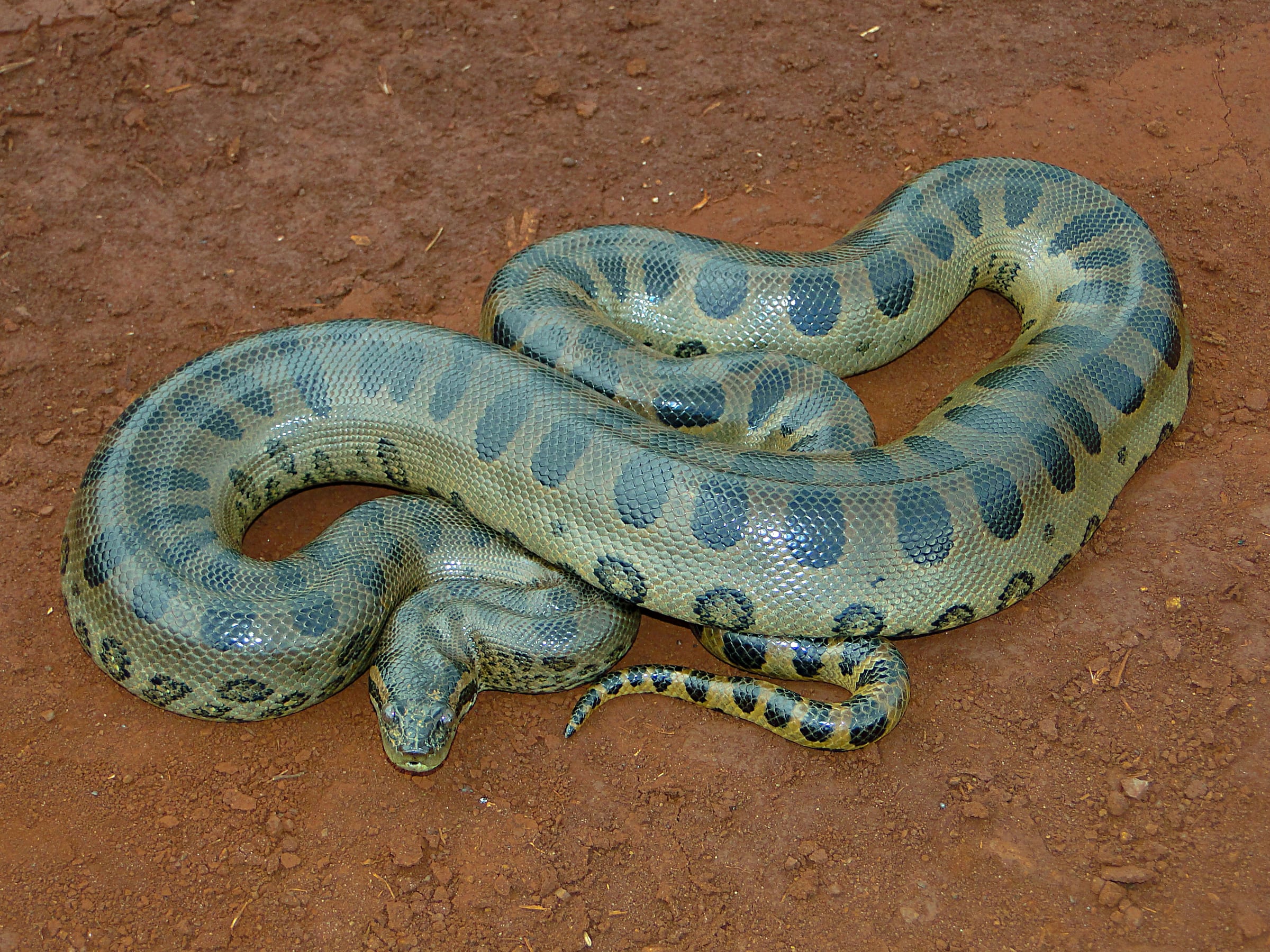
The green anaconda (Eunectes murinus), common anaconda, common water boa, akayima, or sucuri, is a boa species found in South America. It is one of the longest and heaviest known extant snake species. Like all boas, it is a non-venomous constrictor. Green anacondas only have a lifespan of 10 years in the wild, although some specimens live longer when they are taken care of in captivity. Green anacondas live in tropical rainforests and tend to prefer shallow, slow-moving waters, such as streams, rivers and flooded grasslands. They spend most of their time in the water but are also found on land in thick vegetation.
The heaviest snake on earth, ambushing from black water.
Description
The green anaconda is the world's heaviest and one of the world's longest snakes, reaching a length of up to 6.32 m (20 ft 9 in) long. More typical mature specimens reportedly can range up to 5 m (16 ft 5 in), with adult females, with a mean length of about 4.6 m (15 ft 1 in), being generally much larger than the males, which average around 3 m (9 ft 10 in). Weights are less well studied, though reportedly range from 30 to 80 kg (66 to 176 lb) in a typical adult.
It is the largest snake native to the Americas. Although it is slightly shorter than the reticulated python, it is far bulkier. The bulk of a 5.2-metre (17 ft 1 in) green anaconda is comparable to that of a 7.4-metre (24 ft 3 in) reticulated python. Reports of anacondas 11–12 m (35–40 ft) or even longer also exist, but such claims must be regarded with caution, as no specimens of such lengths have ever been deposited in a museum and hard evidence is lacking. The longest and heaviest verified specimen encountered by Jesús Antonio Rivas, who had examined more than 1,000 anacondas, was a female 5.21 m (17 ft 1 in) long and weighing 97.5 kg (214 lb 15 oz). In 1937, a specimen shot in Guyana was claimed to have measured 5.9 m (19 ft 4 in) long and weighed 163 kg (359 lb 6 oz).
Distribution and habitat
Eunectes murinus is found in South America east of the Andes, in countries including Colombia, Venezuela, the Guianas, Ecuador, Peru, Bolivia, Brazil, the island of Trinidad, and as far south as northern Paraguay. The type locality given is "America".
In April 2021, green anacondas were added to Florida's list of prohibited nonnative species. As of August 2023, eleven green anacondas have been verifiably observed in the wild in Florida, including one juvenile found in the Florida Everglades. The range of these specimens, some of which were able to evade capture, spans from Gainesville to Homestead, Florida - a distance of over 350 miles (560 km). Florida is the only state in the continental United States with suitable habitat for the species.
While individual specimens have been observed or captured in Florida dating back to 2010, as of 2023, there is no known established population. However, the ecological, economic, and safety risks posed by their existence in the state are deemed 'very high' by the Florida Fish and Wildlife Conservation Commission, with the ecological threat reaching the extreme risk level, as introduced anacondas are apex predators, able to compete with Florida's native species and potentially prey on native wildlife, such as white-tailed deer, American alligators, American crocodiles, wading birds, other birds, mammals and reptiles.
Behavior
Anacondas are mostly nocturnal and aquatic. They float underwater and are known to swim quickly. Their eyes and nose are located on the top of the head, allowing the snake to breathe and watch for prey while the rest of the body is hidden underwater. When prey passes by or stops to drink, the anaconda strikes, without eating or swallowing it, and coils around it with its body, then constricts and suffocates the prey to death.
Anacondas are apex predators with a wide variety of prey, almost anything they can overpower, including fish, amphibians, birds, various mammals and other reptiles. Particularly large anacondas may consume tapirs, deer, peccaries, capybaras, jaguars, and caimans, but such large meals are rare. Juvenile anacondas feed on small birds and young caiman typically 40–70 grams (1.4–2.5 oz) in weight. As they develop, their diet becomes increasingly complex. Prey availability varies more in grasslands than in river basins.
Longevity
Green anacondas in the wild live for about 10 years. In captivity, they can live 30 years or more. The 2023 Guinness Book of World Records for the oldest living snake in captivity is a green anaconda aged 37 years 317 days, verified on 14 May 2021 by Paul Swires, at Montecasino Bird & Reptile Park in Johannesburg, South Africa.