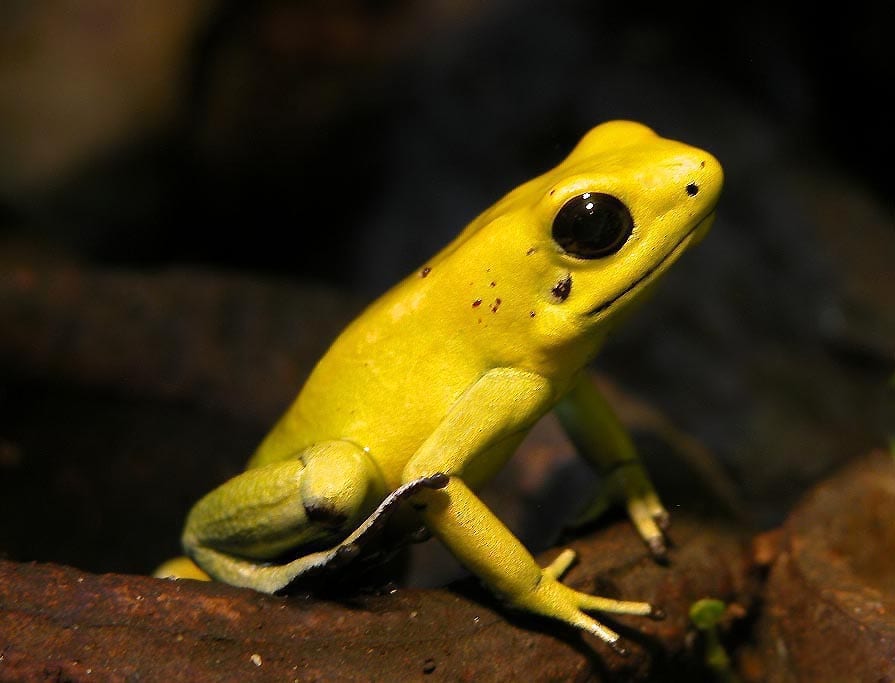
The golden poison frog (Phyllobates terribilis), also known as the golden dart frog or golden poison arrow frog, is a poison dart frog endemic from the rainforests of Colombia. The golden poison frog has become endangered due to habitat destruction within its naturally limited range. Despite its small size, this frog is considered to be the most poisonous extant animal species on the planet.
Smaller than a fingertip, carries enough poison to kill ten men.
Description
The golden poison frog is the largest species of the poison dart frog family, and can reach a weight of nearly 30 grams with a length of 6 cm as adults. Females are typically larger than males. The adults are brightly colored, while juvenile frogs have mostly black bodies with two golden-yellow stripes along their backs. The black fades as they mature, and at around 18 weeks of age the frog is fully colored. The frog's color pattern is aposematic (a coloration to warn predators of its toxicity). Despite their common name, golden poison frogs occur in four main color varieties or morphs:
The yellow morph is the reason Phyllobates terribilis has the common name golden poison frog. These frogs can be pale yellow to deep, golden yellow in color. Yellow Phyllobates terribilis specimens are found in Quebrada Guangui, Colombia.
The largest morph of Phyllobates terribilis exists in the La Brea and La Sirpa areas in Colombia; despite the name "mint green" these frogs can be metallic green, pale green, or white.
Distribution and habitat
The golden poison frog is endemic to humid forests of the Pacific coast of Colombia in the Cauca and Valle del Cauca Departments in the Chocó Rainforest. The optimal habitat of this species is the rainforest with high rain rates (5 m or more per year), altitudes from sea level to 200 m elevation, temperatures of at least 26 °C, and relative humidity of 80–90%. It is known only from primary
transport the tadpoles to permanent pools. Its range is less than 5,000 square km; destruction of this habitat has contributed to P. terribilis becoming an endangered species.
Ecology and behavior
The frog is normally diurnal; golden poison frogs live evenly spaced without forming larger congregations.
This species is an unspecialized ambush hunter; an adult frog can eat food items much larger in relation to its size than most other dendrobatids. The main natural sources of food of P. terribilis are the ants in the genera Brachymyrmex and Paratrechina, but many kinds of insects and other small invertebrates are eaten. Tadpoles feed on algae, mosquito larvae, and other edible material that may be present in their environment.
Males advertise to receptive females with a trilling call. Golden poison frogs are notable for demonstrating tactile courtship during reproduction, each partner stroking its mate's head, back, flanks, and cloacal areas prior to egg deposition. The eggs are fertilized externally. The golden poison frogs lay their eggs on the ground, hidden beneath leaf litter. Once the tadpoles emerge from their eggs, they stick themselves to the mucus on the backs of their parents. The adult frogs carry their young into the canopy, depositing them in the pools of water that accumulate in the centre of bromeliads and water-filled tree holes. The tadpoles feed on algae and mosquito larvae in their nursery.
Taxonomy and etymology
The golden poison frog was described as Phyllobates terribilis in 1978 by herpetologists Charles W. Myers and Borys Malkin as well as biochemist John W. Daly; the species name terribilis is a reference to the deadly toxins present in the skin secretions of this species. Myers' research was based on hundreds of specimens collected on an expedition to the Quebrada Guangui and La Brea regions of the Colombian rainforest, and a breeding colony of 18 frogs established at the American Museum of Natural History.
Toxicity
The golden poison frog is one of the most poisonous animals on the planet; these frogs produce deadly alkaloid batrachotoxins in their skin glands as a defense against predators. To become poisoned, a predator generally must attempt to consume the frog, although contact with the skin is also dangerous. This extraordinarily lethal poison is very rare. Batrachotoxin is found only in three poisonous frogs from Colombia (all genus Phyllobates), a few birds from Papua New Guinea, and four Papuan beetles of the genus Choresine in the family Melyridae. Batrachotoxin affects the sodium channels of nerve cells. While it is unknown how the frog avoids poisoning itself, other species of poisonous frogs have been demonstrated to express a "toxin sponge" protein in blood plasma, internal organs, and muscle that binds and sequesters the toxin so as to prevent autointoxication.