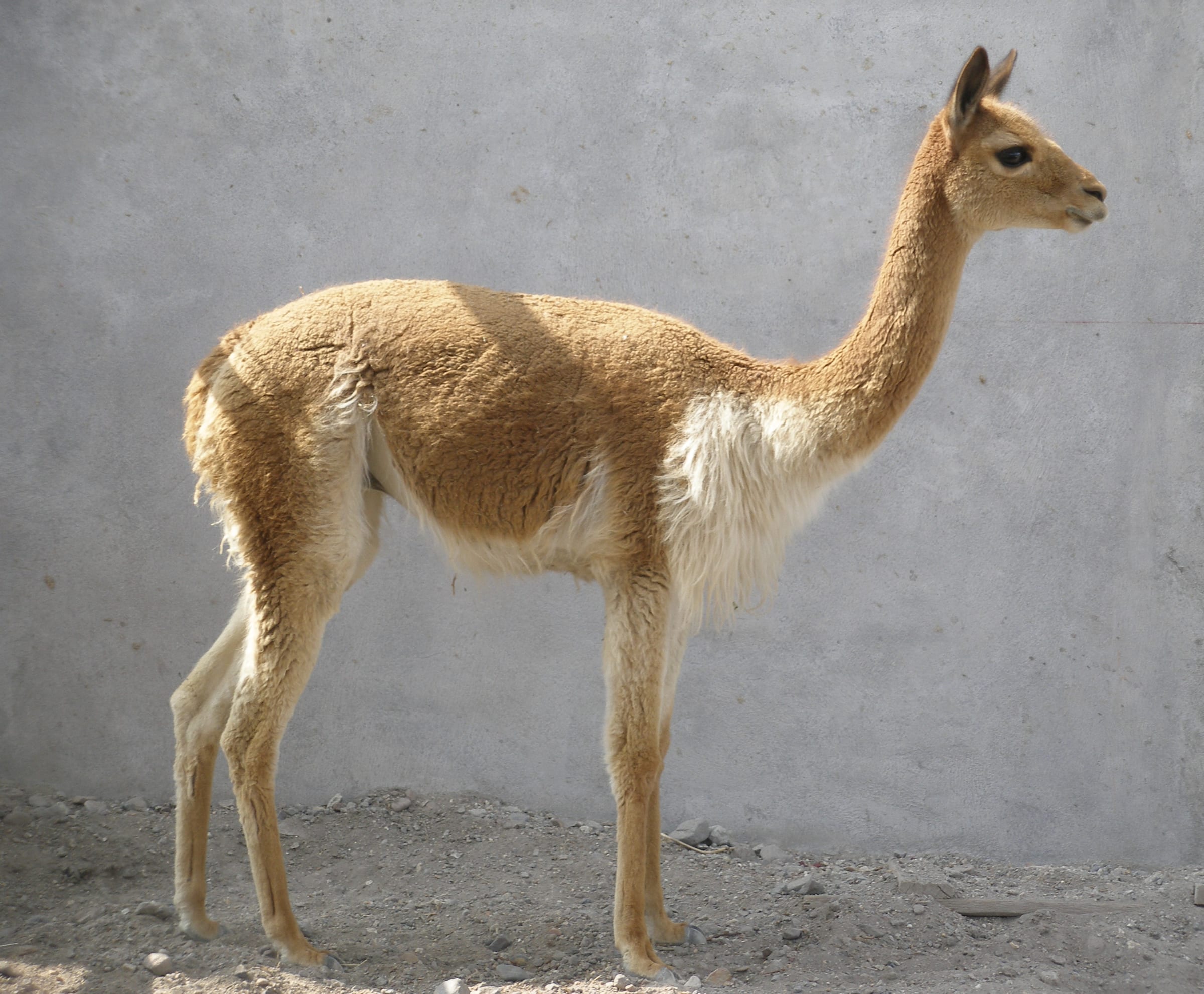
The vicuña (Lama vicugna) or vicuna (both , very rarely spelled vicugna, its Latin specific name) is one of the two wild South American camelids, which live in the high alpine areas of the Andes; the other camelid is the guanaco, which lives at lower elevations. Vicuñas are relatives of the llama, and are now believed to be the wild ancestor of domesticated alpacas, which are raised for their coats. Vicuñas produce small amounts of extremely fine wool, which is very expensive because the animal can be shorn only every three years and has to be caught from the wild. When knitted together, the product of the vicuña's wool is very soft and warm. The Inca valued vicuñas highly for their wool, and it was against the law for anyone but royalty to wear vicuña garments; today, the vicuña is the national animal of Peru and appears on the Peruvian coat of arms.
Both under the rule of the Inca and today, vicuñas have been protected by law, but they were heavily hunted in the intervening period. When they were declared endangered in 1974, only about 6,000 animals were left. Today, the vicuña population has recovered to about 350,000, and although conservation organizations have reduced its level of threat classification, they still call for active conservation programs to protect populations from poaching, habitat loss, and other threats.
Wears the finest wool on earth four thousand metres up.
Description
The vicuña is considered more delicate and gracile than the guanaco and smaller. A key distinguishing element of morphology is the better-developed incisor roots for the guanaco. The vicuña's long, woolly coat is tawny brown on the back, whereas the hair on the throat and chest is white and quite long. Its head is slightly shorter than guanaco's, and the ears are slightly longer. The length of the head and body ranges from 1.45 to 1.60 m (about 5 ft); shoulder height is from 75 to 85 cm (around 3 ft); its weight is from 35 to 65 kg (under 150 lb).
Distribution and habitat
Currently, vicuñas are restricted to South America's central Andes. They are found in Peru, northwestern Argentina, Bolivia, and northern Chile. A smaller, introduced population lives in central Ecuador. However, fossil remains indicate that they were also found as far as Uruguay and the Straits of Magellan until the early Holocene, together with the related guanaco.
Vicuñas live at altitudes of 3,200 to 4,800 m (10,500–15,700 ft). They feed in the daytime on the grassy plains of the Andes Mountains but spend the nights on the slopes. In these areas, only nutrient-poor, tough, bunch grasses and Festuca grow. The sun's rays can penetrate the thin atmosphere, producing relatively warm temperatures during the day; however, the temperatures drop to freezing at night. The vicuña's thick but soft coat is a unique adaptation that traps layers of warm air close to its body to tolerate freezing temperatures.
Chief predators include pumas, culpeos and domestic dogs .
Behavior
The behavior of vicuñas is similar to that of the guanacos. They are timid animals and are easily aroused by intruders due, among other things, to their extraordinary hearing. Like the guanacos, they frequently lick calcareous stones and rocks, which, together with salt water, is its source of salt. Vicuñas are clean animals and always deposit their excrement in the same place. Their diets consist mainly of low grasses which grow in clumps on the ground.
Vicuñas live in family-based groups of a male, 5 to 15 females, and their young. Each group has its territory of about 18 km2 (6.9 sq mi), which can fluctuate depending on food availability.
Mating usually occurs in March–April. After a gestation about 11 months, the female gives birth to a single fawn, which is nursed for about ten months. The fawn becomes independent at about 12 to 18 months old. Young males form bachelor groups, and the young females search for a sorority to join. This deters intraspecific competition and inbreeding.
Conservation
Until 1964, hunting of the vicuña was unrestricted, which reduced its numbers to only 6,000 in the 1960s. As a result, the species was declared endangered in 1974, and its status prohibited the trade of vicuña wool. In Peru, during 1964–1966, the Servicio Forestal y de Caza in cooperation with the US Peace Corps, Nature Conservancy, World Wildlife Fund, and the National Agrarian University of La Molina established a nature conservatory for the vicuña called the Pampa Galeras – Barbara D'Achille in Lucanas Province, Ayacucho. During that time, a game warden academy was held in Nazca, where eight men from Peru and six from Bolivia were trained to protect the vicuña from poaching.
Vicuña wool
Its wool is famous for its warmth and is used for apparel, such as socks, sweaters, accessories, shawls, coats, suits, and home furnishings, such as blankets and throws. Its properties come from the tiny scales on the hollow, air-filled fibres, which causes them to interlock and trap insulating air. Vicuñas have some of the finest fibers in the world, at a diameter of 12 μm. The fiber of cashmere goats is 14 to 19 μm, while angora rabbit is 8 to 12 μm, and that of shahtoosh from the Tibetan antelope, or chiru, is from 9 to 12 μm.