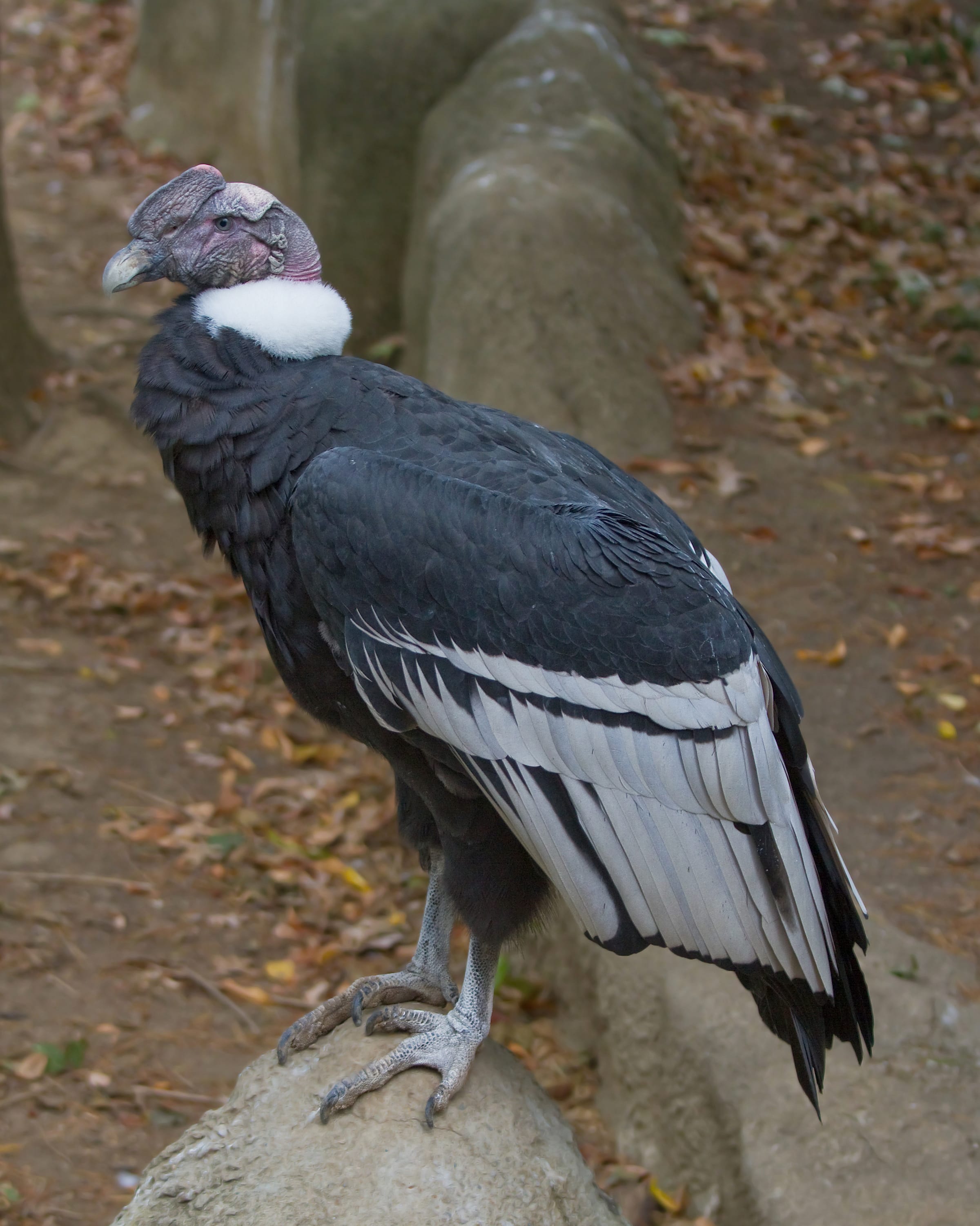
The Andean condor (Vultur gryphus) is a South American New World vulture and is the only extant member of the genus Vultur. It is found in the Andes mountains and adjacent Pacific coasts of western South America. With a maximum wingspan of 3.3 m (10 ft 10 in) and weight of 15 kg (33 lb), the Andean condor is one of the largest flying birds in the world, and is generally considered to be the largest bird of prey in the world.
One of two species commonly referred to as condors, it is a large black vulture with a ruff of white feathers surrounding the base of the neck and, especially in the male, large white patches on the wings. The head and neck are nearly featherless, and are a dull red color, which may flush and therefore change color in response to the bird's emotional state. In the male, there is a wattle on the neck and a large, dark red comb or caruncle on the crown of the head. The female condor is smaller than the male, an exception to the usual sexual dimorphism seen in birds of prey.
A three-metre shadow gliding the spine of the Andes.
Description
The overall length of the Andean condor can range from 100–130 cm (3 ft 3 in – 4 ft 3 in). Among standard measurements, the wing chord is 75.7–85.2 cm (29.8–33.5 in), the tail is 33–38 cm (13–15 in) and the tarsus is 11.5–12.5 cm (4.5–4.9 in). Measurements are usually taken from specimens reared in captivity. The mean weight is 11.3 kg (25 lb), with the males averaging about a kilogram more at 12.5 kg (28 lb), the females a kilogram less at 10.1 kg (22 lb). Condors possess the heaviest average weight for any living flying bird or animal, ahead of trumpeter swans (Cygnus buccinator) and Dalmatian pelicans (Pelecanus crispus). However, other sources claim a mean species body mass of 10.3 kg (23 lb) for the Andean condor. The Andean condor is the largest living land bird capable of flight if measured in terms of average weight and wingspan, although male bustards of the largest species (far more sexually dimorphic in size) can weigh more. The mean wingspan is around 283 cm (9 ft 3 in) and the wings have the largest surface area of any extant bird. It has a maximum wingspan of 3.3 m (10 ft 10 in). Among living bird species, only the great albatrosses and the two largest species of pelican exceed the Andean condor in average and maximal wingspan.The adult plumage is all black, except for a frill of white feathers at the base of the neck and, especially in the male, large white bands on the wings, which only appear after the bird's first moult.
Distribution and habitat
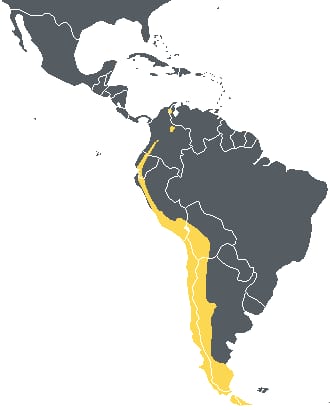
The Andean condor is found in South America in the Andes and the Santa Marta Mountains. In the north, its present range begins in Venezuela and Colombia, where it is extremely rare, then continues south along the Andes in Ecuador, Peru, and Chile, through Bolivia and western Argentina to the Tierra del Fuego. However, its historic range was greater; in the early 19th century, the Andean condor bred from western Venezuela to Tierra del Fuego, along the entire chain of the Andes. Its range was significantly reduced due to human activity.
Its habitat is mainly composed of open grasslands and alpine areas up to 5,000 m (16,000 ft) in elevation. It prefers relatively open, non-forested areas which allow it to spot carrion from the air, such as the páramo or rocky, mountainous areas in general. It occasionally ranges to lowlands in eastern Bolivia, northern Peru, and southwestern Brazil, descends to lowland desert areas in Chile and Peru, and is found over southern-beech forests in Patagonia. In southern Patagonia, meadows are important for Andean condors as this habitat is likely to have herbivores present. In this region, Andean condor distributions are therefore influenced by the locations of meadows as well as cliffs for nesting and roosting.
Ecology and behavior
The condor soars with its wings held horizontally and its primary feathers bent upwards at the tips. The lack of a large sternum to anchor its correspondingly large flight muscles physiologically identifies it as primarily being a soarer. It flaps its wings on rising from the ground, but after attaining a moderate elevation it flaps its wings very rarely, relying on thermals to stay aloft. In The Voyage of the Beagle, Charles Darwin mentioned watching condors for half an hour without once observing a flap of their wings. It prefers to roost on high places from which it can launch without major wing-flapping effort. Andean condors are often seen soaring near rock cliffs, using the heat thermals to aid them in rising in the air. Flight recorders have shown that "75% of the birds' flapping was associated with take-off", and that it "flaps its wings just 1% of the time during flight". The proportion of time for flapping is more for short flights. Flapping between two thermal glides is more than flapping between two slope glides.
Like other New World vultures, the Andean condor has the unusual habit of urohidrosis: it often empties its cloaca onto its legs and feet. A cooling effect through evaporation has been proposed as a reason for this behavior, but it does not make any sense in the cold Andean habitat of the bird. Because of this habit, their legs are often streaked with a white buildup of uric acid.
Relationship with humans
The Andean condor is considered vulnerable by the IUCN and the Peruvian Conservation Organization. As a result of research on its plight, its status was changed to Vulnerable from Near Threatened in 2020, and only about 10,000 individuals remain. It was first placed on the United States Endangered Species list in 1970, a status which is assigned to an animal that is in danger of extinction throughout all or a significant portion of its range. Threats to its population include loss of habitat needed for foraging, secondary poisoning from animals killed by hunters and persecution. It is threatened mainly in the northern area of its range, and is extremely rare in Venezuela and Colombia, where it has undergone considerable declines in recent years. Because it is adapted to very low mortality and has correspondingly low reproductive rates, it is extremely vulnerable to human persecution, most of which stems from the fact that it is perceived as a threat by farmers due to alleged attacks on livestock. Education programs have been implemented by conservationists to dispel this misconception. Reintroduction programs using captive-bred Andean condors, which release birds hatched in North American zoos into the wild to bolster populations, have been introduced in Argentina, Venezuela, and Colombia. The first captive-bred Andean condors were released into the wild in 1989.
Taxonomy and systematics
The Andean condor was described by Swedish scientist Carl Linnaeus in 1758 in the tenth edition of his Systema Naturae and retains its original binomial name of Vultur gryphus.
The Andean condor is sometimes called the Argentinean condor, Bolivian condor, Chilean condor, Colombian condor, Ecuadorian condor, or Peruvian condor after one of the nations to which it is native. The generic term Vultur is directly taken from the Latin vultur or voltur, which means "vulture". Its specific epithet is derived from a variant of the Greek word γρυπός (grupós, "hook-nosed"). The word condor itself is derived from the Quechua kuntur.