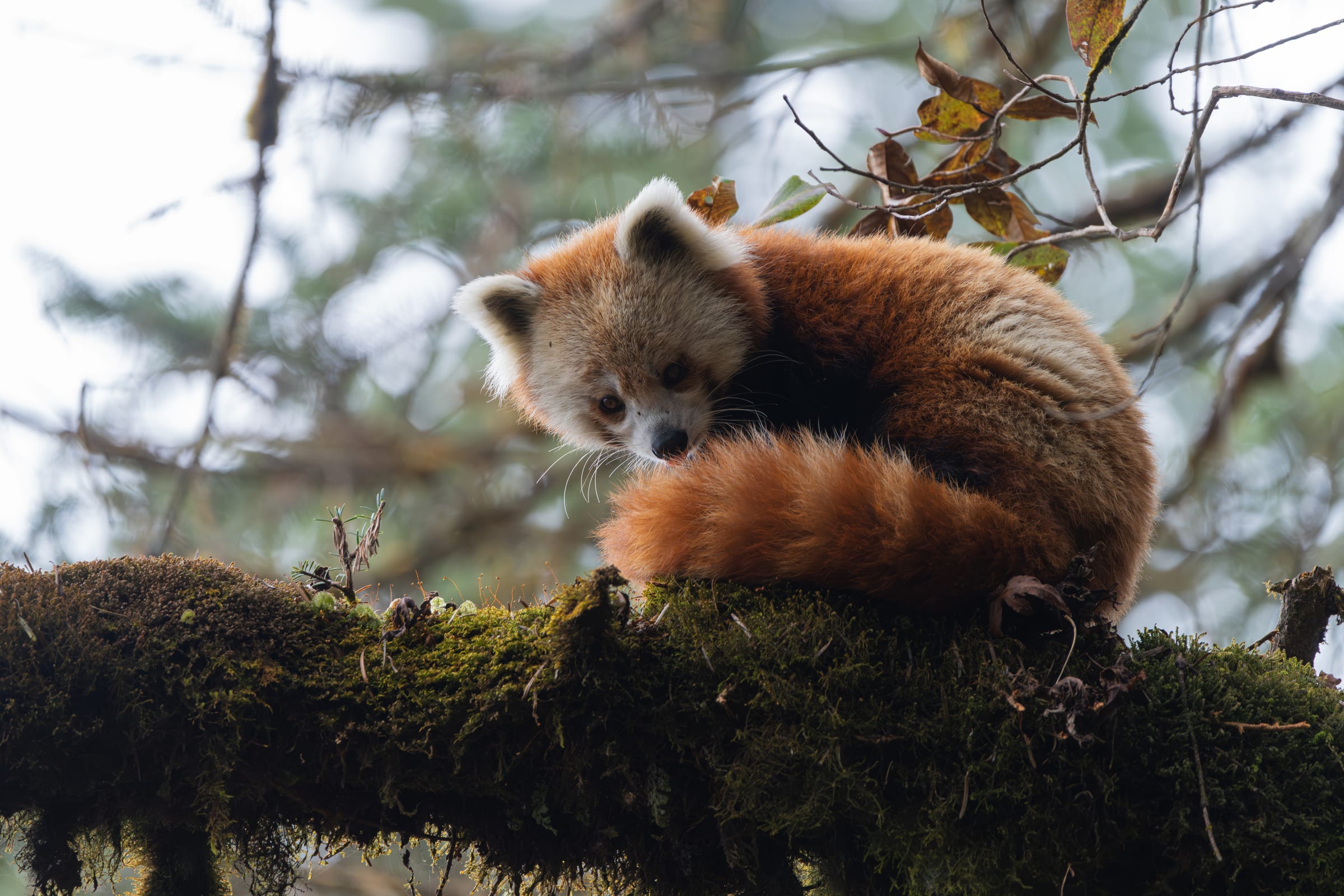
The red panda (Ailurus fulgens), also known as the lesser panda, is a small mammal native to the eastern Himalayas and southwestern China. It has dense reddish-brown fur with a black belly and legs, white-lined ears, a mostly white muzzle and a ringed tail. Its head-to-body length is 51–63.5 cm (20.1–25.0 in) with a 28–48.5 cm (11.0–19.1 in) tail, and it weighs between 3.2 and 15 kg (7.1 and 33.1 lb). It is well adapted to climbing due to its flexible joints and curved semi-retractile claws.
The red panda was formally described in 1825. The two recognised subspecies, the Himalayan and the Chinese red panda, genetically diverged about 250,000 years ago. The red panda's place on the evolutionary tree has been debated, but modern genetic evidence places it in close affinity with raccoons, weasels, and skunks. It is not closely related to the giant panda, which is a bear, though both possess elongated wrist bones or "false thumbs" used for grasping bamboo. The evolutionary lineage of the red panda (Ailuridae) stretches back around 25 to 18 million years ago, as indicated by extinct fossil relatives found in Eurasia and North America.
A fire-colored ghost in the misty bamboo canopy.
Description
The red panda's coat is mainly red or orange-brown with a black belly and legs. The muzzle, cheeks, brows and inner ear margins are mostly white while the bushy tail has red and buff ring patterns and a dark brown tip. The colouration appears to serve as camouflage in habitat with red moss and white lichen-covered trees. The guard hairs are longer and rougher while the dense undercoat is fluffier with shorter hairs. The guard hairs on the back have a circular cross-section and are 47–56 mm (1.9–2.2 in) long. It has moderately long whiskers around the mouth, lower jaw and chin. The hair on the soles of the paws allows the animal to walk in snow.
The red panda has a relatively small head, though proportionally larger than in similarly sized raccoons, with a reduced snout and triangular ears, and nearly evenly lengthed limbs. It has a head-body length of 51–63.5 cm (20.1–25.0 in) with a 28–48.5 cm (11.0–19.1 in) tail. The Himalayan red panda is recorded to weigh 3.2–9.4 kg (7.1–20.7 lb), while the Chinese red panda weighs 4–15 kg (8.8–33.1 lb) for females and 4.2–13.4 kg (9.3–29.5 lb) for males. It has five curved digits on each foot, each with curved semi-retractile claws that aid in climbing. The pelvis and hindlimbs have flexible joints, adaptations for an arboreal quadrupedal lifestyle. While not prehensile, the tail helps the animal balance while climbing.
Distribution and habitat
The red panda inhabits Nepal, the states of Sikkim, West Bengal and Arunachal Pradesh in India, Bhutan, southern Tibet, northern Myanmar and China's Sichuan and Yunnan provinces. The global potential habitat of the red panda has been estimated to comprise 47,100 km2 (18,200 sq mi) at most; this habitat is located in the temperate climate zone of the Himalayas with a mean annual temperature range of 18–24 °C (64–75 °F). Throughout this range, it has been recorded at elevations of 2,000–4,300 m (6,600–14,100 ft).
Behaviour and ecology
The red panda is difficult to observe in the wild, and most studies on its behaviour have taken place in captivity. The red panda appears to be both nocturnal and crepuscular, sleeping intermittently at night. It typically rests or sleeps in trees or other elevated spaces, stretched out prone on a branch with legs dangling when it is hot, and curled up with its hindlimb over the face when it is cold. It is adapted for climbing and descends to the ground head-first with the hindfeet holding on to the middle of the tree trunk. It moves quickly on the ground by trotting or bounding.
Threats
The red panda is primarily threatened by the destruction and fragmentation of its habitat, the causes of which include increasing human population, deforestation, the unlawful taking of non-wood forest material and disturbances by herders and livestock. Trampling by livestock inhibits bamboo growth, and clearcutting decreases the ability of some bamboo species to regenerate. The cut timber stock in Sichuan alone reached 2,661,000 m3 (94,000,000 cu ft) in 1958–1960, and around 3,597.9 km2 (1,389.2 sq mi) of red panda habitat were logged between the mid-1970s and late 1990s. Throughout Nepal, the red panda habitat outside protected areas is negatively affected by solid waste, livestock trails and herding stations, and people collecting firewood and medicinal plants. Threats identified in Nepal's Lamjung District include grazing by livestock during seasonal transhumance, human-made forest fires and the collection of bamboo as cattle fodder in winter. Vehicular traffic is a significant barrier to red panda movement between habitat patches.
Conservation
The red panda is listed in CITES Appendix I and protected in all range countries; hunting is illegal. It has been listed as Endangered on the IUCN Red List since 2008 because the global population is estimated at 10,000 individuals, with a decreasing population trend. A large extent of its habitat is part of protected areas.
A red panda anti-poaching unit and community-based monitoring have been established in Langtang National Park. Members of Community Forest User Groups also protect and monitor red panda habitats in other parts of Nepal. Community outreach programs have been initiated in eastern Nepal using information boards, radio broadcasting and the annual International Red Panda Day in September; several schools endorsed a red panda conservation manual as part of their curricula.