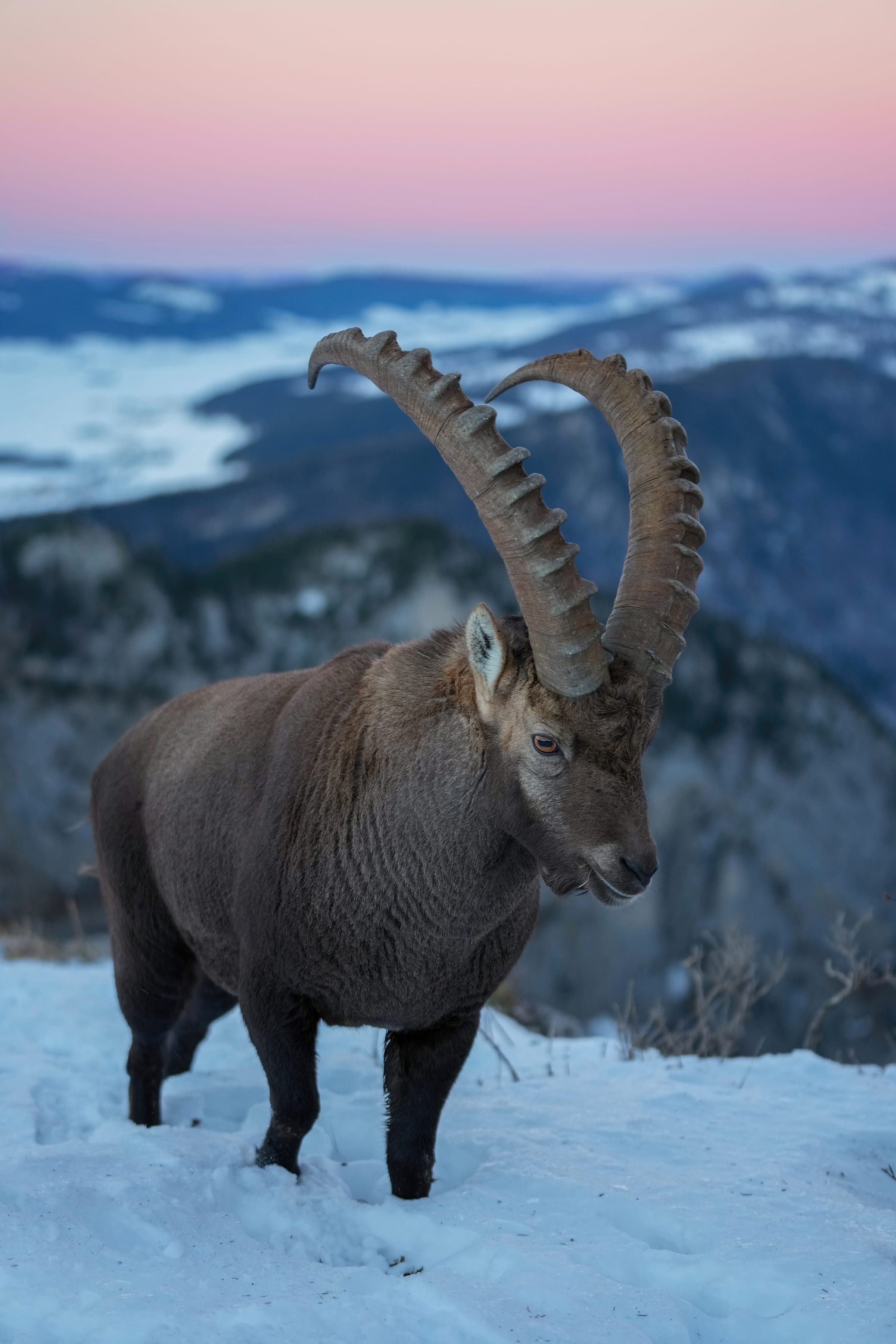
The Alpine ibex (Capra ibex), also known as the steinbock, is a European species of goat which lives in the Alps. It is one of ten species in the genus Capra, and its closest living relative is the Iberian ibex. The Alpine ibex is a sexually dimorphic species; males are much larger and carry much larger, longer horns than females. Its coat is brownish-grey. Alpine ibexes tend to live in steep, rough terrain and open alpine meadows. They can be found at elevations as high as 3,300 m (10,800 ft) and their sharp hooves allow them to scale the steep slopes and cliffs of their mountainous habitat.
Alpine ibexes primarily feed on grass and are active throughout the year. Although they are social animals, adult males and females segregate for most of the year, coming together only to mate. During the breeding season, males use their long horns to fight for access to females. Ibexes have few predators but may succumb to parasites and diseases.
Climbs sheer dams as if gravity politely looked away.
Appearance
Alpine ibexes are sexually dimorphic. Males grow to a height of 90 to 101 cm (35 to 40 in) at the withers with a body length of 149–171 cm (59–67 in) and weigh 67–117 kg (148–258 lb). Females are much smaller and have a shoulder height of 73–84 cm (29–33 in), a body length of 121–141 cm (48–56 in), and weigh 17–32 kg (37–71 lb).
The Alpine ibex is a stocky animal with a tough neck and robust legs with short metapodials. Compared with most other wild goats, the species has a wide, shortened snout. Adaptations for climbing include sharp, highly separated hooves and a rubbery callus under the front feet. Both male and female Alpine ibexes have large, backwards-curving horns with an elliptical cross-section and a trilateral-shaped core. Transverse ridges on the front surface of the horns mark an otherwise flat surface. At 69–98 cm (27–39 in), the horns of males are substantially longer than those of females, which reach only 18–35 cm (7.1–13.8 in) in length.
Distribution and habitat
The Alpine ibex is native to the Alps of central Europe; its range includes France, Switzerland, Liechtenstein, Italy, Germany, and Austria. Fossils of the species have been found as far south as Greece, where it became locally extinct about 7,500 years ago due to human predation. Between the 16th and 18th centuries, the species disappeared from much of its range due to hunting, leaving by the 19th century one surviving population in and around Gran Paradiso, Italy. The species has since been reintroduced into parts of its former range, as well as new areas such as Slovenia and Bulgaria.
The Alpine ibex is an excellent climber; it occupies steep, rough terrain at elevations of 1,800 to 3,300 m (5,900 to 10,800 ft). It prefers to live in open areas, but when there is little snow and depending on population density, adult males may gather in larch and mixed larch-spruce woodland. Outside the breeding season, the sexes live in separate habitats. Females are more likely to be found on steep slopes while males prefer more level ground. Males inhabit lowland meadows during the spring, when fresh grass appears, and climb to alpine meadows during the summer. In early winter, both males and females move to steep, rocky slopes to avoid dense buildups of snow. Alpine ibexes prefer slopes of 30–45°, and take refuge in small caves and overhangs.
Behaviour and ecology
The Alpine ibex is strictly herbivorous. Its diet consists mostly of grass, which is preferred all year; during the summer, ibexes supplement their diet with herbs, while during autumn and winter they also eat dwarf shrubs and conifer shoots. The most-commonly eaten grass genera are Agrostis, Avena, Calamagrostis, Festuca, Phleum, Poa, Sesleria, and Trisetum. In the spring, animals of both sexes spend about the same amount of time feeding during the day, while in summer, females, particularly those that are lactating, eat more than males. High temperatures cause heat stress in large adult males, reducing their feeding time, but they may avoid this problem by feeding at night.
In Gran Paradiso, home ranges of the Alpine Ibex can exceed 700 ha (1,700 acres) and in reintroduced populations, home ranges may approach 3,000 ha (7,400 acres). Home-range size depends on the availability of resources and the time of year. Home ranges tend to be largest during summer and autumn, smallest in winter, and intermediate in spring. Females' home ranges are usually smaller than those of males. Ibexes do not hibernate during the winter; they take shelter on cold winter nights and bask in the mornings. They also reduce their heart rate and metabolism.
Conservation
During the Middle Ages, the Alpine ibex ranged throughout the Alpine region of Europe. Starting in the early 16th century, the overall population declined due almost entirely to hunting by humans, especially with the introduction of firearms. By the 19th century, only around 100 individuals remained in and around Gran Paradiso in north-west Italy and on the Italian-French border. In 1821, the Government of Piedmont banned hunting of the Alpine ibex and in 1854, Victor Emmanuel II declared Gran Paradiso a royal hunting reserve. In 1920, his grandson Victor Emmanuel III donated the land to the state of Italy and it was established as a national park. By 1933, the Alpine ibex population reached 4,000 but subsequent mismanagement by the fascist government caused it to drop to around 400 by 1945. Their protection improved again after the war and by 2005, there were 4,000 in the national park. In the late 20th century, the Gran Paradiso population was used for reintroductions into other parts of Italy.
Cultural significance
The Alpine ibex is called the steinbock, which originated from the Old High German word steinboc, literally "stone buck". Several European names for the animal developed from this, including the French bouquetin and the Italian stambecco. The Alpine ibex is one of many animals depicted in the art of the Late Pleistocene-era Magdalenian culture in Western Europe. Local people used ibexes for traditional medicine; the horn material was used to counter cramps, poisoning, and hysteria, while the blood was thought to prevent stones from developing in the bladder. The species' value as a source of medicine led to its near extinction. Since its recovery, the Alpine ibex has been seen as a resilient symbol of the mountain range.
Ibex appear as a rare charge in English heraldry. The heraldic ibex appears as a variant of the heraldic antelope, which itself likely originated as an attempted to depict real-life antelopes or ibexes. Like the heraldic antelope, the ibex is depicted with a tusked head, a deer-like body, a series of tufts on its neck and back, and a long tail. The heraldic ibex is distinguished from the antelope by its saw-edged horns. The ibex is depicted on the coat of arms of the Swiss canton of Grisons.