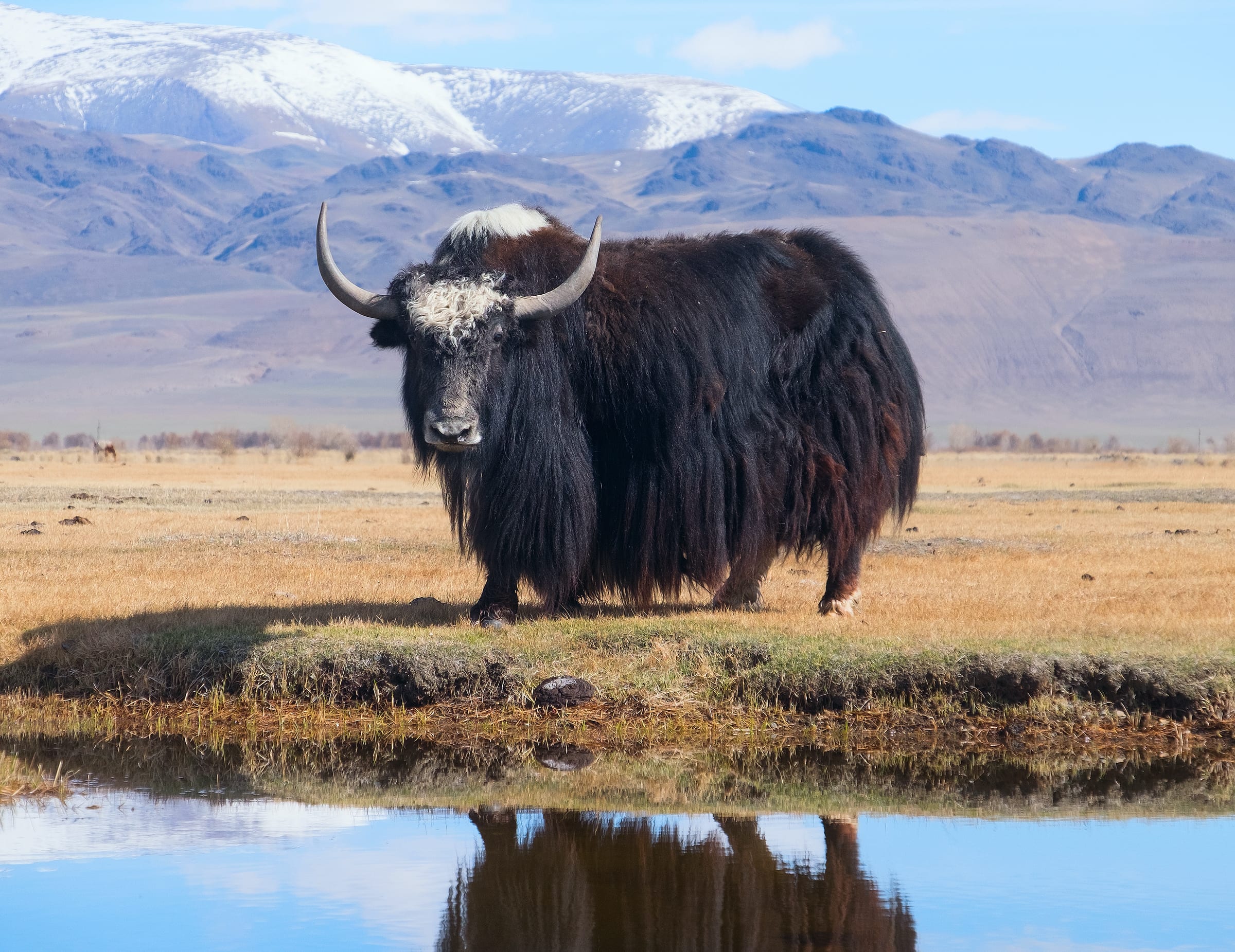
The yak (Bos grunniens), also known as the Tartary ox, grunting ox, hairy cattle, sarlak or sarlyk, or domestic yak, is a species of long-haired domesticated cattle found throughout the Himalayan region, the Tibetan Plateau, Tajikistan, the Pamir Mountains, and as far north as Mongolia and Siberia. It is descended from the wild yak (Bos mutus).
Lungs and lashes built for five thousand metres of thin sky.
Physical characteristics
Yaks are heavily built animals with bulky frames, sturdy legs, rounded, cloven hooves, and extremely dense, long fur hanging lower than the belly. While wild yaks are generally dark, blackish to brown in colouration, domestic yaks can be quite variable, often having rusty brown and cream patches. They have small ears and broad foreheads, with smooth horns that are generally dark in colour. In males (bulls), the horns sweep out from the sides of the head and then curve backwards; they typically range from 48 to 99 cm (19 to 39 in) in length.
The horns of females (cows) are smaller, at 27 to 64 cm (11 to 25 in) in length, and have a more upright shape. Both sexes have a short neck with a pronounced hump over the shoulders, although this is larger and more visible in males. Males weigh 350 to 585 kg (772 to 1,290 lb), females weigh 225 to 255 kg (496 to 562 lb). Wild (feral) yaks can be substantially heavier, bulls reaching weights of up to 1,000 kg (2,200 lb). Depending on the breed, domestic yak males are 111–138 cm (44–54 in) high at the withers, while females are 105–117 cm (41–46 in) high at the withers.
Reproduction and life history
Yaks mate in the summer, typically between July and September, depending on the local environment. For the remainder of the year, many bulls wander in small bachelor groups away from the large herds. Still, as the rut approaches, they become aggressive and regularly fight with each other to establish dominance. In addition to non-violent threat displays, bellowing, and scraping the ground with their horns, bull yaks compete more directly, repeatedly charging at each other with heads lowered or sparring with their horns. Like bison, but unlike cattle, males wallow in dry soil during the rut, often while scent-marking with urine or dung. Females enter oestrus up to four times a year, and females are receptive only for a few hours in each cycle.
Gestation lasts between 257 and 270 days, so that the young are born between May and June, and results in the birth of a single calf. The cow finds a secluded spot to give birth, but the calf can walk within about ten minutes of birth, and the pair soon rejoin the herd. Females of both the wild and domestic forms typically give birth only once every other year, although more frequent births are possible if the food supply is good.
Husbandry
For thousands of years, domesticated yaks have been kept in Mongolia and Tibet, primarily for their milk, fibre (wool), and meat, and as beasts of burden. Their dried droppings are an important fuel, used all over Tibet, and are often the only fuel available on the high, treeless Tibetan Plateau. Yaks transport goods across mountain passes for local farmers and traders and are an attraction for climbing and trekking expeditions:
Only one thing makes it hard to use yaks for long journeys in barren regions. They will not eat grain, which could be carried on the journey. They will starve unless they can be brought to a place where there is grass.
They also are used to draw ploughs. Yaks' milk is often processed to a cheese called chhurpi in Tibetan and Nepali languages, and byaslag in Mongolia. Butter made from yaks' milk is an ingredient of the butter tea that Tibetans consume in large quantities, and is also used in lamps and made into butter sculptures used in religious festivities.
Customs
In parts of Tibet and Karakorum, yak racing is a form of entertainment at traditional festivals and an important part of their culture. More recently, sports involving domesticated yaks, such as yak skiing or yak polo, are being marketed as tourist attractions in South Asian countries, including in Gilgit-Baltistan, Pakistan.
In Nepal, an annual festival is held to drink the fresh blood of yak, and it is believed that it cures various diseases such as gastritis, jaundice, and body strain. The fresh blood is extracted from the neck of a yak without killing it. The cut is healed after the ceremony is over. The ritual is believed to be originated in Tibet and Mustang.
Traditionally, yaks are used to transport deceased people to charnel grounds for sky burials in Tibet, with Tibetan practice holding that the yaks be set free upon the conclusion of the task.