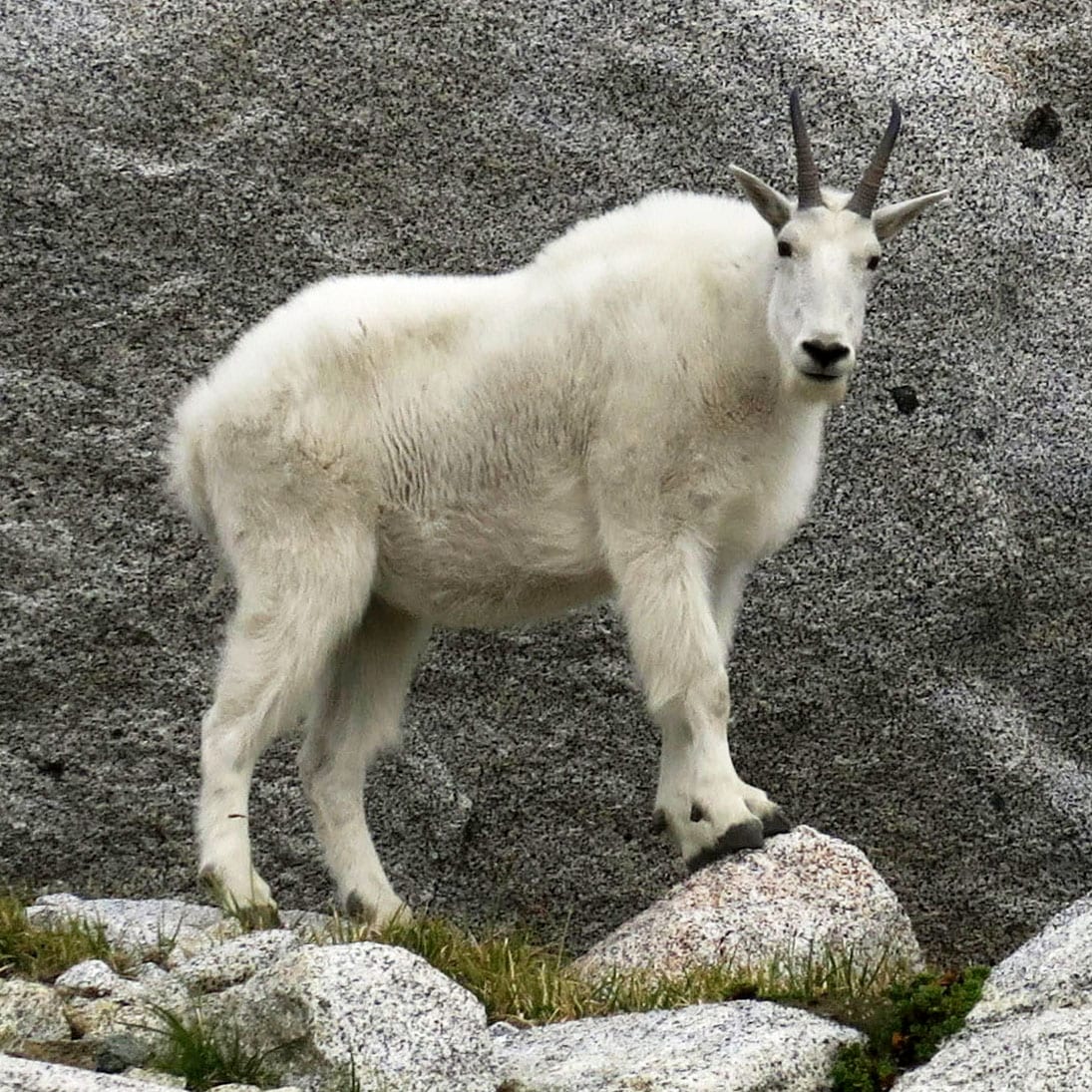
The mountain goat (Oreamnos americanus), also known as the Rocky Mountain goat, is a cloven-footed mammal that is endemic to the remote and rugged mountainous areas of western North America. A subalpine to truly alpine species, it is a sure-footed climber commonly seen on sheer rock faces, near-vertical cliffs and icy passages. Mountain goats generally avoid venturing down into lower elevations—except during seasonal food shortages or during particularly bad weather—as the extreme elevation of their habitat is the primary defense against predators such as black and brown bears, pumas and wolves.
Despite its vernacular name and both genera being in the same subfamily (Caprinae), the mountain goat is not a member of Capra, the genus that includes all true goats (such as the wild goat (Capra aegagrus), from which the domestic goat is derived); rather, it is more closely allied with the other bovids known as "goat-antelopes", including the European chamois (Rupicapra), the gorals (Naemorhedus), the takins (Budorcas) and the serows (Capricornis), of Japan and eastern South Asia.
A white blizzard that walks on impossible ledges.
General appearance and characteristics
Both male and female mountain goats have beards, short tails, and long black horns, 15–28 cm (5.9–11 in) in length, which contain yearly growth rings. They are protected from the elements by their woolly greyish white double coats. The fine, dense wool of their undercoats is covered by an outer layer of longer, hollow hairs. Mountain goats molt in spring by rubbing against rocks and trees, with the adult billies shedding their extra wool first and the pregnant nannies shedding last. Their coats help them to withstand winter temperatures as low as −46 °C (−51 °F) and winds of up to 160 kilometres per hour (99 mph).
A male goat stands about 1 m (3.3 ft) at the shoulder to the waist and can weigh considerably more than the female (around 30% more in some cases). Male goats also have longer horns and longer beards than females. The head-and-body length can range from 120–179 cm (47–70 in), with a small tail adding 10–20 cm (3.9–7.9 in).
Range and habitat
The mountain goat inhabits the Rocky Mountains and Cascade Range and other mountain regions of the Western Cordillera of North America, from Washington, Idaho and Montana through British Columbia and Alberta, into the southern Yukon and southeastern Alaska. British Columbia contains half of the world's population of mountain goats. Its northernmost range is said to be along the northern fringe of the Chugach Mountains in south-central Alaska. Introduced populations can also be found in such areas as Idaho, Wyoming, Utah, Nevada, Oregon, Colorado, South Dakota, and the Olympic Peninsula of Washington.
Mountain goats are the largest mammals found in their high-altitude habitats, which can exceed elevations of 13,000 ft (4,000 m). They sometimes descend to sea level in coastal areas although they are primarily an alpine and subalpine species. The animals usually stay above the tree line throughout the year but they will migrate seasonally to higher or lower elevations within that range. Winter migrations to low-elevation mineral licks often take them several kilometers through forested areas.
Diet
Mountain goats are herbivores and spend most of their time grazing. Their diets include grasses, herbs, sedges, ferns, mosses, lichens, and twigs and leaves from the low-growing shrubs and conifers of their high-altitude habitat.
In captivity, the mountain goat's diet can also include grain, alfalfa, fruits, vegetables and grass.
Aggressive behavior
Nannies can be very competitive and protective of their space and food sources. They fight with one another for dominance in conflicts that can ultimately include all the nannies in the herd. In these battles, nannies circle each other with their heads lowered, displaying their horns. These conflicts can occasionally lead to injury or death, but are usually harmless. To avoid fighting, an animal may show a posture of nonaggression by stretching low to the ground.
In regions below the tree line, nannies use their fighting abilities to protect themselves and their offspring from predators. Predators, including wolves, wolverines, lynxes, and bears, attack goats of most ages given the opportunity. The cougar, or mountain lion, is perhaps the primary predator, being powerful enough to overwhelm the largest adults and uniquely nimble enough to navigate the rocky ecosystem of the goats. Though their size protects them from most potential predators in higher altitudes, nannies must sometimes defend their young from both bald and golden eagles, which can be a predatory threat to kids. Nannies have even been observed trying to dominate the more passive, but often heavier bighorn sheep that share some of their territory. In 2021, a mountain goat gored a grizzly bear to death in Yoho National Park, British Columbia.
Life cycle and mating
In the wild, mountain goats usually live 12 to 15 years, with their lifespans limited by the wearing down of their teeth. In zoos, however, they can live for 16-20 years.
Mountain goats reach sexual maturity at about 30 months. Nannies in a herd undergo synchronized estrus in late October through early December, at which time females and males participate in a mating ritual. Mature billies stare at nannies for long periods, dig rutting pits, and fight each other in showy (though occasionally dangerous) scuffles. Nannies often ignore young billies, who try to participate but are discounted in favor of older partners. Both females and males usually mate with multiple individuals during breeding season, although some billies try to keep other males away from certain nannies. After the breeding season is over, females and males move away from each other. Nannies form loose-knit nursery groups of up to 50 animals. The adult billies leave, often alone or with two or three other billies.